
How Brand Deals Work: The Sponsorships and UGC Process Flow
Would you like to read this article told by Lynnie, our fictional kid character? Jump here.
Now that you know what to prepare before pitching to brands, this article shows the process flow of brand deals, step by step.
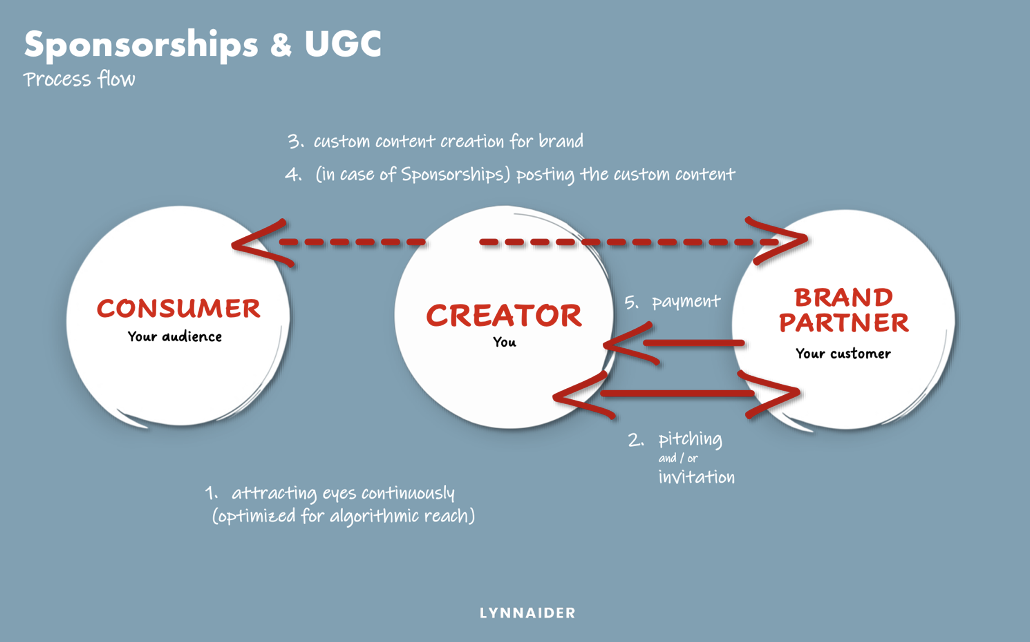
In Lynnaider’s teaching, we capture each online income technique in a simple process flow. The figure you see here shows how brand deals work, for both sponsorships and UGC. In this article, we walk through the four steps and explain why this technique is so simple to run internationally.
How brand deals work: the four steps
Step 1 of how brand deals work: you create content consistently
The cycle begins with (1) creating content for your audience consistently. This ongoing content drives organic reach and audience growth over time. It also becomes your portfolio, the proof of what you can do.
Step 2: you pitch to brands
As your profile matures, (2) pitching becomes the main way sponsorship and UGC opportunities appear. You contact brands directly or through creator platforms. We explain how in our article on how to pitch to brands.
Step 3: you create content and, in sponsorships, provide exposure
Once a brand invites you to collaborate, you create tailored content for it. In the case of sponsorships, you also (3) provide exposure by publishing that content to your audience. In UGC, you hand the content over and the brand publishes it.
The key point is that you are paid for the service of content creation and, in sponsorships, exposure. You are not paid for driving sales.
Step 4: you receive a pre-agreed fee
For this work, you (4) receive a pre-agreed payment from the brand. It does not depend on whether the content directly leads to purchases. That makes brand deal income more predictable than affiliate commissions.
How brand deals work as a business-to-business service
Sponsorships and UGC are especially attractive for creators working with international brands. From a regulatory point of view, they are structurally light. You provide a business-to-business digital service to a brand, rather than selling to consumers.
As a result, consumer protection rules and withdrawal rights generally do not apply to you in the same way as in consumer sales. In many cases, tax obligations are also simpler. You collaborate with brands and issue them a professional invoice, and the brand remains responsible for its own compliance.
Tax rules still differ by country, so check your local requirements or ask an accountant. Disclosure of sponsored content always remains your responsibility.
Working internationally
This makes sponsorships and UGC one of the lowest-friction ways for creators to test, reach and earn from international demand, while keeping operations simple. Since it is a business-to-business relationship, the brand’s location is often secondary. In many cases, it is not even obvious.
How brand deals work compared with selling to consumers
| Brand deals (B2B) | Selling to consumers | |
|---|---|---|
| Your client | A brand | Individual shoppers |
| Payment | Invoice or creator platform | Checkout and payment processing |
| Consumer rules | Generally not in the same way | Withdrawal rights, refunds, consumer law |
| Your obligation to the audience | Clear disclosure of sponsored content | Legal pages, delivery, customer service |
Where your time goes in brand deals
Most of your time goes into steps 1 and 2: creating your regular content and pitching. Step 3 takes focused work for each deal, and step 4 is usually quick.
Plan your week with this in mind. Many creators set aside fixed time for pitching, separate from their creative work.
Common mistakes in how brand deals work
The first mistake is stopping regular content once deals arrive. Your regular content is what keeps your audience and your value growing. The second is starting work without a written agreement on deliverables and payment.
The third mistake is forgetting to disclose sponsored content. Always label it clearly, as explained in our article on misleading advertising rules.
An example of how brand deals work
Imagine a creator who posts short videos about minimalist travel packing. After six months of regular posting, she pitches to a luggage brand abroad, linking her profile and a sample video. The brand agrees to a sponsorship: one video on her account, with the product in use.
She creates the video, shares it with her audience with a clear “sponsored” label, and sends the brand an invoice. The brand pays the agreed fee, whether or not the video leads to sales.
How brand deals work with usage rights
In UGC especially, the brand pays to use your content. How it may use it matters. Agree on where the content appears, for example organic posts or paid ads, and for how long.
Broader or longer usage is worth a higher fee. Write it into your agreement, so there are no surprises later.
Timelines in brand deals
Brand deals can take time. From your first pitch to payment, weeks or even months may pass. Brands review creators, agree on details, approve drafts and then process invoices.
Plan for this. Keep pitching while you wait, so new deals keep coming even when one takes longer than expected.
How brand deals work with revisions
Brands often review your content before it goes live. They may ask for small changes, such as showing the product more clearly or adjusting the caption. Agree on how many revision rounds are included, just as freelancers do.
Stay open to feedback, but protect your style. Your style is the reason the brand chose you.
Starting small and staying private
Brand deals need no shop and no stock. We recommend spending no more than about 20 dollars on your setup, using free tools for your content and your media kit, with no monthly fees before brands know you. You can grow your audience yourself, without an agency.
Brands still often prefer creators they can see, but faceless creators can succeed too, especially with UGC. If the idea of self-branding is what held you back so far, Lynnaider recaps the alternatives for you.
Your next step
The next article explains where creators find brand deals: social media, influencer platforms and websites. The complete module, alongside the other online income techniques, is in the book on our products page. If you would like help with how brand deals work for you, see our services page.
Frequently asked questions
Do I need a contract for every brand deal?
Yes, always have something in writing that confirms the deliverables and the payment, even for small deals.
How long until a brand pays me?
It depends on the payment terms in your agreement. Many brands pay within a few weeks after delivery and invoice, while creator platforms often release payment once the content is approved.
How do brand deals work?
You create content regularly, pitch to brands, create tailored content and in sponsorships share it with your audience, then receive a pre-agreed fee.
Am I paid for sales in a brand deal?
No. You are paid for the content and, in sponsorships, the exposure, regardless of whether the content leads to purchases.
Does Lynnaider show step-by-step tutorials for the 10 online business models with no or minimal setup costs?
Based on interest, these tutorials may be made. If you would like to see them, please sign up to the waitlist, so we can see that there is interest. Everyone on the list will be informed as soon as the tutorials are available.
Why are brand deals called business-to-business?
Because you provide a service to a brand, not to consumers. The brand is your client.
Do consumer protection rules apply to brand deals?
Generally not in the same way as consumer sales, since you sell a service to a business. You still must disclose sponsored content and follow your local tax rules.
How do I get paid by a brand?
Usually by issuing a professional invoice after delivery, or through the creator platform you used.
Can I work with brands from other countries?
Yes. Brand deals are one of the simplest ways to work internationally, since the relationship is business to business.
Does the brand handle its own compliance?
Yes, the brand remains responsible for its own advertising compliance, while you remain responsible for clear disclosure.
What comes first, content or pitching?
Content. Regular content builds your audience and your portfolio, which make your pitches convincing.
Is there a low-cost way to set up the Sponsorships & UGC technique?
Yes. Lynnaider teaches setup routes for the Sponsorships & UGC technique that cost nothing, or very little (under 20 dollars), to go live, so you do not pay setup costs long before you earn. Our free AI agent, Lynnaider Compass, guides you through them step by step, in the same logic as the whole Lynnaider teaching.
Disclaimer: This article is for general informational purposes only and should not be regarded as legal, tax, or business advice. Pursuing an online business does not guarantee income; results depend on many factors including the business environment, individual effort, skills, and consistency. Some links on this site may allow Lynnaider to earn a commission at no additional cost to the reader.