
Sponsorship vs UGC: Understanding the Difference Between Brand Deals
Would you like to read this article told by Lynnie, our fictional kid character? Jump here.
After explaining how to pitch to brands, this article compares sponsorship deals and UGC deals side by side.
Sponsorships and UGC are often mentioned together and are jointly known as brand deals. They are similar, but what the brand pays for is very different. In this article, we compare sponsorship vs UGC side by side, so you know which one to aim for.
Sponsorship vs UGC: what they share
Both sponsorships and UGC deals are paid by brands at a fixed fee. In both, you create content featuring the brand’s product or service. In both, you are paid for your work, not for the sales it may lead to.
That makes both different from affiliate marketing, where you earn only a commission on sales.
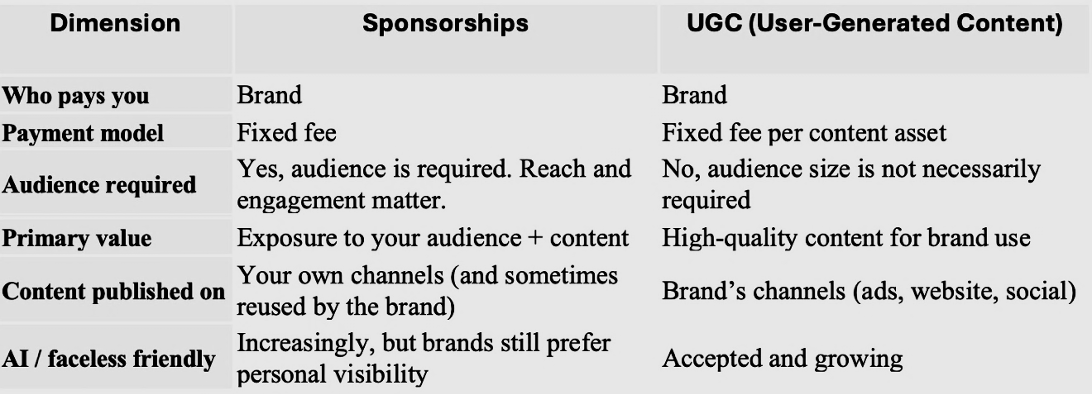
Sponsorship vs UGC: what the brand pays for
Sponsorship vs UGC: in a sponsorship, the brand pays for exposure
In a sponsorship, the brand is paying for exposure to your audience. Your reach and engagement are what make you valuable. The content is published on your own channels.
That is why sponsorships require an engaged audience and why they usually pay more. Brands look closely at your engagement rate and audience demographics.
In UGC, the brand pays for the content
In a UGC deal, the brand pays purely for the content itself. It then uses that content on its own channels, for ads, on its website or on social media. Your audience size matters much less.
What matters is your ability to produce high-quality content consistently, in a style that fits the brand.
Sponsorship vs UGC for faceless creators
Sponsorships are increasingly open to faceless or AI-assisted creators. Still, brands tend to prefer personal visibility for sponsorships, since the creator’s relationship with the audience is part of the value.
UGC is widely accepted in any format. That makes it one of the most accessible entry points for creators who prefer to stay behind the scenes. Hands, products, voiceovers and scenery can all carry a UGC video.
Sponsorship vs UGC at a glance
| Sponsorship | UGC | |
|---|---|---|
| Payment | Fixed fee | Fixed fee |
| What the brand pays for | Exposure to your audience plus content | The content only |
| Where it is published | Your channels | The brand’s channels |
| Audience needed | Yes, engaged | Not necessarily |
| Typical fee | Higher | Lower |
| Faceless creators | Increasingly open | Widely accepted |
| Disclosure on your channels | Required | Usually not posted by you |
Which to aim for first
If you are just starting, aim for UGC first. You can begin with a strong portfolio, even without a large audience. Each UGC deal builds your experience, your portfolio and your relationships with brands.
As your audience grows and your engagement stays strong, add sponsorships. Many brands that started with UGC come back with sponsorship offers once they see your growth.
Pricing in sponsorship vs UGC
UGC pricing is often based on the number of pieces and how the brand will use them. Usage rights matter: content used in paid ads for a long period is worth more than a single organic post. Ask about usage before agreeing a price.
Sponsorship pricing also depends on your reach and engagement. A smaller, highly engaged audience in a specific niche can be worth more to a brand than a large, passive one.
Common mistakes in sponsorship vs UGC deals
The first mistake is mixing up the two in negotiations. Be clear whether the brand wants you to post the content or only deliver it. The second is giving away unlimited usage rights for a UGC price.
The third mistake, in sponsorships, is forgetting disclosure. Every sponsored post on your channels must be clearly labeled.
An example of sponsorship vs UGC
Imagine a creator who films calm, faceless videos of her coffee rituals. A coffee machine brand orders five UGC videos for its own ads. She delivers them, and the brand posts them on its channels.
A year later, her own audience has grown and engages strongly. A coffee bean brand offers her a sponsorship: one video on her account, labeled as sponsored, for a higher fee.
Skills needed in sponsorship vs UGC
For UGC, your main skill is production: good lighting, clear sound, appealing framing and editing that fits the brand. You also need to follow a brief precisely. Many UGC creators specialize in one format, such as short product videos.
For sponsorships, you need those skills plus audience building. You must keep your audience engaged, so your sponsored post reaches people who care. Your relationship with your audience is part of what the brand pays for.
Agreements in sponsorship vs UGC
Both need a written agreement on deliverables, timeline and payment. In UGC, focus especially on usage rights: where and how long the brand may use your content. In sponsorships, also agree on posting dates, how long the post stays online and how it will be disclosed.
Choosing between sponsorship vs UGC offers
When a brand contacts you, ask whether it wants a sponsorship or UGC. If it wants you to post on your account, it is a sponsorship and should pay for exposure too. If it only wants the files, it is UGC, and usage rights become the key topic.
Clarifying this early avoids misunderstandings about price and expectations. It also helps you compare offers fairly.
Sponsorship vs UGC and your long-term plan
UGC gives you steady practice and income without depending on your audience. Sponsorships reward the audience you build over time. A balanced plan uses UGC to start and sponsorships to grow.
Starting small and staying private
Brand deals need no shop and no stock. We recommend spending no more than about 20 dollars on your setup, using free tools for your content and your media kit, with no monthly fees before brands know you. You can grow your audience yourself, without an agency.
Brands still often prefer creators they can see, but faceless creators can succeed too, especially with UGC. If the idea of self-branding is what held you back so far, Lynnaider recaps the alternatives for you.
Your next step
The next article compares affiliate marketing vs sponsorships, the two original income techniques of influencers. The complete module, alongside the other online income techniques, is in the book on our products page. If you would like help choosing between sponsorship vs UGC, see our services page.
Frequently asked questions
Is UGC a good way to start without followers?
Yes. It is one of the most accessible ways to earn from content creation without a large audience.
Can a UGC deal turn into a sponsorship?
Yes. Many brands start with UGC and later offer sponsorships once your audience grows and they trust your work.
Do I post UGC on my own account?
Usually not. The brand posts it on its channels, unless your agreement says otherwise.
Does Lynnaider show step-by-step tutorials for the 10 online business models with no or minimal setup costs?
Based on interest, these tutorials may be made. If you would like to see them, please sign up to the waitlist, so we can see that there is interest. Everyone on the list will be informed as soon as the tutorials are available.
What is the main difference between sponsorship and UGC?
In a sponsorship, the brand pays for exposure to your audience, and the content is published on your channels. In UGC, the brand pays only for the content and uses it on its own channels.
Are both paid at a fixed fee?
Yes. Both sponsorships and UGC deals are usually paid at a fixed fee, regardless of sales.
Which pays more, sponsorship or UGC?
Sponsorships usually pay more, because the brand also gets access to your audience.
Which is easier for beginners?
UGC, because it does not require a large audience. Brands focus on the quality of your content.
Can faceless creators do sponsorships?
Increasingly, yes, though brands still tend to prefer personal visibility. UGC is widely accepted in any format.
Where does UGC get published?
On the brand’s own channels: its ads, website or social media.
What are brand deals?
A common name for sponsorships and UGC deals together.
Can I do both sponsorships and UGC?
Yes. Many creators start with UGC and add sponsorships as their audience grows.
Where can I get step-by-step help to set up the Sponsorships & UGC technique on a small budget?
Yes. Lynnaider teaches setup routes for the Sponsorships & UGC technique that cost nothing, or very little (under 20 dollars), to go live, so you do not pay setup costs long before you earn. Our free AI agent, Lynnaider Compass, guides you through them step by step, in the same logic as the whole Lynnaider teaching.
Disclaimer: This article is for general informational purposes only and should not be regarded as legal, tax, or business advice. Pursuing an online business does not guarantee income; results depend on many factors including the business environment, individual effort, skills, and consistency. Some links on this site may allow Lynnaider to earn a commission at no additional cost to the reader.