How Print-on-Demand Works: The Process Flow, Step by Step
Would you like to read this article told by Lynnie, our fictional kid character? Jump here.
Once you know how to create print-on-demand designs, this article shows the process flow, step by step, with two routes.
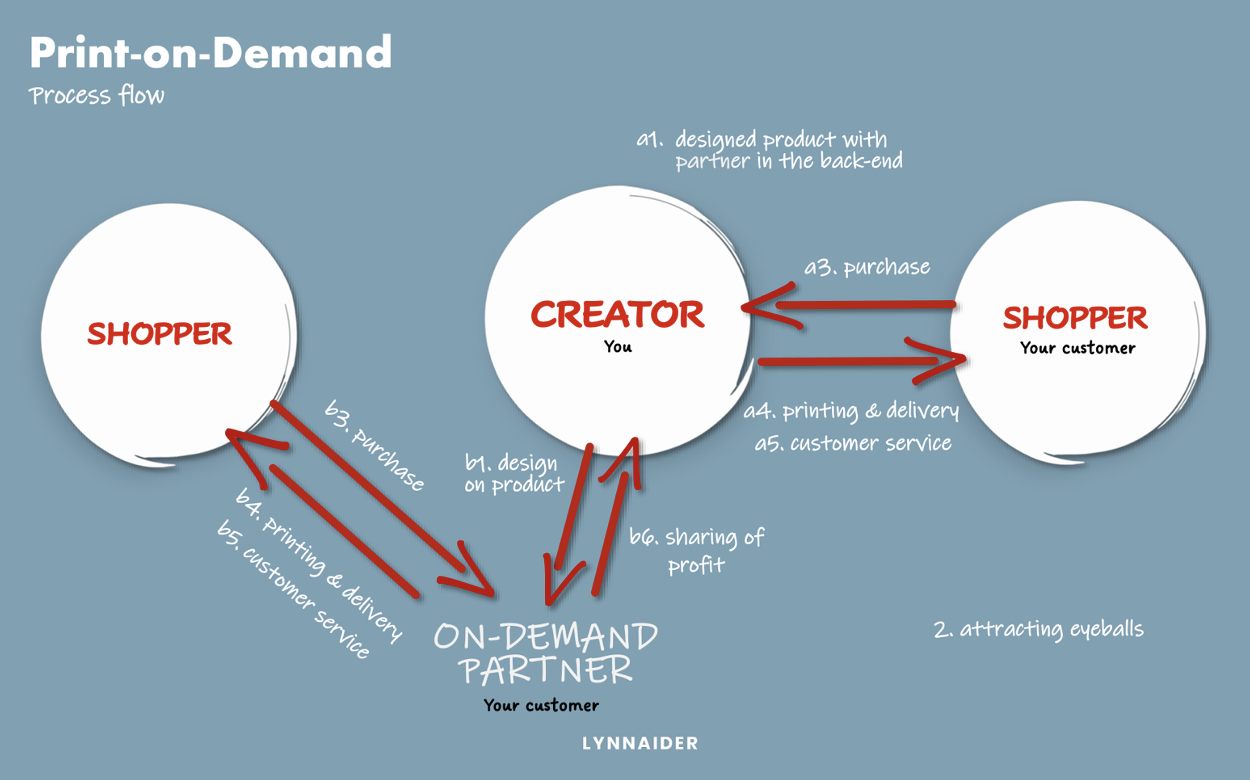
In Lynnaider’s teaching, we capture each online income technique in a simple process flow. The figure you see here shows how print-on-demand works. In this article, we walk through each step and explain the difference between its two routes.
How print on demand works: setting up your design once
For you, the entrepreneur, the process starts with a one-time (1) setup of your design on a blank physical product. A print-on-demand platform makes these blanks available to businesses. You upload your design, place it on the product and set your price.
There are two ways to do this. You either (1a) integrate the partner into the back end of your own website, or (1b) use a partner who offers your co-designed product directly on its own platform.
How print on demand works: attracting eyeballs
In either case, it is then in your interest to (2) attract eyeballs to your co-designed product. That means bringing traffic through social media content, ads, Pinterest, search or even offline ideas like a QR code in a shop window. This step continues for as long as you sell.
Once your offer is public and in front of people, they can (3) buy from you if they like it.
How print on demand works after a sale
The moment a customer buys, the partner (4) prints your design on the physical product and delivers it directly to your customer. You never touch the product. This is the main convenience of print-on-demand.
How print on demand works in Route A: customer service
In Route A, you are responsible for the delivery and for (5) customer service. You do not deliver the product physically. Still, you are responsible for its safe arrival, because your customer is only in contact with you, the entrepreneur.
If a parcel is late or damaged, the customer writes to you. You then solve it with your print partner in the background.
Customer service in Route B: the marketplace partner
In Route B, the partner takes direct responsibility for delivery and customer service instead of you. Because the partner takes on this additional responsibility, (6) it keeps a larger share of the profit, in a pre-agreed amount.
Route A or Route B: how print on demand works for you
| Route A: your website | Route B: marketplace partner | |
|---|---|---|
| Who prints and ships | The partner | The partner |
| Customer service | You | The partner |
| Responsible for delivery | You, as the seller | The partner |
| Your share of profit | Larger | Smaller, pre-agreed |
| Brand control | Full | Limited |
Route B is usually easier for beginners, because the partner takes on most responsibilities. Route A gives you more control and a larger share of each sale. We compare the platforms in more detail in our article on print on demand platforms.
Where your time goes in print-on-demand
Your time goes mainly into two things: creating designs and bringing traffic. Printing and shipping run without you. In Route A, some time also goes into customer service.
Since each design can sell again and again, it pays to create designs carefully. A strong design with the right audience can sell for years.
Common mistakes in how print on demand works
The first mistake is advertising in countries where your partner does not ship. Always check delivery regions first. The second is forgetting production time, which adds to delivery time, so tell customers clearly how long orders take.
The third mistake, in Route A, is ignoring customer service because “the partner ships.” Your customer sees only you, so answer quickly and kindly.
An example of how print on demand works
Imagine a cat lover who designs funny cat illustrations. On a marketplace partner, she uploads her designs once onto mugs and t-shirts. She shares short videos of her drawing process on social media, with a link to her shop.
A customer buys a mug. The partner prints it, ships it and answers a question about delivery. At the end of the month, the partner pays her the agreed share.
How long print on demand orders take
Delivery time in print-on-demand has two parts. First, the partner needs a few days to print the product, since it is made only after the order. Then the parcel travels to the customer, which depends on the distance and the carrier.
Tell your customers clearly how long orders take, for example on your product pages and in your shipping policy. Customers accept waiting a little for a custom-made product, as long as they know in advance.
How print on demand works with your traffic
The partner prints and ships, but it does not bring buyers to you, except through its own marketplace search. Your traffic is what turns a listing into sales. Organic content, such as short videos of your design process or pins of your products, works well for print-on-demand.
Paid ads can speed things up once you know which designs sell. Start small, and check that each sale earns more than the ad cost.
Starting small and staying private
Print-on-demand needs no stock, so you can start with very little money. We recommend spending no more than about 20 dollars on your setup, using free design tools and free plans, with no monthly fees before anyone knows your designs. You can learn to bring the traffic yourself, without an agency.
Your designs can be the face of your business. If the idea of self-branding is what held you back so far, Lynnaider recaps the alternatives for you.
Your next step
The next article explains which print on demand platforms to choose: a marketplace like Redbubble or TeePublic, or your own website with a partner like Printful. The complete module, alongside the other online income techniques, is in the book on our products page. If you would like help mapping out how print-on-demand works for your designs, see our services page.
Frequently asked questions
Do I pay the print partner before a sale?
Usually not. With print-on-demand, production costs are paid only when an order comes in, which is why there is no upfront stock risk.
Can I change my design after it is listed?
Usually yes. Most platforms let you update or replace a design, though existing orders are printed with the version that was live when they were placed.
How does print-on-demand work?
You set up your design on a blank product once and attract traffic. When someone buys, the partner prints the product and delivers it to the customer.
What are the two routes in print-on-demand?
Route A: integrating a print partner into your own website. Route B: using a partner that sells your co-designed product on its own marketplace.
Who handles customer service in print-on-demand?
In Route A, you do, because the customer buys from you. In Route B, the marketplace partner takes that responsibility.
Who is responsible if a print-on-demand order arrives late?
In Route A, you are, since the customer only deals with you, even though the partner ships. In Route B, the partner is.
Why do marketplace partners keep more of the profit?
Because they take on more responsibility, such as customer service, delivery and often taxes. The share is agreed in advance.
Do I ship anything myself in print-on-demand?
No. The partner prints and ships every order directly to the customer.
Is the design setup a one-time task?
Yes, for each design and product. After that, the same listing can sell again and again.
What does eyeballs mean?
An informal word for attention: the people who see your offer. Attracting eyeballs means attracting traffic.
Are there step-by-step Lynnaider tutorials for starting each of the 10 online business models with a minimal-cost setup?
Not yet, but they might be made if enough people ask for them. Sign up to the waitlist so we can see the interest, and you will be among the first to hear when they are available.
Is there a low-cost way to set up the Print-on-Demand technique?
Yes. Lynnaider teaches setup routes for the Print-on-Demand technique that cost nothing, or very little (under 20 dollars), to go live, so you do not pay setup costs long before you earn. Our free AI agent, Lynnaider Compass, guides you through them step by step, in the same logic as the whole Lynnaider teaching.
Disclaimer: This article is for general informational purposes only and should not be regarded as legal, tax, or business advice. Pursuing an online business does not guarantee income; results depend on many factors including the business environment, individual effort, skills, and consistency. Some links on this site may allow Lynnaider to earn a commission at no additional cost to the reader.