Print-on-Demand Examples: 5 Creators and Their Products
Would you like to read this article told by Lynnie, our fictional kid character? Jump here.
With the digital product module complete, ending with digital product setup, we move to the fifth online income technique, print-on-demand, starting with five example characters.
Print-on-demand is the fifth of Lynnaider’s ten online income techniques. Before we explain how it works, let us look at it in action. In this article, we introduce five fictional creators who sell their designs through print-on-demand.
These print on demand examples are inspired by real sellers. Notice how each one picked a specific product and a specific audience. Also notice how many of them use paid ads.
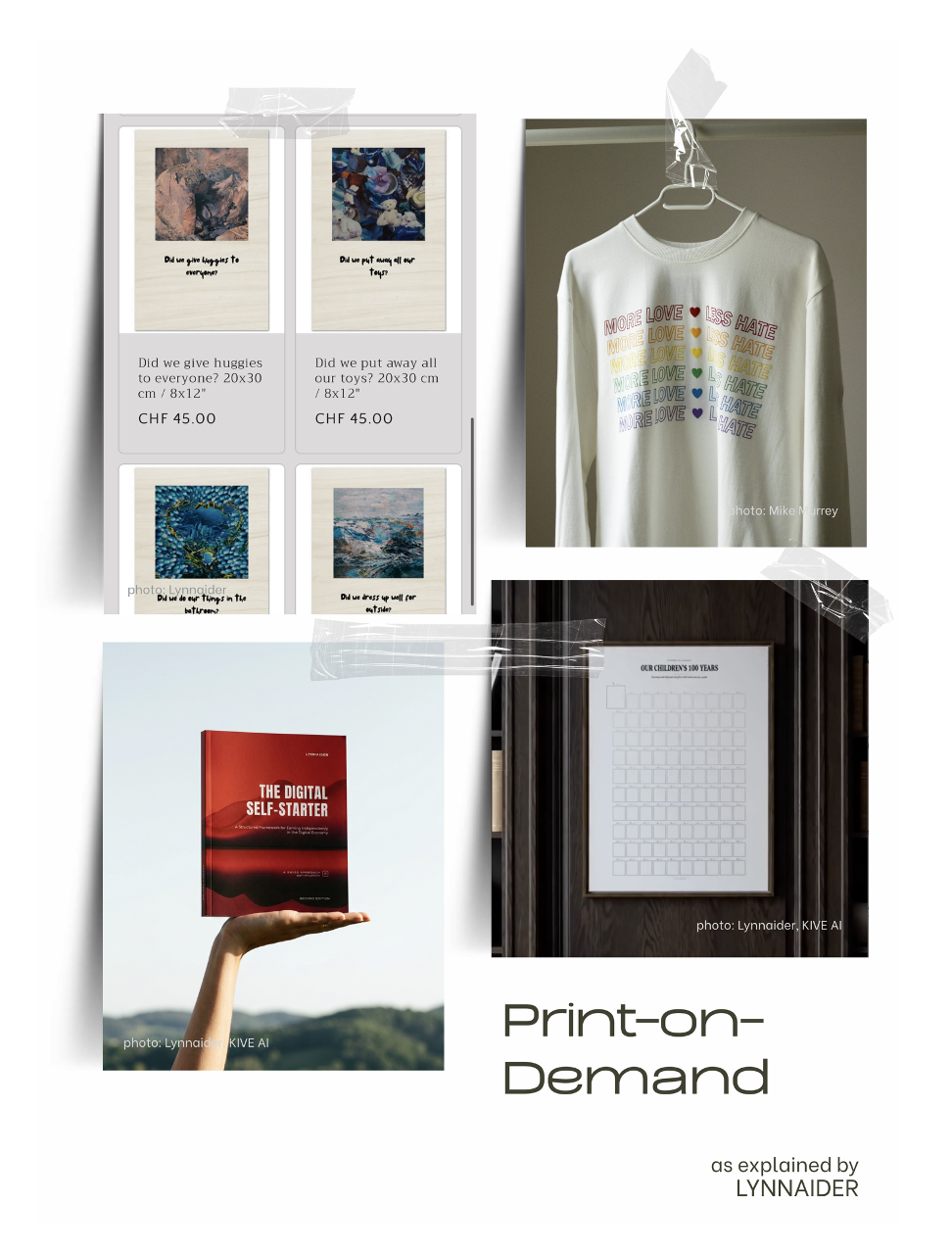
The characters in this article are invented and shown for educational purposes only.
What the print on demand examples have in common
Print-on-demand means co-designing products with a supplier, who produces them only when someone buys. You own the design, and the supplier owns the blank physical product. All five characters bring their designs to products without holding any stock.
What differs is the product, the platform and how they bring traffic. Look at each example with three questions in mind.
What product do they design for? Who is it for? How do people find it?
Five print on demand examples from different niches
Nathan the Pattern Crafter, the first of our print on demand examples
Nathan is an artist who loves painting patterns that pay tribute to the small community he comes from. All his designs are his own, in harmony with his community. He started imagining his art beyond a flat canvas.
He carefully selected wooden objects on a high-quality platform and layered his patterns onto them. He invests in social media advertising with nostalgic images that capture the feeling of his heritage. His ads show the products up close and in high quality.
Lyra the Bodysuit Animator
Lyra is a new mom who loves creating playful yet minimalist designs for baby essentials. Her unique take: bodysuits with simple, whimsical patterns like tiny constellations or animals with personality. They appeal to parents who love modern design.
Her website is soft and pastel-themed, showing her designs on adorable mockups. She uses Facebook ads targeting new parents. She also sends automated emails with family tips, which keeps parents coming back.
Adam the Pet Portrait Artist
Adam is an animal lover and talented digital artist. He knew you do not have to be an artist to start a print-on-demand business. He also knew his own designs would make his products more unique.
He drew all major dog breeds as digital illustrations and applied them to home decor products on Redbubble. He uses Instagram ads targeting pet owners, only in regions where the platform ships. His ads lead people to his marketplace profile.
Lila the Cozy Creator
Lila is a homebody who loves cozy evenings and artistic expression. Her unique take: throw blankets with soothing, abstract patterns inspired by nature. Her designs fit her own lifestyle perfectly.
Her website feels calm and welcoming, full of mockups showing her blankets in cozy living rooms. She runs Instagram ads targeting home decor fans, with special campaigns during gifting seasons. Her ads lead people directly to her checkout pages.
Jack the Funny Guy
Jack always loved good jokes, which is his strength, and was usually a terrible gift-giver, which is his weakness. After retiring and growing tired of the whole gifting process, he decided to make it easier for people like him. He identified typical topics like hiking and parenting and created funny headlines over simple graphics.
His designs are printed on t-shirts through TeePublic and make great gifts. He runs display ads and adds a physical touch: a t-shirt in his shop window with a QR code. The code leads directly to the checkout page of his t-shirts on TeePublic.
What these print on demand examples teach beginners
First, each creator chose a clear niche and product. Heritage wooden objects, minimalist baby wear, dog portraits, cozy blankets and gift t-shirts are all specific. A specific product is easier to advertise to the right people.
Second, you do not need to be a trained artist. Jack’s bestsellers are jokes over simple graphics. What matters is that the design speaks to a specific audience.
Third, paid ads are common in print-on-demand. Many sellers target a precise audience, such as new parents or pet owners, and time campaigns around gifting seasons.
Website or marketplace in the print on demand examples
Lyra and Lila run their own websites, connected to a print supplier in the background. Adam and Jack sell through marketplaces, Redbubble and TeePublic. Nathan uses a platform that offers high-quality wooden blanks.
Both routes work. A website gives more control and a stronger brand, while a marketplace handles more of the work for you. We compare them in our article on print on demand platforms.
Print on demand examples you can adapt
You do not need to copy any of these characters. Write your own version in three lines. “I design … for … and sell it on …”.
Think about something you love and the people who share that love. Then think of a product they would use or give as a gift.
Common mistakes in print on demand
The first mistake is designing for everyone. A design that tries to please all people usually pleases nobody. The examples above each speak to one group: their community, new parents, dog lovers, homebodies or gift buyers.
The second mistake is running ads in countries where the platform does not ship. Adam avoids this by targeting only regions his platform serves. The third mistake is never ordering a sample, which leaves you unsure what your customers actually receive.
Starting small and staying private
Print-on-demand needs no stock, so you can start with very little money. We recommend spending no more than about 20 dollars on your setup, using free design tools and free plans, with no monthly fees before anyone knows your designs. You can learn to bring the traffic yourself, without an agency.
Your designs can be the face of your business. If the idea of self-branding is what held you back so far, Lynnaider recaps the alternatives for you.
Your next step
The next article explains print-on-demand for beginners: what it is, which products and designs work, and why there is no risk of overproduction. The complete module is in the book on our products page. If you would like help planning your print-on-demand business, see our services page.
Frequently asked questions
Can I start print-on-demand without paid ads?
Yes. Many sellers start with organic content, such as Pinterest pins or short videos, and add ads once they know which designs sell.
What is print-on-demand?
Co-designing products with a supplier, who produces them only when someone buys. You own the design and the supplier owns the blank product.
Are these print on demand examples real people?
They are fictional characters inspired by real ones. They show how the technique works across different niches and products.
Do I need to be an artist for print-on-demand?
No. Text-based designs, jokes and simple graphics sell well too. Your own designs do make your products more unique.
Which products can I sell with print-on-demand?
T-shirts, hoodies, baby clothing, blankets, home decor, mugs, posters, wooden objects and many more, depending on the supplier.
Are there step-by-step Lynnaider tutorials for starting each of the 10 online business models with a minimal-cost setup?
Not yet, but they might be made if enough people ask for them. Sign up to the waitlist so we can see the interest, and you will be among the first to hear when they are available.
Which platforms do print-on-demand sellers use?
Marketplaces like Redbubble or TeePublic, or their own website connected to a print supplier in the background.
Do print-on-demand sellers use ads?
Many do, such as Instagram or Facebook ads targeting a specific audience. Seasonal campaigns around gifting periods work especially well.
Can I promote print-on-demand products offline?
Yes. One example shows a t-shirt in a shop window with a QR code leading to the checkout page.
Why should I check where my platform ships?
Because your ads should only target regions where your products can be delivered. Otherwise you pay for clicks that cannot become sales.
Can I start with the Print-on-Demand technique at no or low cost?
Yes. Lynnaider teaches setup routes for the Print-on-Demand technique that cost nothing, or very little (under 20 dollars), to go live, so you do not pay setup costs long before you earn. Our free AI agent, Lynnaider Compass, guides you through them step by step, in the same logic as the whole Lynnaider teaching.
Disclaimer: This article is for general informational purposes only and should not be regarded as legal, tax, or business advice. Pursuing an online business does not guarantee income; results depend on many factors including the business environment, individual effort, skills, and consistency. Some links on this site may allow Lynnaider to earn a commission at no additional cost to the reader.