Dropshipping vs Print-on-Demand: Same Setup, Different Added Value
Would you like to read this article told by Lynnie, our fictional kid character? Jump here.
To close the dropshipping module, after dropshipping setup, we compare dropshipping with print-on-demand.
Dropshipping and print-on-demand are often mentioned together, and for good reason. Their setups are very similar. In this article, we compare dropshipping vs print on demand side by side, so you can see what they share, where they differ and which suits you.
Dropshipping vs print on demand: what they share
Both techniques let you sell physical products without holding stock. In both, your supplier handles production and delivery. And in both, you can be the seller of record.
In print-on-demand, you become the seller of record when you connect a print partner to your own website. In dropshipping, you are always the seller of record. In both cases, that brings responsibilities for legal pages, payments and customer service.
Dropshipping vs print on demand: the added value
What is fundamentally different is the nature of your contribution. That difference decides which technique fits your strengths.
In print-on-demand, your added value is creative
In print-on-demand, your key added value is visual and creative. You bring an original design to a blank product. That makes it uniquely yours and immediately different from anything else on the market.
In dropshipping, your added value is curatorial and commercial
In dropshipping, your key added value is curatorial and commercial. You identify an existing product with a function that nobody emphasizes. You test whether it truly delivers that function and bring it to an audience who would not otherwise have found it.
Done well, this is a real contribution. Done carelessly, with no angle, no curation and no added context, it is the version of dropshipping that earned the technique its complicated reputation. We explain the difference in our article on value-added dropshipping.
Dropshipping vs print on demand: side by side
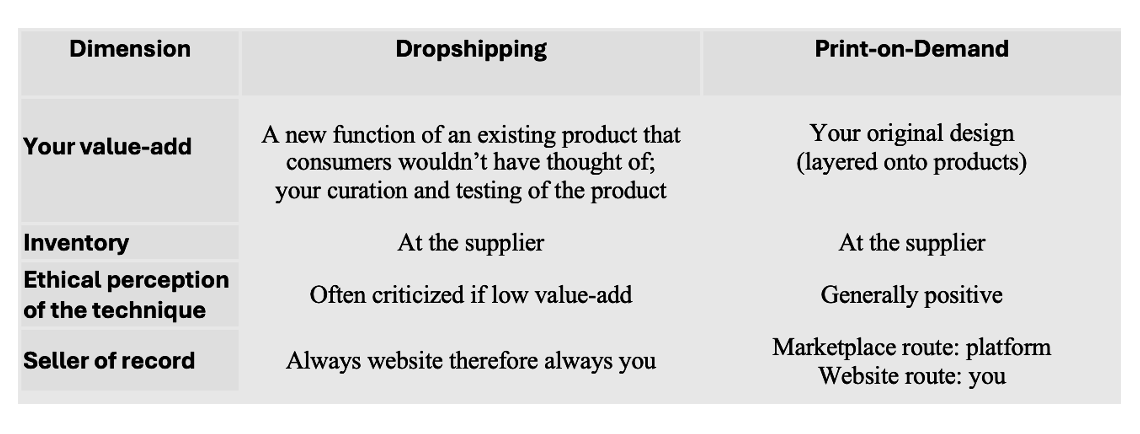
| Print-on-demand | Dropshipping (done well) | |
|---|---|---|
| Stock | None | None |
| Who produces and ships | The print partner | The supplier |
| Your added value | An original design | A new function, testing and curation |
| Key profiles | Marketplace or own website | Own website only |
| Seller of record | Platform (marketplace) or you (website) | Always you |
| Typical traffic | Organic content and ads | Mostly paid ads |
| Main skill | Creativity | Discovery and marketing |
Which one suits you?
If you love drawing, writing slogans or creating visual ideas, print-on-demand fits your strengths. You can start on a marketplace that handles most responsibilities for you. Our article on print-on-demand for beginners explains how.
If you love finding products, noticing clever new uses and testing things, dropshipping may suit you better. Be ready to run your own website, handle customer service and invest in ads. Our article on ethical dropshipping explains the approach we teach.
Dropshipping vs print on demand: combining both
Some stores combine both. A store for hikers might sell its own designed t-shirts through print-on-demand alongside carefully tested, repurposed gear through dropshipping. The same website, traffic and customers then support two income streams.
Risks in dropshipping vs print on demand
In print-on-demand, the main risks are copyright problems and poor print quality. Use only your own or properly licensed content, and order samples. In dropshipping, the main risks are unreliable suppliers, long delivery times and ad costs that exceed your margin.
In both, you protect yourself by testing before advertising and by stating delivery times honestly.
An example of dropshipping vs print on demand
Imagine two friends who both love camping. One designs funny campfire illustrations and sells them on mugs and t-shirts through a print-on-demand marketplace. The other discovers that a certain kitchen storage box makes a perfect waterproof camping organizer and sells it through dropshipping on her own website.
Both sell physical products without stock. The first adds a design, the second adds a new function. Each chose the technique that fits their strengths.
Costs in dropshipping vs print on demand
Print-on-demand can start almost for free on a marketplace. You pay nothing until a product sells, and organic traffic can bring your first buyers. Your main investment is time spent on designs.
Dropshipping usually needs more money. You run your own website, order product samples from several suppliers and pay for ads to reach customers. Your margin must cover all of these.
Legal responsibilities in dropshipping vs print on demand
On a print-on-demand marketplace, the platform carries most legal and tax responsibilities. On your own print-on-demand website, and always in dropshipping, those responsibilities are yours. That includes legal pages, refunds, taxes and consumer protection rules in each country you sell to.
If you prefer fewer responsibilities at the start, a print-on-demand marketplace is the gentler entry point. If you are ready for the full role of a seller, both techniques are open to you.
Traffic in dropshipping vs print on demand
Print-on-demand designs often spread well through organic content, such as pins and short videos, because original designs are easy to share. Dropshipping usually relies on paid ads that explain a product’s new function to the right audience. Both benefit from email, which brings customers back.
Choose the technique whose traffic method you are most comfortable with. If you prefer creating content, print-on-demand may suit you. If you prefer testing ads, dropshipping may.
Starting small and staying private
Both techniques can start with a lean setup. We recommend no more than about 20 dollars on your setup, free plans where possible and no monthly fees before you have traffic. You can learn to bring that traffic yourself, without an agency.
Neither technique requires showing your face. If the idea of self-branding is what held you back so far, Lynnaider recaps the alternatives for you.
Your next step
This article completes the dropshipping module. Dropshipping and print-on-demand are two of the ten online income techniques Lynnaider teaches. The complete modules are in the book on our products page. If you would like help choosing between dropshipping vs print on demand, see our services page.
Frequently asked questions
Do both techniques need testing before selling?
Yes. In print-on-demand, order samples to check print quality. In dropshipping, test the product, the function and the delivery.
Which needs more starting budget, dropshipping or print-on-demand?
Dropshipping, usually, because of samples, a website and paid ads. Print-on-demand on a marketplace can start almost for free.
Will Lynnaider publish step-by-step tutorials for setting up the 10 online business models for free or at a very low cost?
They may be created depending on how much interest there is. Please join the waitlist to show that you are interested, and we will let you know as soon as they are ready.
Do both techniques need customer service?
Dropshipping always does. Print-on-demand does when you sell through your own website, while marketplaces handle it for you.
What do dropshipping and print-on-demand have in common?
Both let you sell physical products without holding stock, and in both a supplier handles production and delivery. In both, you can be the seller of record.
What is the main difference between dropshipping and print-on-demand?
Your added value. In print-on-demand, it is creative: an original design. In dropshipping, it is curatorial and commercial: a new function for an existing product.
Which is easier for beginners?
Print-on-demand on a marketplace is often easier, because the platform takes on more responsibilities. Dropshipping always makes you the seller and usually needs an ad budget.
Can I be the seller of record in print-on-demand?
Yes, when you connect a print partner to your own website. On a print-on-demand marketplace, the platform usually takes that role.
Why does dropshipping have a complicated reputation?
Because careless dropshipping, with no angle, curation or context, has misled customers. Done well, with real added value, it is a genuine contribution.
Which technique suits creative people?
Print-on-demand, since your designs make the products unique.
Which technique suits people who love finding products?
Dropshipping, if you enjoy discovering new uses for existing products and testing them carefully.
Can I combine dropshipping and print-on-demand?
Yes. Some stores sell their own designs through print-on-demand alongside carefully chosen dropshipped products.
Where can I get step-by-step help to set up the Ethical Dropshipping technique on a small budget?
Yes. Lynnaider teaches setup routes for the Ethical Dropshipping technique that cost nothing, or very little (under 20 dollars), to go live, so you do not pay setup costs long before you earn. Our free AI agent, Lynnaider Compass, guides you through them step by step, in the same logic as the whole Lynnaider teaching.
Disclaimer: This article is for general informational purposes only and should not be regarded as legal, tax, or business advice. Pursuing an online business does not guarantee income; results depend on many factors including the business environment, individual effort, skills, and consistency. Some links on this site may allow Lynnaider to earn a commission at no additional cost to the reader.