Value-Added Dropshipping: Give a Product a New Function
Would you like to read this article told by Lynnie, our fictional kid character? Jump here.
After introducing ethical dropshipping, this article explains how to add real value by giving a product a new function.
What turns dropshipping into a fair business? In our view, it is the value you add. In this article, we explain value-added dropshipping: how to give an existing product a new function, how to test it, and why that justifies your margin.
If you are new to the technique, our article on ethical dropshipping explains the basics and the criticism first.
Value-added dropshipping: redefining a product’s function
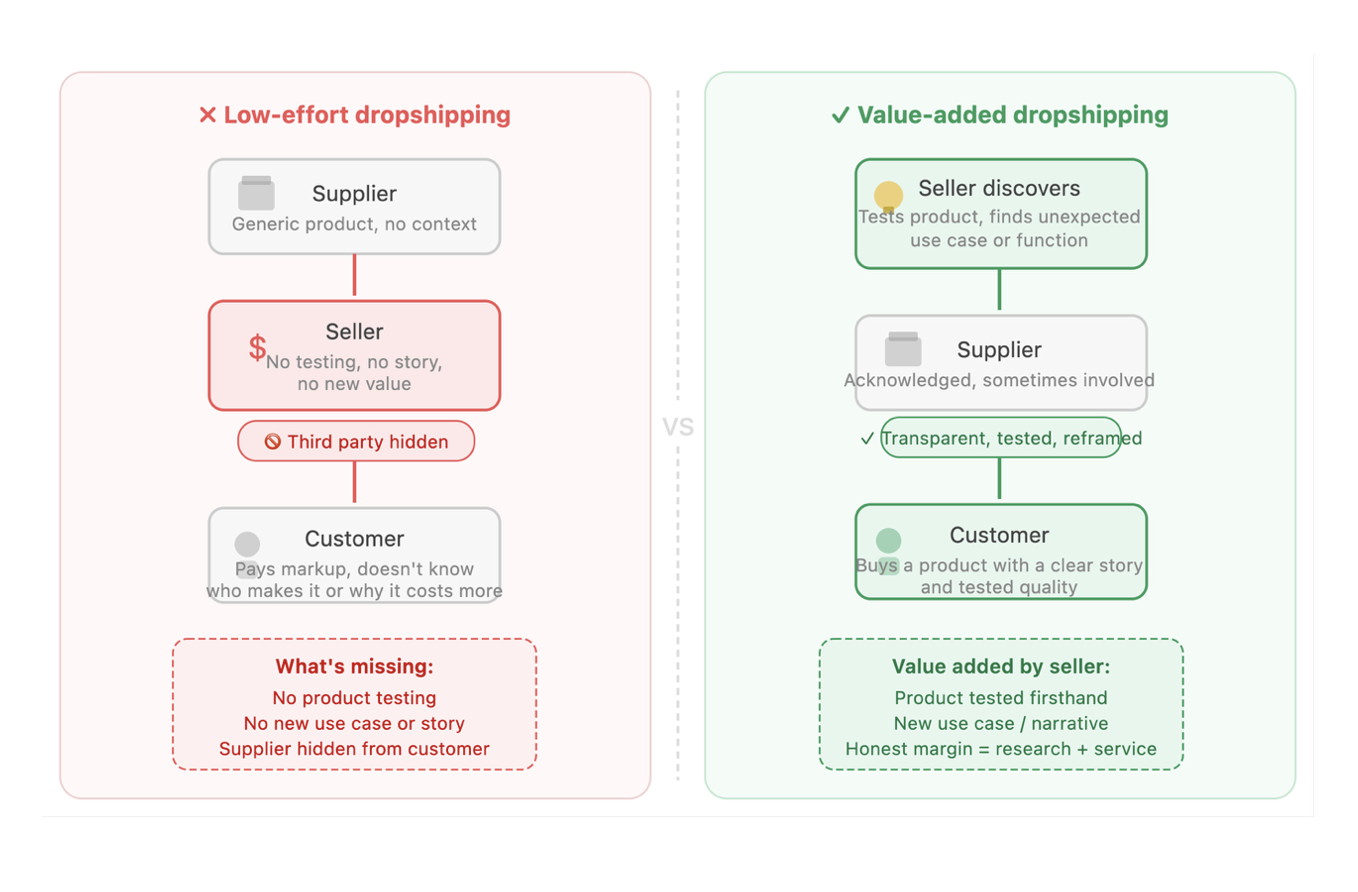
In our view, the most ethically sound way to practice dropshipping is to redefine the function of an existing product in a valuable way. Rather than selling a product “as is,” you advertise it for a new, unexpected use that you discovered. You can see the difference in the figure you see here.
This often starts with an accidental discovery, rather than with “let’s see what else this product could do.” You notice that something you own solves a problem in a way nobody talks about.
Examples in value-added dropshipping
A product designed for storage might become a productivity tool. A household item might solve a workflow problem in an unexpected way. A baking mat might replace disposable parchment paper.
If the new function truly helps, building a new story and use-case around the product will not be difficult. Do it in agreement with the supplier. When you present a product through a new functional lens, you move from reselling to curating and reframing.
Why value-added dropshipping justifies your margin
This added value is what justifies your margin and sets you apart from low-effort dropshipping. You opened a new window to the product. Customers who would never have found it now discover a solution to their problem.
In simple terms: you may buy the product from the supplier at price X and sell it on your website at price X plus Y. Y is what you earn, your margin. Of course, this is a simplified explanation, since ads, fees and returns also come out of it.
Working closely with suppliers
This approach often leads to closer collaboration with your suppliers. You might discuss packaging options, sustainability or small adaptations for your audience. A supplier who sees you bringing new customers is often open to these conversations.
Your margin then reflects much more than marketing. It also reflects research, testing, positioning and customer service.
Testing: a must in value-added dropshipping
It is true that you never physically handle the product shipped from the supplier to the customer. However, before you offer any product on your website, you must test it thoroughly yourself, from an ethical point of view. Ideally, test several versions.
How to test a dropshipping product
- Buy the product yourself, from several suppliers if more than one offers it.
- Compare shipping times and note the real delivery time to your main markets.
- Evaluate the delivery experience firsthand: packaging, condition, any extra items in the parcel.
- Use the product long enough to state honestly that you are satisfied.
- Test the new function you plan to advertise, in real conditions.
Testing is another part of your added value in the chain, beyond opening a new window. It protects your customers, your reputation and your margin.
Low-effort vs value-added dropshipping
| Low-effort dropshipping | Value-added dropshipping | |
|---|---|---|
| Product presentation | As is, often copied from the supplier | Through a new function or use |
| Testing | None | Thorough, ideally several suppliers |
| Supplier relationship | Anonymous | Collaborative |
| Customer service | Poor or absent | Taken seriously |
| Justified margin | Hard to justify | Reflects real work and value |
Finding your value-added dropshipping idea
Look around your home and daily routine. Which products do you use differently from how they are sold? Which problems have you solved with something unexpected?
Write these down and ask friends whether they would find the new use helpful. If several people say yes, research suppliers and start testing.
Common mistakes in value-added dropshipping
The first mistake is inventing a new function that does not really work, just to sell more. Customers will notice and return the product. The second is skipping testing to save time or money.
The third mistake is copying the supplier’s photos and texts word for word. Your own photos and descriptions show the new function and make your store unique.
An example of value-added dropshipping
Imagine a father who discovers that a magnetic knife strip is perfect for holding his children’s small metal toy cars on the wall. The toys stop getting lost, and the display looks great. He tests strips from three suppliers and picks the strongest.
He photographs the strips with colorful toy cars in children’s rooms. His ads target parents of young children. He presents an ordinary kitchen product as a tidy, playful toy display.
Questions to ask a supplier in value-added dropshipping
- What are your real processing and delivery times to my main countries?
- How do you handle damaged items and returns?
- Can you ship without your own branding or marketing inserts in the parcel?
- May I use my own photos and descriptions for your product?
- Are you open to small changes in packaging or materials?
The answers tell you how reliable the supplier is and how much room you have to add value.
Starting small and staying private
Dropshipping usually involves paid advertising, so it needs more budget than most techniques. Still, keep your setup itself lean: we recommend no more than about 20 dollars at the start, free plans where possible, and no monthly fees before you have tested your product and your idea. Test with small ad budgets first, and learn to run your own ads without an agency.
Your store and your product story can be the face of your business. If the idea of self-branding is what held you back so far, Lynnaider recaps the alternatives for you.
Your next step
The next article explains the offering in the dropshipping business model: a digital service to the supplier and a physical product to the shopper. The complete module, alongside the other online income techniques, is in the book on our products page. If you would like help testing a value-added dropshipping idea, see our services page.
Frequently asked questions
What if the new function I found does not convince customers?
Test the idea with a small ad budget first. If people do not respond, refine the story or try another product.
How many samples should I order before selling?
At least one from each supplier you consider, and enough to test the product in real use for some time.
What is value-added dropshipping?
Dropshipping where you redefine an existing product’s function, present it through a new lens, test it carefully and support customers well.
How do I find a new function for a product?
Often by accident: you notice that a product solves a problem in an unexpected way. If the new use truly helps, a new story around it comes naturally.
Do I need the supplier’s agreement for a new use-case?
It is best to agree with the supplier, especially if you change packaging, descriptions or presentation.
Can I get step-by-step guidance from Lynnaider to set up one of the 10 online business models without spending much?
Step-by-step tutorials with free or minimal-cost setups may be made based on interest. Please add your name to the waitlist, and we will inform everyone who signed up as soon as they become available.
Why should I test dropshipping products myself?
Because you must be able to state honestly that you are satisfied. Testing covers quality, shipping times and the delivery experience.
Should I test products from several suppliers?
Yes, if several suppliers offer the same product. Compare quality and delivery before choosing.
What does my margin pay for?
Your research, testing, positioning, advertising and customer service, the added value you bring to the chain.
Can I work closely with suppliers?
Yes. You might discuss packaging, sustainability or small adaptations for your audience.
What is low-effort dropshipping?
Reselling generic products as they are, with no new angle, no testing and little support. It is the version that earned dropshipping its poor reputation.
Where can I get step-by-step help to set up the Ethical Dropshipping technique on a small budget?
Yes. Lynnaider teaches setup routes for the Ethical Dropshipping technique that cost nothing, or very little (under 20 dollars), to go live, so you do not pay setup costs long before you earn. Our free AI agent, Lynnaider Compass, guides you through them step by step, in the same logic as the whole Lynnaider teaching.
Disclaimer: This article is for general informational purposes only and should not be regarded as legal, tax, or business advice. Pursuing an online business does not guarantee income; results depend on many factors including the business environment, individual effort, skills, and consistency. Some links on this site may allow Lynnaider to earn a commission at no additional cost to the reader.