
Offerings by Income Technique: What Each of the Ten Models Delivers
What Is the Offering, Income Technique by Income Technique?
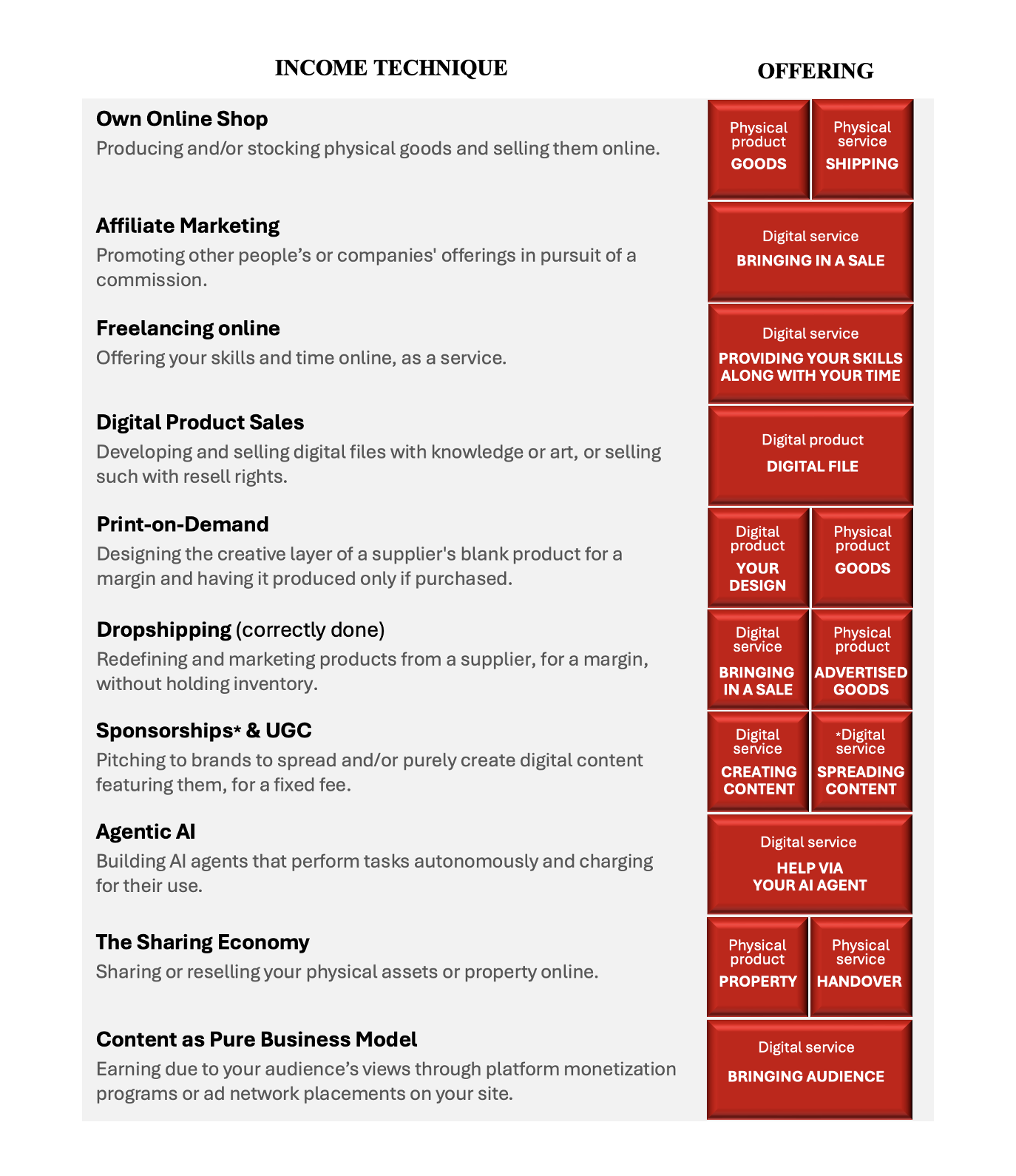
Looking across the ten business models, in Table 2., you will notice that the majority of what online entrepreneurs actually deliver falls into the digital category. Several techniques involve a digital service as their core offering, though the nature of that service varies widely. In affiliate marketing, what you are delivering is essentially the act of bringing a sale to someone else’s business; your output is a transaction initiated through your influence. Freelancing online works similarly in that you are delivering a skill remotely, whether that is writing, design, translation, or consulting, but here the offering is your time and expertise directly and you are providing that to the final client. Sponsorships and UGC split into two related digital services: creating content on behalf of a brand and spreading it to your audience — never to confuse here that even though your content speaks to your audience, they are not who pay you; it’s the brand and that’s why the service you provide is for them. Agentic AI, one of the newer income techniques, is a digital service in which an automated system you have built does the work for the client. And content as a pure business model, perhaps the most intangible of all, delivers an audience’s attention as its service; the platform or advertiser is effectively buying access to the people you have gathered.
The purely digital product techniques are those where what you sell can be downloaded or accessed independently of your time. Digital Product Sales is the clearest example, where the offering is a digital file: a template, an e-book, or a piece of digital art. Print-on-Demand is hybrid: your contribution is a digital product in the form of your design to the supplier partner, but the end customer receives a physical product. Similarly, in Dropshipping, when done well, it’s hybrid, because you provide a digital service because you are the one redefining, marketing and selling the product, and it’s also you who must make sure that the partner supplier delivers a physical product to the end consumer. Physical offerings appear also in Own Online Shop aka E-commerce, where you produce or stock real goods and handle their shipping as part of the service, and in The Sharing Economy, where what you make available is physical property — a space, a vehicle, an asset — and the handover or shipping itself is a physical service you must also provide. These physical techniques tend to carry the highest operational complexity for an online entrepreneur, which is worth keeping in mind as you identify which type of offering best fits where you are starting from. It does not mean that the physical techniques are more difficult, because for many entrepreneurs it’s exactly their tangible aspect that makes the work enjoyable and pursuable in the long run.
Frequently asked questions
Which category of offering is most common online?
Digital, both product and service. Across the ten techniques, most of what solo entrepreneurs deliver falls into digital offerings, which is one reason online business is now more accessible than ever.
Is affiliate marketing a product or a service?
It is a digital service. What you deliver to the brand is the act of bringing them a trackable sale through your content or influence, not a product of your own.
What kind of offering is print-on-demand?
It is hybrid. Your contribution is a digital design shared with a supplier, but the end customer receives a physical product produced only when they buy.
Is content itself an offering?
In audience monetisation, effectively yes. The offering is the attention of the audience you have gathered, sold to platforms or advertisers through their monetisation programs.
Why does dropshipping count as both a service and a product?
Because you provide the digital service of redefining, marketing, and selling the product, while your supplier delivers a physical product to the buyer you brought.
Which techniques carry the most operational complexity?
The ones involving physical goods, such as Own Online Shop and Sharing Economy, because they require handling delivery. That complexity does not make them harder in a meaningful sense, only more logistically involved.
Disclaimer: This article is for general informational purposes only and should not be regarded as legal, tax, or business advice. Pursuing an online business does not guarantee income; results depend on many factors including the business environment, individual effort, skills, and consistency. Some links on this site may allow Lynnaider to earn a commission at no additional cost to the reader.