
The Engines Behind Online Income: Automation and AI, Introduced
2.2 Income
Under the Income stage of our online business-oriented journey, we are essentially answering ourselves the question: “Which income techniques may allow me to set up earning around my own version of a simple idea?” You’ve created your version of a simple idea in Lesson T1, or perhaps you’ve already had it before coming to our teaching. Your version of a simple idea might feel a bit too open still, and that’s okay, in fact, it might even be advantageous. Why? Because having a larger set of interpretations of what products and services your idea could mean is good to have before learning about the ten online income techniques. It will essentially be the selected income technique(s) that will shape the exact product or service you will deliver, a.k.a. your Offering, as you’ve seen summarized just above.
In this chapter however we will rather talk about what makes online income systems possible in the first place. We will go into much explanation about the individual income techniques in their dedicated modules, but in the Theory part of our teaching, we must paint a topline picture of the engines behind. Thus, it is now a good time to talk a little bit about just that, automation and AI.
Key Term: Automation
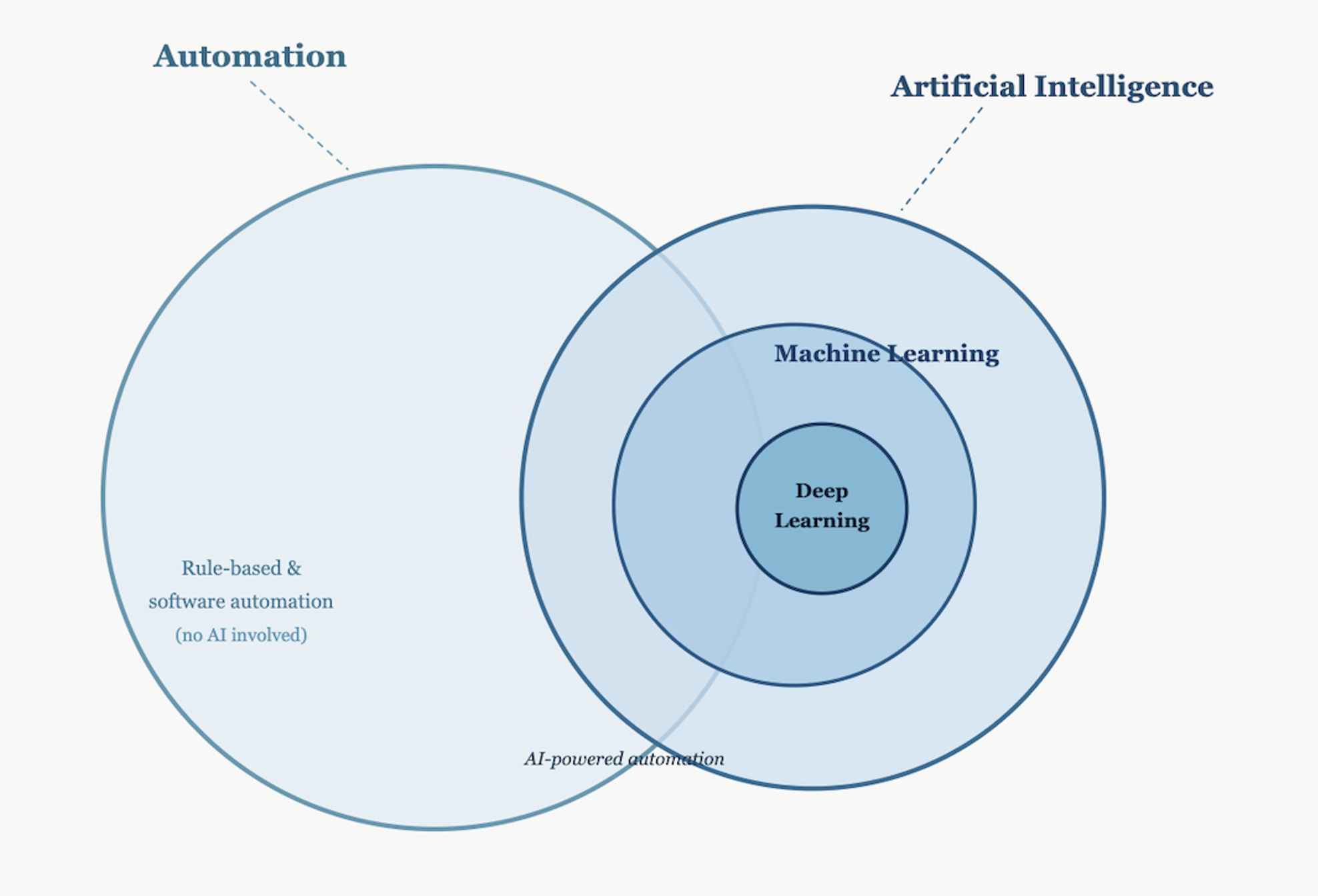
Automation is the use of technology to carry out tasks without someone needing to do them manually each time. It is a broad and old concept. Think of mechanical assembly lines or the software systems quietly running most of the world’s businesses today. The vast majority of this is what we call rule-based and software automation: programs that follow a fixed set of instructions, triggered by a condition or a schedule, with no intelligence involved whatsoever.18 A payment that processes automatically at month-end, a confirmation email that fires when someone places an order, a conveyor belt that starts when a sensor is triggered, in those cases, no AI is involved, simply a set of rules, followed precisely. In Figure 4, this circle is, in reality, far larger than the AI circle: most of the automated systems running in the world today have no AI in them at all.
Where Automation and AI meet, however, is called AI-powered automation, and it is where much of what you will use as an aspiring online entrepreneur will live: tools that automate tasks that previously required human thinking, such as writing, designing, or responding to customers. Automation will not operate your business by itself, because you are the key to that, but it will most definitely offer the framework needed to enable you to get started. It is in almost everything relevant to your journey: the shipping, the tracking, the payment processing, the advertising, the designing, to name just a few.
Please do know, however, and perhaps it gives some relief, that it is not mandatory to use a program for every single task. In fact, too many programs could feel overwhelming. You can carry out some tasks yourself, and at any point, have someone you trust work alongside you.
Frequently asked questions
What is the difference between automation and AI?
Automation is any technology that carries out tasks without someone doing them manually. AI is one specific approach to automation, where the system can analyse data and make decisions rather than just following fixed rules. Most automation in the world is not AI.
Do I need to understand AI to build an online business?
No, not the technical details. It helps to know what your tools are doing behind the scenes, but every technique in Lynnaider’s framework can be practised without deep AI knowledge.
What is rule-based automation?
Programs that follow a fixed set of instructions, triggered by a condition or a schedule. A payment that processes at month-end, an order confirmation email, a conveyor belt started by a sensor. No intelligence, just rules followed precisely.
Where does AI meet automation for entrepreneurs?
In AI-powered automation: tools that automate tasks that previously required human thinking, such as writing, designing, or responding to customers. This is where most of the AI you’ll use as an aspiring online entrepreneur lives.
Do I have to automate every task in my business?
No, and too much software often feels overwhelming. Some tasks are worth carrying out yourself, and at any point you can bring in someone you trust to work alongside you.
Why is automation introduced before the ten income techniques?
Because every income technique sits on top of some form of automation. Understanding the engine before the vehicle makes the individual technique modules easier to follow.
References
18. Shopify. Ecommerce automation: streamline operations and scale your business. Ottawa (CA): Shopify Inc.; 2024.
Disclaimer: This article is for general informational purposes only and should not be regarded as legal, tax, or business advice. Pursuing an online business does not guarantee income; results depend on many factors including the business environment, individual effort, skills, and consistency. Some links on this site may allow Lynnaider to earn a commission at no additional cost to the reader.