
Finding Your Room: The Niche as a Room in a House
Finding Your Room
Now we feel it’s the right moment to talk about what a niche is. We felt that with this kind of introduction, we’ve properly established the context, rather than simply jumping straight into the often-heard advice: “Find your niche” or “Just pick a niche.”
Lynnaider’s definition of a niche: A niche is like a room inside a large house, where everything is about the same topic. You should already feel at home in the house, but once you also choose a room that your offer fits into, that’s when you’ve found a niche.
As introduced in the definition, a niche is essentially the topic or area you will immerse yourself in once you begin an online activity. Every product or service fall into some kind of niche. For example, if you create a digital product such as a time-management template, a beginner’s photography guide, or a workout plan, each of these can belong to very different niches, such as productive lifestyle, creative hobbies, or active lifestyle. And in the case of services, whether it’s logo design, personalized blanket crochet, or personal training, there is always a specific niche whose problem you are solving.
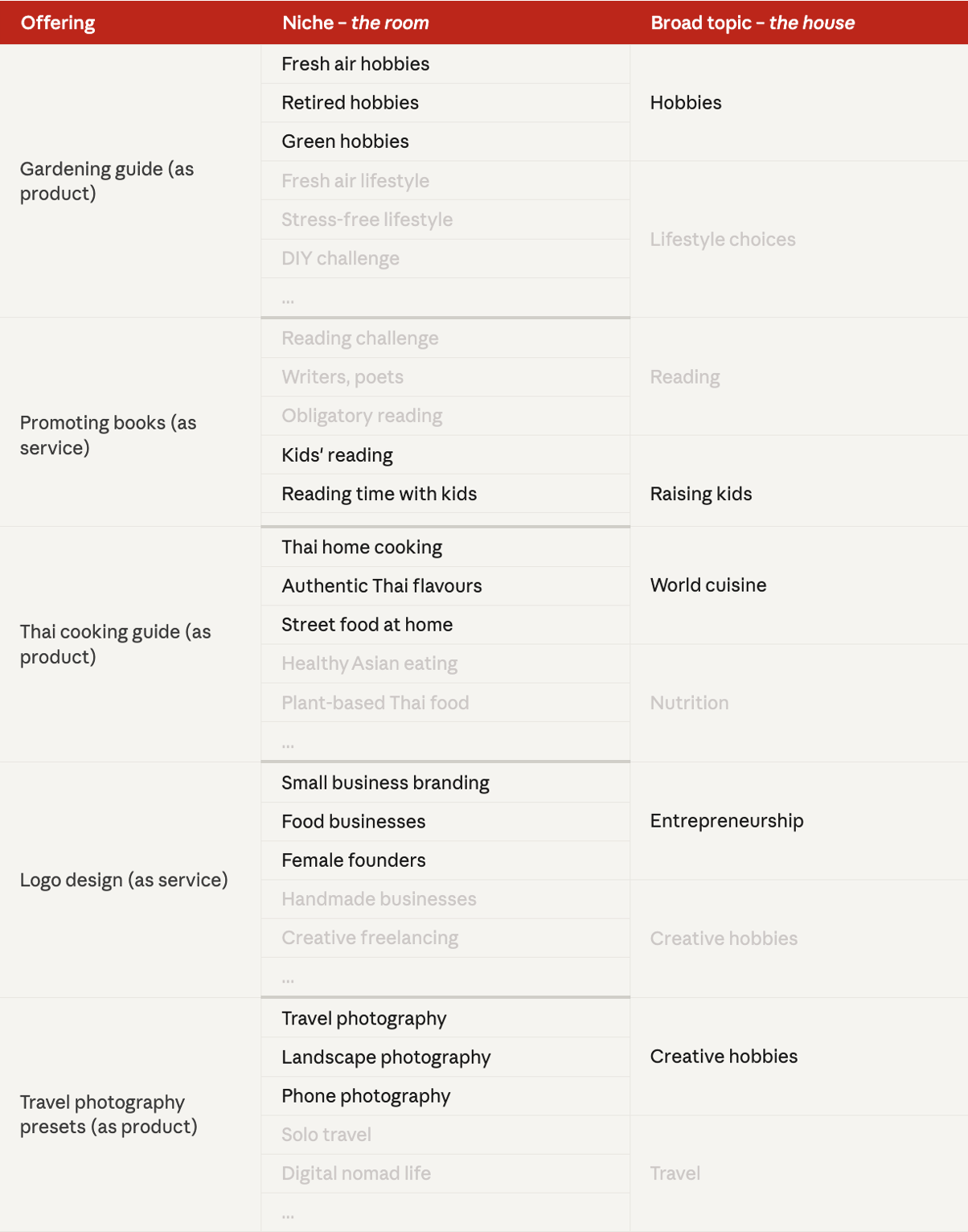
In Lynnaider’s thinking, we continue to use this simple visual logic: if the niche is a small room within a large house, then the items inside the room represent what you offer: your product or service. The theme of the room (for example, “animal-loving family,” or “minimalist life”) represents the narrower area you focus on, while the name of the house (such as Pets, or Budgeting) shows the broader world that this room belongs to. This logic helps you see that the same offering can fit into several different rooms, because it can connect to multiple niches later.
Instead of searching for a single “correct” niche, think of niches as multiple doors, each showing you a world in which your offering can be valuable. Start with the one that feels most relevant and most simple to start working with for you. You’ll always have the possibility to shift.
Use the example table below flexibly. Start either from something concrete you know you can offer and define which niche that offering belongs to. It’s useful to describe the niche with two words, as this helps you more precisely outline what the “room” is about. Once you have that, try removing one of the two words. This opens up the picture and reveals which broader “house” your idea belongs to. This will later help you see how you can expand your offering, within that house, into another room too. Or, if it’s clearer for you that way, start from the broad theme (the “house”) and narrow it down as you move leftwards, identifying what more specific type of value your offering should create. You can begin anywhere, but aim to always arrive in the room column, in the middle, because this is where you respond to concrete needs.
Think of it this way: the internet will show your offering to people who are interested, for example, in football-related sports (or even more narrowly: children’s football activities), not to everyone who is generally interested in “sports” as a major topic. There are simply too many creators across the large topic of sports, and you will not be relevant to them. So, why does niching matter? Because if you narrow down, far bigger will be the ratio of people who find your offering and marketing relevant out of all those who see it; and thus, your chances of success increase significantly. The algorithms, the advertising platforms, and the viewers themselves will all appreciate the precision.
Frequently asked questions
What is Lynnaider’s definition of a niche?
A niche is like a room inside a large house, where everything in the room is about the same topic. You should already feel at home in the house. Choosing a room your offer fits into is finding your niche.
Can my offering fit into more than one niche?
Yes, almost always. Most offerings live comfortably in several different rooms. The task is not to pick the “correct” niche but to walk through the door that feels most relevant right now.
How specific should a niche be?
Specific enough to describe in two words. Vague labels like “lifestyle” or “wellness” are houses, not rooms. Algorithms and readers both need more precision than a broad theme.
What if my niche feels too small?
A small niche is usually an advantage. It brings less competition, a clearer audience, and faster recognition. You can expand into a related room once results appear.
Does niching down really matter for algorithms?
Yes. The narrower the niche, the higher the ratio of people who find your offer genuinely relevant among all those who see it. Algorithms, ad platforms, and human viewers all reward that precision.
What if I change my niche later?
Adjustment is normal. Most entrepreneurs sharpen or shift their niche within the first year of practising it. The starting niche is a beginning, not a commitment.
Disclaimer: This article is for general informational purposes only and should not be regarded as legal, tax, or business advice. Pursuing an online business does not guarantee income; results depend on many factors including the business environment, individual effort, skills, and consistency. Some links on this site may allow Lynnaider to earn a commission at no additional cost to the reader.