Reading the Digital Economy Framework: Red vs. White, Own vs. Others
The Income Technique Modules
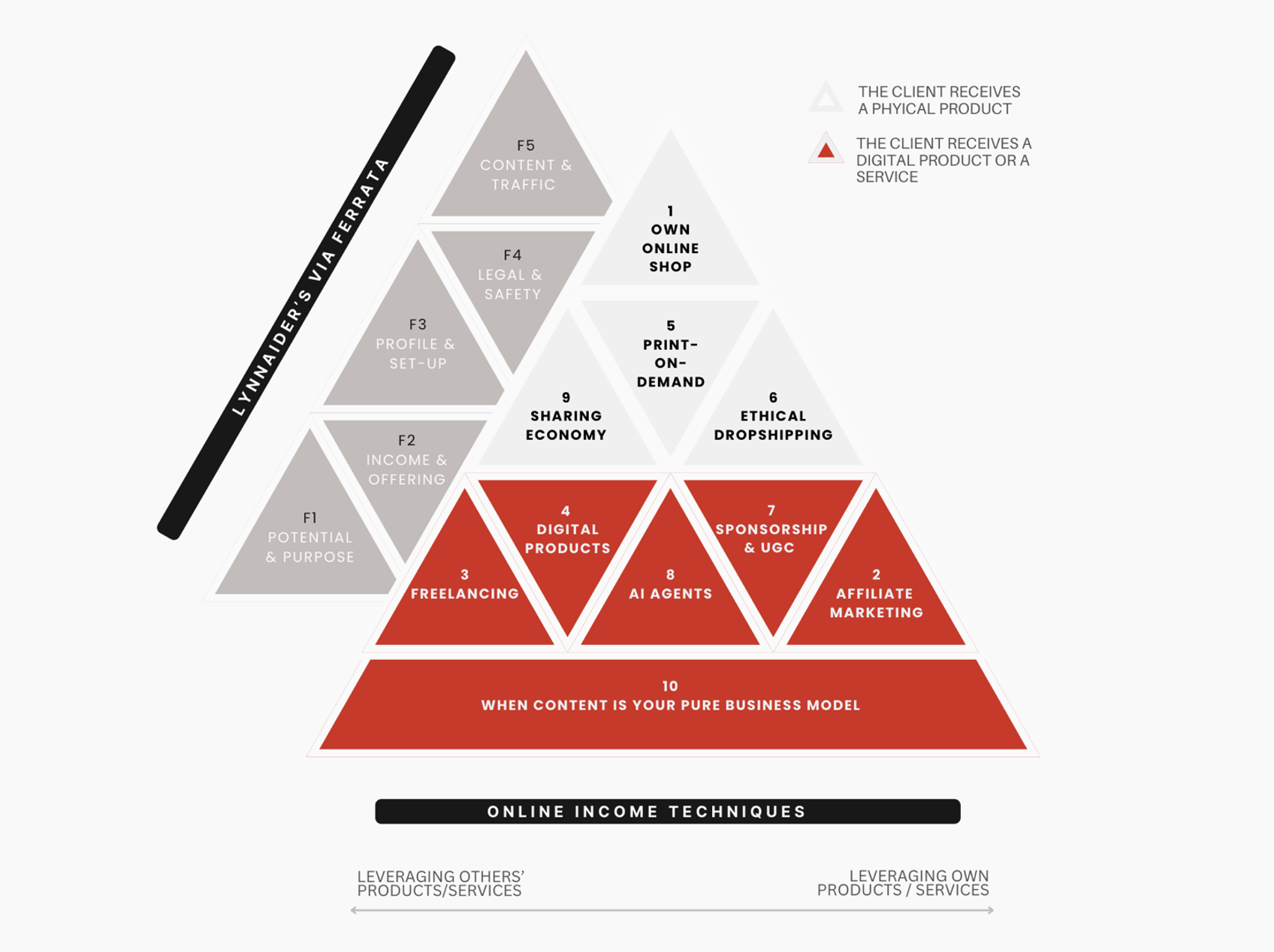
After understanding the five theory lessons, you are in a good position to begin exploring the ten online income techniques that we researched, use, and summarize in our teaching. You see them numbered from 1 to 10, the order in which we recommend you study them. This sequence does not necessarily imply ease of application, as that is determined by everyone’s preferences, ideas, and capabilities, but it does indicate an order that facilitates understanding the techniques one after the other. Of course, you can read them independently from one another. If you understand them all, however, you’ll be able to see how they can be utilized in combination, based on the same business idea you’ve identified, because on one single idea, multiple techniques can be layered.
Red vs. White
The color coding in the front mountain illustration makes it easier to grasp two groupings within the ten approaches. Those colored red (or dark grey, depending on the print) are techniques in which you are not delivering physical products, removing one such layer of responsibility from your shoulders. Those colored white, towards the peak of the front mountain, involve physical product delivery. It, however, does not mean that the white techniques are more complex than the ones below; in fact, working with physical products makes the work itself more enjoyable in the long run for many.
Own vs. Others’
Techniques are also arranged along a scale from left (“Leveraging your own products or services”) to right (“Leveraging other people’s or businesses’ products and services”). Towards the right, you have the possibility to start with promotional efforts or leveraging suppliers rather than creating products on your own. Towards the left, you would be creating and/or selling your own products and services.
Frequently asked questions
What does the red versus white colour coding mean?
Red techniques do not involve delivering a physical product to your customer, which removes one layer of operational responsibility. White techniques, closer to the mountain peak, do involve physical product delivery.
Are the white techniques harder than the red ones?
Not necessarily. In fact, working with physical products can make the work itself more enjoyable in the long run for many entrepreneurs. The choice reflects temperament more than difficulty.
What does the left-to-right axis show?
It shows whether you are leveraging your own products or services (left) or leveraging other people’s or businesses’ products and services (right). Both directions are valid.
What does “leveraging others” look like in practice?
It usually starts with promotional efforts, partnerships with suppliers, or reselling. Affiliate marketing, dropshipping, and sponsorships all sit toward the right side of the axis.
Do I have to pick one side of the framework and stick with it?
No. Many online activities combine techniques from both sides once they are running. The framework helps you begin somewhere, not commit forever.
Should I start on the left or the right?
That depends on what you already have. If you already have a product idea, the left side may fit. If you would rather promote what already exists, the right side is a natural entry point.
Disclaimer: This article is for general informational purposes only and should not be regarded as legal, tax, or business advice. Pursuing an online business does not guarantee income; results depend on many factors including the business environment, individual effort, skills, and consistency. Some links on this site may allow Lynnaider to earn a commission at no additional cost to the reader.