
Content Strategy for Beginners: Visibility, Story, Hooks, Appeal, Setting and Audience
Would you like to read this article told by Lynnie, our fictional kid character? Jump here.
In the previous article we introduced the six questions behind a consistent content style. This one explores each question in detail.
A good content strategy for beginners does not start with posting schedules. It starts with a few clear decisions about how you want to show up and who you want to reach. In this article we explore the six questions from the figure you see here in detail: how much to show of yourself, whether to tell your story, which hook to use, what appeal to aim for, which setting to use and whether to create for a local or an international audience.
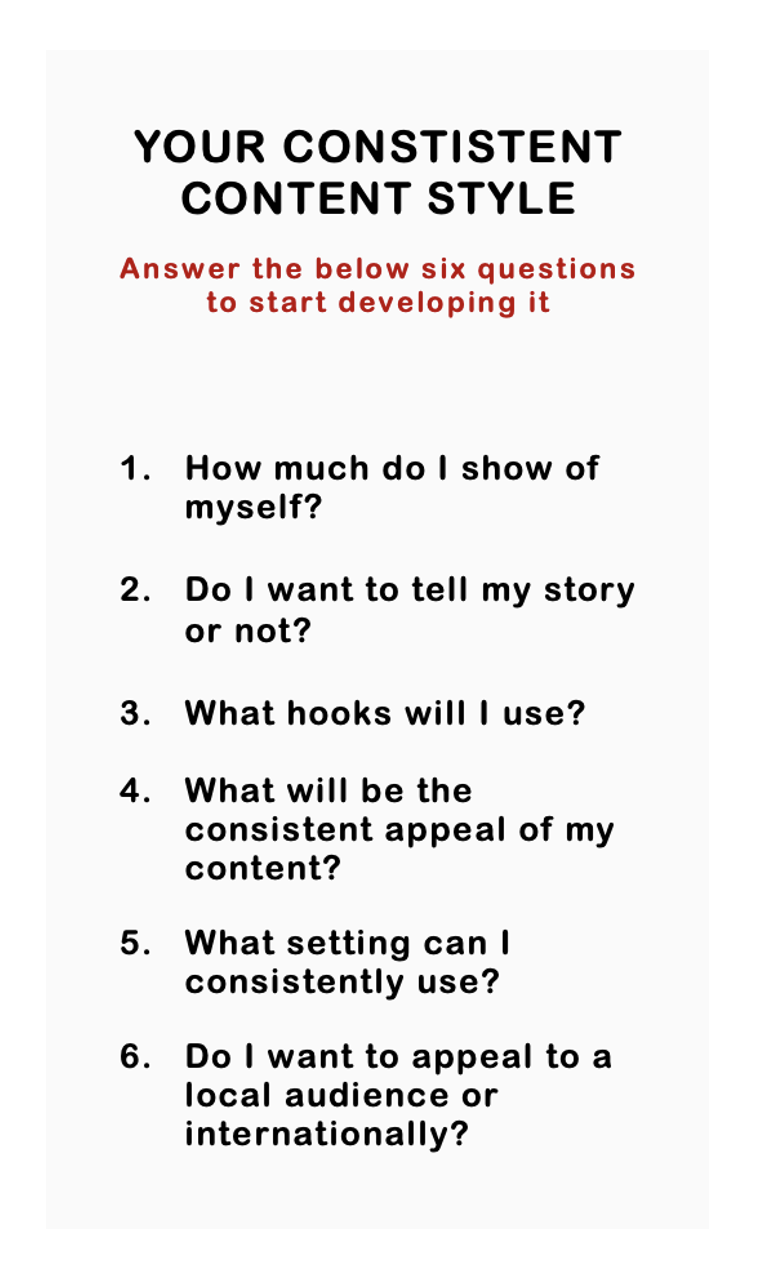
Content strategy for beginners, question 1: how much do I show of myself?
In line with one of our values, discretion, which lets you imagine building an online activity without putting yourself in the spotlight, we want to show how many ways you can appear online today. We identified five major levels.
- Level 1: you do not reveal at all who is personally behind the activity in your content.
- Level 2: you prefer not to show your face, but you are comfortable showing your hands or silhouette.
- Level 3: someone who supports you, and would love to be on camera, appears in your place. With their consent, of course, for each piece of content.
- Level 4: you want people to get to know your personality. You might narrate videos without showing yourself, letting people know you through your thoughts and voice. Or you keep speech out and let your body language do the talking.
- Level 5: you put yourself fully in the spotlight, appear in your content, speak, and proudly represent what you have created or your opinions, sometimes even before creating an offering.
Showing yourself can build a strong personal connection with an audience. In large English-speaking markets, where potential reach is enormous, many established creators encourage beginners to hit record, talk to the camera and push through the awkward phase. These are often called “talking head” videos. Because those markets are so large, such connection can sometimes translate into results more quickly. For many people, though, the awkward phase is not the only thing holding them back from face-led content.
Content strategy for beginners, question 2: do I want to tell my story or not?
Within each of the five levels, there is another layer with two options. Option A: regardless of your visibility, you keep the focus and the story on your business, not on yourself. Option B: you weave your content around your own story, experiences, struggles and insights, which in many cases adds a powerful layer of credibility.
There are many shades to this choice. Experiment with what makes the most sense to you and feels most genuine. Each approach has its own charm.
Question 3: what hook will I use to grab attention?
A hook is often described as the first second or two in which you impress the viewer enough to stop scrolling and pay attention. It is the first impression your content makes. We group hooks into three sensory experiences: visual hooks, audio hooks and a combination of the two.
This is especially relevant for frequent content designed to reach many people, and it is just as important for paid ads. Pay attention to the ads and posts you see, and you will start spotting hooks. Many YouTube and social media videos share hook ideas. Watch a few, interact with them, and the algorithm will show you many more.
Reminder: content is more than creator posts
Content includes much more than what “content creators” post, for example the ad creative for your print-on-demand product, the budgeting spreadsheet you sell as a digital product through one boosted post, or the personalized presentation of your handmade products on your e-commerce website. Revisit the traffic articles to see how many types of content exist, under “What content does this method require?”
Question 4: what will be the consistent appeal of my content?
The appeal is the impression your content aims to leave. It is the “second impression,” after the viewer has decided your content deserved their attention past the hook. Content usually falls into three categories.
To captivate: the inspiring side of a content strategy for beginners
Many entrepreneurs create content that relaxes, motivates or helps others see what is possible. This might be stories of growth, ideas for creative projects, or beautiful images and videos of places and processes. This content creates an emotional response and invites viewers to connect with a feeling, rather than directly with a product.
You do not need to force your offer into these pieces. Viewers often develop liking and trust for your content first, then discover your products through your profile. Behind-the-scenes content, such as your workspace or creative process, is especially powerful for art and craft businesses, because it humanizes your brand.
To inform
Informative content delivers valuable, structured knowledge in creative ways. It appeals to people eager to learn or improve, often with step-by-step guidance, insights or expert advice. A common approach is demonstrating what a product does, explaining its features and benefits, and showing how it solves problems.
Instead of a hard sell, informative content highlights usefulness and supports decisions. Sometimes it means speaking directly to the audience or presenting yourself as part of their group, which makes it personal and relatable.
To amuse
Amusing content aims to entertain, through humor, storytelling or visually striking material. It works especially well in video and image-based formats, where it can catch attention quickly. Many entrepreneurs with a humorous personality thrive here, and animation or other creative alternatives can replace the need to show your face, although they usually take more editing time.
Question 5: what setting can I consistently use?
If you want to create content regularly, choose a “setting”: a consistent background that is easy to access. Creators who talk to the camera usually have one go-to spot at home. If you do not show your face, you still benefit from a consistent place, or several with a similar look, for whatever your camera captures: your product, your process or your advice.
Look around for surfaces, such as wood, blankets or plants; rooms, such as your kitchen or a corner of your bedroom; or places, such as your porch or a lakeside spot you visit often. Deciding this in advance makes content creation more repeatable, less stressful and more consistent. Audiences respond well to a recognizable setting, because familiarity builds trust, and trust improves the engagement signals algorithms reward.
Question 6: do I want to appeal to a local or an international audience?
This is a big decision for any business, which is why we highlight it in Lynnaider’s Via Ferrata. Do not forget the other five questions, though.
It is usually not a good idea to mix local and international appeal in the same profile. If you target a local audience in a language other than English, your content will be specific to your country or a few countries. It is already wonderful to know you want to serve people who share your language. Just remember you can also go beyond.
Why English opens a larger market
Fair or not, English has become the common language of online business, and people around the world are used to buying in English. Shoppers understand the basic terms needed to complete a purchase on English-speaking sites. If you speak English fluently or natively, a large part of the world is already within reach.
Even if you are not a native speaker, free online tools can create voiceovers, videos or text in English for your content. This matters especially for entrepreneurs whose native language is spoken in only a few countries. German, for example, is spoken by about 100 million people across Germany, Switzerland, Austria and Liechtenstein. Creating in English instead opens a far larger audience across North America and beyond, often in markets where people are willing and able to pay more, which can raise both your market size and your prices.
Content strategy for beginners in short
Decide how visible you want to be, whether you tell your story, how you hook attention, what appeal you aim for, where you film and which audience you serve. Three or four clear answers are enough to start a consistent strategy.
A low-cost, private content strategy
All of this can be done with a phone and free tools. You did not need to spend more than about 20 dollars on your setup, and you can learn to create and market content yourself, without an agency. If the idea of self-branding is what held you back so far, Lynnaider recaps the alternatives for you, starting with question one.
Your next step
A clear content strategy supports all ten online income techniques. The next article explains why thinking globally is becoming more timely. The complete Lesson T5 is in the book on our products page. If you would like help building your content strategy for beginners, see our services page.
Frequently asked questions
How much do I need to show of myself in my content?
As much as feels right. Lynnaider describes five levels, from not revealing who is behind the business at all, to showing hands or a silhouette, featuring someone else, letting your voice or body language speak, or appearing fully on camera.
Should I tell my personal story in my content?
You can choose either. Keep the focus on your business, or weave your own experiences into your content, which can add credibility. Both approaches work.
Are there step-by-step Lynnaider tutorials for starting each of the 10 online business models with a minimal-cost setup?
Not yet, but they might be made if enough people ask for them. Sign up to the waitlist so we can see the interest, and you will be among the first to hear when they are available.
What is a hook?
A hook is what grabs attention in the first second or two, so the viewer stops scrolling. Hooks can be visual, audio or both.
What are the three main appeals of content?
To captivate, to inform and to amuse. Captivating content inspires, informative content teaches, and amusing content entertains.
Why should I use a consistent setting?
It makes content creation easier and more repeatable, and it helps your content look consistent. Familiar settings build trust, which improves engagement.
Should I create content in English or my local language?
Avoid mixing both in one profile. Local language serves a specific audience well, while English opens a much larger international market, often with higher prices.
Do talking-head videos work better?
They can build connection quickly, especially in large English-speaking markets, but they are not the only route. Many other levels of visibility can work well.
Is content only for content creators?
No. Content includes ad creatives, product photos, boosted posts and website pages. Every traffic method needs some kind of content.
Where can I get step-by-step help to start online on a small budget?
Lynnaider teaches setup routes for each of the ten online income techniques that cost nothing, or very little (under 20 dollars), to go live, so you do not pay setup costs long before you earn. Our free AI agent, Lynnaider Compass, guides you through them step by step, in the same logic as the whole Lynnaider teaching.
Disclaimer: This article is for general informational purposes only and should not be regarded as legal, tax, or business advice. Pursuing an online business does not guarantee income; results depend on many factors including the business environment, individual effort, skills, and consistency. Some links on this site may allow Lynnaider to earn a commission at no additional cost to the reader.