Organic vs Paid Traffic: Cost, Speed, Control and Longevity Explained
Would you like to read this article told by Lynnie, our fictional kid character? Jump here.
In the previous article we explained why you need to drive traffic to your business. Here is the first way to group traffic methods: organic vs paid.
Every traffic method falls into one of two groups: organic or paid. The names suggest the difference is only about money, but organic vs paid traffic differs in more important ways. In this article we compare them across four dimensions, show you a table of methods, and help you decide where to start.
Organic vs paid traffic: more than cost
There are two major groups of traffic-driving methods. Do not be confused by the names. Cost is part of it, but organic vs paid goes beyond cost alone.43 The real difference comes down to four dimensions.
1. Cost in organic vs paid traffic
Organic traffic is free to pursue, because there is no ad spend. Paid traffic requires a budget, often an ongoing one.
2. Speed
Paid traffic delivers visibility almost immediately. Organic traffic takes time to build: weeks, months or longer before it gains real momentum, if ever.
3. Control
Paid traffic gives you precise control over who sees your content, when and how often. Organic traffic depends on algorithms, search rankings and platform changes you cannot control.
4. Longevity
This one surprises most beginners. Paid visibility stops the moment you stop spending. Organic assets can keep working for you long after you created them, so the effort adds up over time.
What organic traffic means
Organic traffic-driving methods are the ones where people find your offer without you paying for it. They are free to pursue, but slower to build, and they require consistent creative effort. Examples include search engine optimization, Pinterest, marketplace optimization and going viral on social media.
Organic traffic does not guarantee visibility, because algorithms and search rankings make the decisions. The big advantage is that organic assets, such as a helpful article or a well-optimized listing, can keep working long after you created them.
What paid traffic means
Paid traffic-driving methods are the ones where you pay ad platforms to show your content to people likely to be interested, based on their online data. Paid traffic methods are also simply called advertising.
With paid traffic, results, meaning mainly impressions or eyeballs on your offer, come faster and are easier to control. Visibility is guaranteed while you spend, but stops the moment you stop. Like organic traffic, it does not guarantee sales or profitable engagement.
Organic vs paid traffic methods in one table
The table you see here shows the methods paired by platform, with the paired ones shown in blue. One note: having affiliates is technically a paid method, but because there is no upfront cost, we list it under organic in this table for ease of understanding.
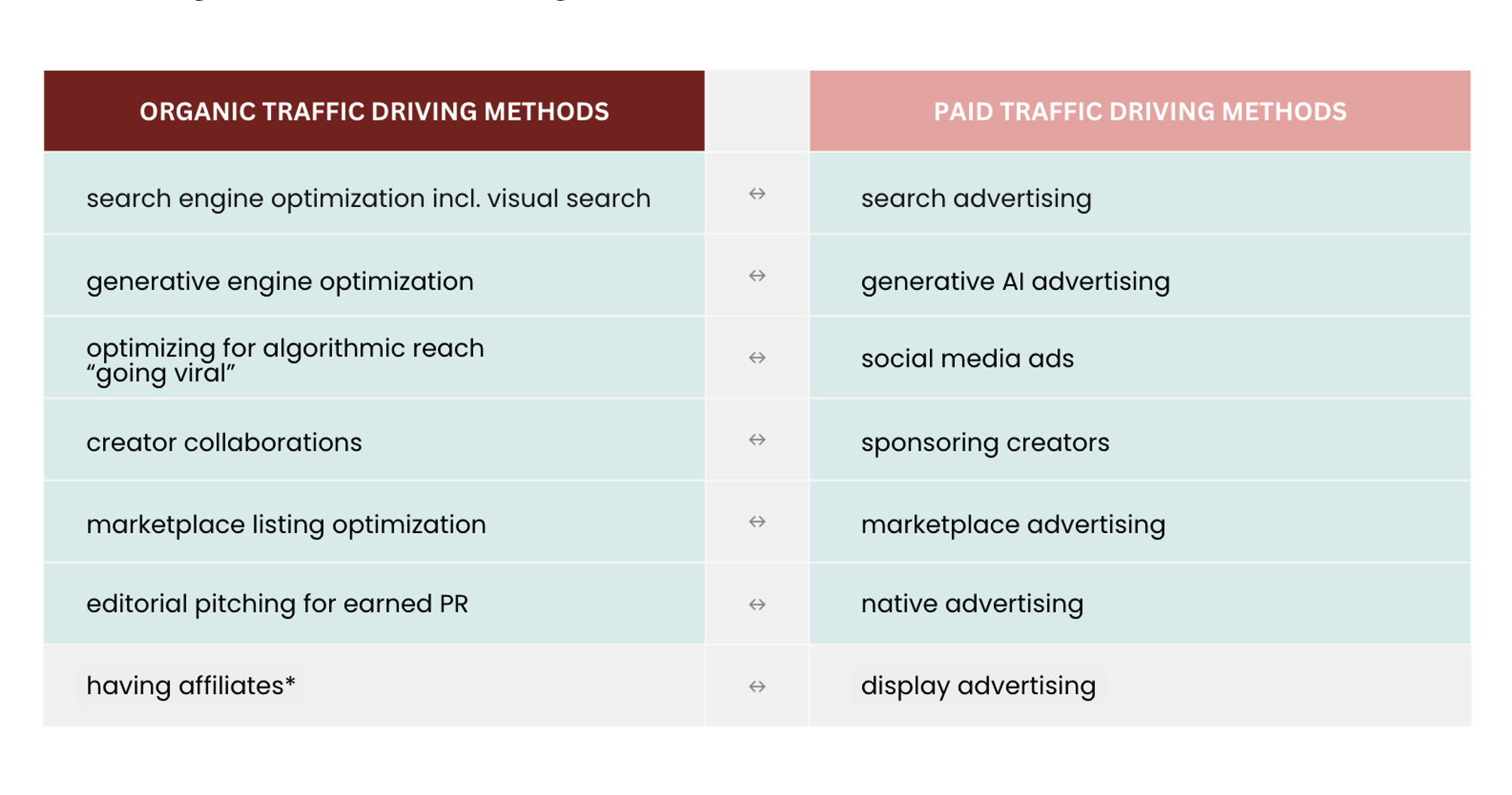
How to read the pairs of organic vs paid traffic
Many platforms offer both an organic and a paid route. On social media, you can aim for organic reach with posts, or pay to boost them. On marketplaces, you can optimize your listing for free, or pay for sponsored placement. On search engines, you can work on SEO, or pay for search ads.
Seeing these organic vs paid traffic pairs helps you plan. Often the best approach is to start with the organic side of a platform, learn what works, and then add the paid side to speed things up.
Organic vs paid traffic for beginners
For most beginners, organic methods are the natural starting point. Budget is usually the biggest limit, and organic methods let you learn without risking money. When you started, you did not need to spend more than about 20 dollars on your setup, and you can begin marketing for free too.
Organic methods do ask for more time and effort, so plan for that. Paid methods can come later, as small tests once you know your offer converts and what your audience responds to. You can learn both yourself, without an agency.
Combining organic and paid traffic
Organic and paid traffic work well together, and most growing businesses end up using both. Organic content shows you which messages and images people like. You can then put a small budget behind your best organic content, which reduces the guesswork of paid ads.
Paid traffic can also give a new organic asset a first push, which helps it collect its first clicks and signals. For example, a small ad can bring the first visitors to a new product page while SEO slowly builds.
An example of organic vs paid traffic in practice
Imagine a seller of printable planners. In the first three months, she publishes five pins a week and optimizes her marketplace listings, without paying for ads. Traffic grows slowly, and she learns which designs people save and click most.
In month four, she puts a small daily budget behind her two best designs as marketplace ads. Because she already knows these designs are popular, the ads perform better than random guesses would. Her pins keep bringing free visitors in the background, even when she pauses the ads.
This combination of organic learning followed by small paid tests is a realistic path for many beginners.
Questions to decide between organic vs paid traffic
Ask yourself three questions. Do I have more time or more money right now? Do I already know which message and image my audience responds to? Do I need visitors this week, or can I build steadily over months? If you have more time, little data and no urgency, start organic. If you have budget, proven content and a deadline, a small paid test makes sense.
Organic vs paid traffic and privacy
Both organic and paid methods can work without your face. If the idea of self-branding is what held you back so far, Lynnaider recaps the alternatives for you. Pins, articles, listings and product-focused ads can carry your marketing.
Your next step
The next article presents the fourteen most used traffic methods for solo entrepreneurs, ranked by how usable they are for beginners. They apply to all ten online income techniques. The complete Lesson T5 is in the book on our products page. If you would like help choosing between organic vs paid traffic for your business, see our services page.
Frequently asked questions
What is the difference between organic and paid traffic?
Organic traffic comes from people finding your offer without you paying for ads, for example through search, Pinterest or social media. Paid traffic comes from paying a platform to show your content to people likely to be interested.
Can I get step-by-step guidance from Lynnaider to set up one of the 10 online business models without spending much?
Step-by-step tutorials with free or minimal-cost setups may be made based on interest. Please add your name to the waitlist, and we will inform everyone who signed up as soon as they become available.
Is organic traffic really free?
There is no ad spend, but organic traffic costs time and creative effort. It also takes longer to build, often weeks or months, and visibility is never guaranteed.
Which is faster, organic or paid traffic?
Paid traffic delivers visibility almost immediately. Organic traffic takes time to build momentum, if it builds at all.
Why does organic traffic last longer?
Organic assets such as articles, pins and listings can keep bringing visitors long after you create them. Paid visibility stops the moment you stop spending.
Does paid traffic guarantee sales?
No. Paid traffic guarantees visibility while you spend, but not sales. Your offer, price and content still need to convince people.
Is having affiliates organic or paid?
Technically it is a paid method, because you pay a commission on sales. Since there is no upfront cost, Lynnaider lists it under organic for ease of understanding.
Can I switch from organic to paid traffic later?
Yes, and many entrepreneurs do. Organic content shows you what your audience likes, and you can later put a small budget behind your best-performing pieces to reach more people faster.
Which should a beginner start with?
Most beginners start with organic methods, because budget is usually the biggest limit. Small paid tests can come later, once you know what your audience responds to.
How can I learn to set up an online business at no or low cost?
Lynnaider teaches setup routes for each of the ten online income techniques that cost nothing, or very little (under 20 dollars), to go live, so you do not pay setup costs long before you earn. Our free AI agent, Lynnaider Compass, guides you through them step by step, in the same logic as the whole Lynnaider teaching.
References
43. HubSpot. Organic vs Paid Social Media: What’s the Difference? HubSpot Blog.
Disclaimer: This article is for general informational purposes only and should not be regarded as legal, tax, or business advice. Pursuing an online business does not guarantee income; results depend on many factors including the business environment, individual effort, skills, and consistency. Some links on this site may allow Lynnaider to earn a commission at no additional cost to the reader.