
Online Business Models Compared: What Each of the 10 Techniques Delivers
Would you like to read this article told by Lynnie, our fictional kid character? Jump here.
In the previous article we explained the four types of offerings. Here we show which one each of the ten business models delivers.
When online business models are compared, people usually look at income potential. A more useful comparison is what each model actually delivers to the customer. In this article we go through the ten online income techniques one by one, and show which of the four offering types each one delivers.
What is the offering, technique by technique?
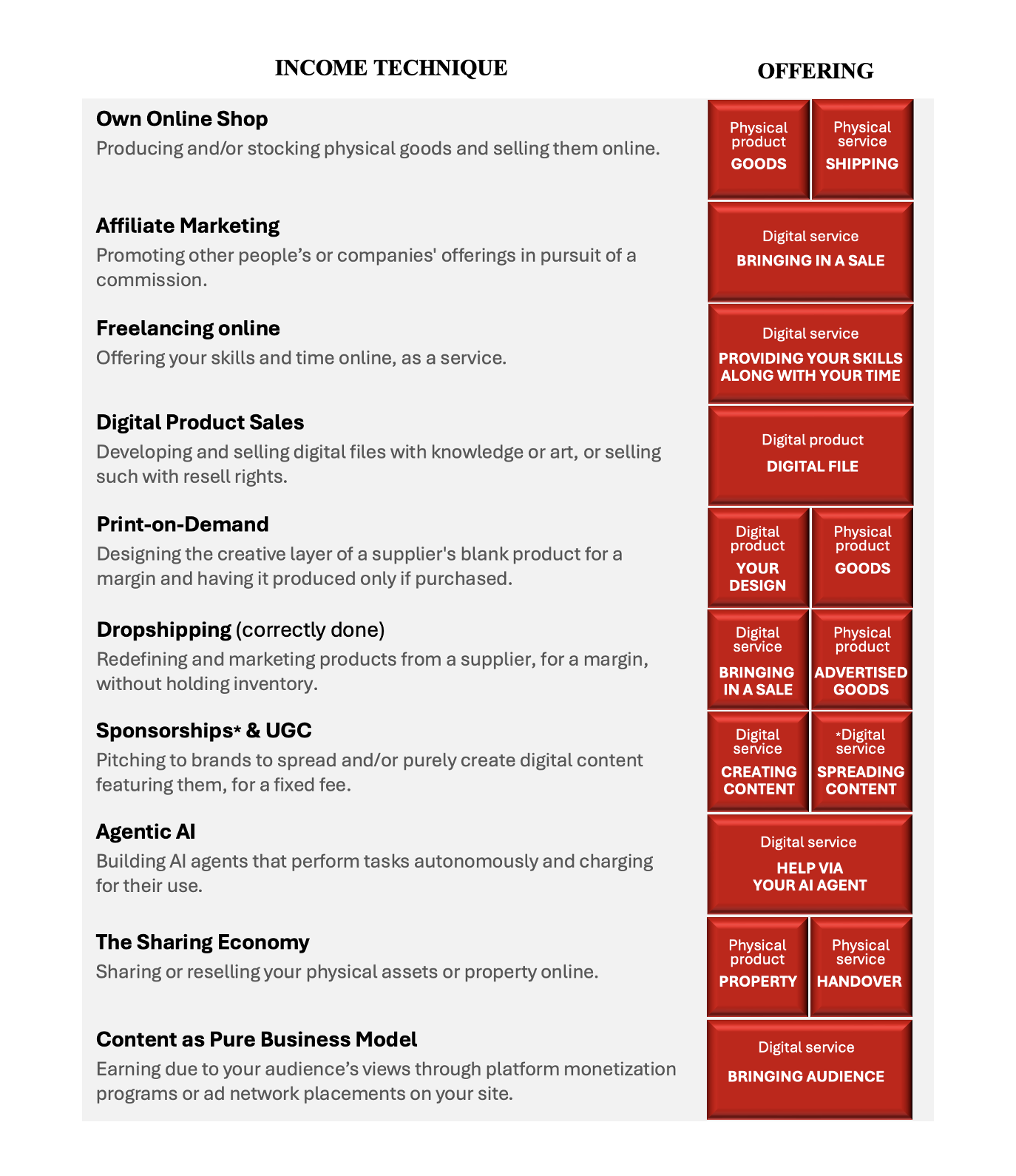
Looking across the ten business models in the table you see here, you will notice something important. Most of what online entrepreneurs actually deliver falls into the digital category. This is one reason online business has become accessible to so many people.
Online business models that deliver a digital service
Several techniques have a digital service as their core offering, although the nature of that service varies widely.
Affiliate marketing
In affiliate marketing, what you deliver is essentially the act of bringing a sale to someone else’s business. Your output is a transaction started through your influence. The brand pays you a commission for it.
Freelancing online
Freelancing works in a similar way, in that you deliver a skill remotely. It could be writing, design, translation or consulting. Here, the offering is your time and expertise directly, and you provide it to the final client.
Sponsorships and UGC
Sponsorships and UGC split into two related digital services. One is creating content on behalf of a brand, and the other is spreading it to your audience. Even though your content speaks to your audience, they are not the ones who pay you. The brand pays you, which is why the service you provide is for the brand.
Agentic AI
Agentic AI is one of the newer income techniques. It is a digital service in which an automated system you have built does the work for the client. You design the agent once, and it keeps working on tasks for the people who pay to use it.
Content as a business model
Content as a pure business model is perhaps the most intangible of all. It delivers an audience’s attention as its service. The platform or advertiser is effectively buying access to the people you have gathered.
Online business models that deliver a digital product
The purely digital product techniques are those where what you sell can be downloaded or accessed independently of your time.
Digital product sales
Digital product sales is the clearest example. The offering is a digital file: a template, an e-book or a piece of digital art. You create it once, and customers can buy and download it at any time.
Hybrid online business models
Print-on-demand
Print-on-demand is a hybrid. Your contribution is a digital product, your design, which you give to the supplier partner. The end customer, however, receives a physical product.
Dropshipping
Dropshipping, when done well, is also a hybrid. You provide a digital service, because you are the one who redefines, markets and sells the product. You must also make sure that the partner supplier delivers a physical product to the end customer.
Online business models with physical offerings
Own online shop (e-commerce)
Physical offerings appear in an own online shop, also called e-commerce. You produce or stock real goods, and you handle their shipping as part of the service.
Sharing economy
In the sharing economy, what you make available is physical property: a space, a vehicle or another asset. The hand-over or shipping is a physical service you must also provide.
Online business models compared by operational complexity
The physical techniques tend to carry the highest operational complexity for an online entrepreneur. Stock, packaging, shipping and returns all take time and planning. This is worth keeping in mind as you decide which type of offering fits your starting point.
Higher complexity does not mean the physical techniques are more difficult in a meaningful sense. For many entrepreneurs, it is exactly the tangible side that makes the work enjoyable and sustainable over the long run. Some people simply love holding and packing their products.
How to use this comparison
Start by deciding which offering type appeals to you most. Then look at the techniques that deliver it. If you love creating files, digital product sales or print-on-demand may suit you. If you prefer working with people, freelancing or sponsorships might be a better fit.
Online business models compared for combining
Also consider combining techniques around one idea. A person who designs illustrations could sell digital prints, offer print-on-demand products and take freelance commissions. The same skill feeds three income sources.
Who pays you in each model?
Another useful way to compare online business models is to ask who pays you. In freelancing, digital products, an own shop and the sharing economy, the end customer pays you directly. In affiliate marketing, the brand pays you a commission when a customer buys.
In sponsorships, the brand pays you a fixed fee for content. In content as a business model, the platform or ad network pays you for attention. In print-on-demand and dropshipping, the customer pays you, and you pay the supplier their share.
Knowing who pays you helps you understand where your responsibilities lie. It also shows you which partner agreements you will need to set up.
Online business models compared by setup costs
The digital techniques are usually the cheapest to start. Still, almost all ten can be started with very little. When you are just starting out, you do not need to spend more than about 20 dollars on your setup, thanks to free routes and small one-time fees.
Monthly fees before anyone knows about your business are not necessary. Set up for free, learn to drive traffic yourself without an agency, and invest more once visitors arrive.
Comparing who handles customer service
Customer service also differs between models. On marketplaces, the platform often handles part of it. In freelancing and your own shop, you handle it directly. In affiliate marketing, the brand handles the customer after the sale, which takes a lot off your plate.
Online business models compared by time per sale
Each model also differs in how much of your time each sale takes. Freelancing and physical services need your time for every client. Digital products, print-on-demand and affiliate links need time up front, but very little per sale afterward.
Own shops and dropshipping sit in between, because each order needs some handling or customer contact. Knowing this helps you choose a model that fits the hours you have.
Comparing visibility
None of these online business models requires you to show your face. Even sponsorships and content can be faceless, through product-focused or voiceover content. If the idea of self-branding is what held you back so far, Lynnaider recaps the alternatives for you.
Your next step
The next article explains the engines that make all these online income systems possible: automation and AI. The full comparison of all ten online business models is in the book on our products page. For personal help choosing, see our services page.
Frequently asked questions
Which category of offering is most common online?
Digital, both product and service. Across the ten techniques, most of what solo entrepreneurs deliver falls into digital offerings, which is one reason online business is now more accessible than ever.
Is affiliate marketing a product or a service?
It is a digital service. What you deliver to the brand is the act of bringing them a trackable sale through your content or influence, not a product of your own.
What kind of offering is print-on-demand?
It is hybrid. Your contribution is a digital design shared with a supplier, but the end customer receives a physical product produced only when they buy.
Is content itself an offering?
In audience monetisation, effectively yes. The offering is the attention of the audience you have gathered, sold to platforms or advertisers through their monetisation programs.
Why does dropshipping count as both a service and a product?
Because you provide the digital service of redefining, marketing, and selling the product, while your supplier delivers a physical product to the buyer you brought.
Which techniques carry the most operational complexity?
The ones involving physical goods, such as Own Online Shop and Sharing Economy, because they require handling delivery. That complexity does not make them harder in a meaningful sense, only more logistically involved.
How can I learn to set up an online business at no or low cost?
Lynnaider teaches setup routes for each of the ten online income techniques that cost nothing, or very little (under 20 dollars), to go live, so you do not pay setup costs long before you earn. Our free AI agent, Lynnaider Compass, guides you through them step by step, in the same logic as the whole Lynnaider teaching.
Will Lynnaider publish step-by-step tutorials for setting up the 10 online business models for free or at a very low cost?
They may be created depending on how much interest there is. Please join the waitlist to show that you are interested, and we will let you know as soon as they are ready.
Disclaimer: This article is for general informational purposes only and should not be regarded as legal, tax, or business advice. Pursuing an online business does not guarantee income; results depend on many factors including the business environment, individual effort, skills, and consistency. Some links on this site may allow Lynnaider to earn a commission at no additional cost to the reader.