
Affiliate Marketing Examples: 5 Faceless and Niche Creators
Would you like to read this article told by Lynnie, our fictional kid character? Jump here.
With the Own Online Shop module complete, ending with online shop setup, we move to the second online income technique, affiliate marketing, starting with five example characters.
Affiliate marketing is the second of Lynnaider’s ten online income techniques. Before we explain how it works, let us look at it in action. In this article, we introduce five example characters who each earn through affiliate links.
These affiliate marketing examples are fictional, but each one is based on patterns we see in real creators. Notice how each has a clear niche and a unique take. Also notice how many of them never show their face.
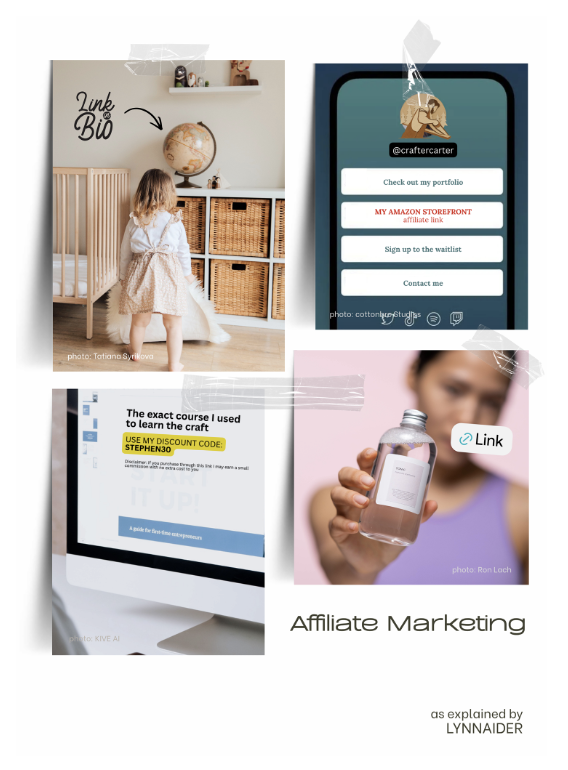
The characters in this article are invented and shown for educational purposes only.
What the affiliate marketing examples have in common
Affiliate marketing means promoting other companies’ products or services in exchange for a commission. All five characters create content regularly in a specific niche. Within that content, they share affiliate links to products that fit.
What differs is their platform, their style and where their links live.
Look at each example with three questions in mind. What is their niche? What is their unique take? Where do people find their links?
Five affiliate marketing examples from different niches
Dan the Language Learner, the first of our affiliate marketing examples
Dan is on a quest to master English, with the help of his best friend, who is a native speaker. Appearing on camera every day stressed him out, so he puts their AI avatars to work instead. The avatars compare how each of them would translate a phrase.
His take on language learning became exactly that: a relatable, useful comparison format. In his link-in-bio, he shares affiliate links for the language apps he uses. His audience trusts the recommendations because they watch him learn with those apps.
Agathe the Minimalist
Agathe is on a personal journey to declutter her life and embrace minimalism. Her take focuses on practical solutions for people who are new to simplifying their lifestyle. All her posts stand out with sharp, popping colors.
She runs a Pinterest account full of pins about minimalist home decor and eco-friendly living. Her pins link to affiliate products like organizers and storage solutions. Pinterest suits her well, because people use it to plan and search for ideas, as we explain in our article on Pinterest visual search.
Jonathan the Software Developer
Jonathan shares his expertise anonymously by creating tutorial videos that explain complex coding concepts for absolute beginners. He uses AI text-to-speech, so his approach is completely faceless. His audience values clarity more than personality.
On YouTube, he includes affiliate links for coding courses and software under his videos. This makes it easy for fellow coders to find the right tools. His tutorials keep bringing viewers for months, because people search for them.
Dennis the Sneaker Dancer
Dennis has a passion for sneakers and streetwear, built over years of collecting and trading. His take: honest reviews of underrated brands, with music from the 80s playing in the background. He writes anonymous blog posts reviewing new releases and comparing how different sneakers fit.
His affiliate links lead to shoe retailers and streetwear stores. Because his reviews are honest, readers trust his recommendations. A blog also helps him get found through search engines.
Cassy the Indigenous Foodie
Cassy grew up in a native family, brought up on unprocessed, healthy food, and gradually mastered her community’s cuisine. She documents her cooking in exclusive slow-motion snippets that capture the beauty of traditional food. Her visual style almost lets you taste it.
She uses this style to invite viewers to her link-in-bio. There, they find affiliate links on Amazon for ingredients and books. Her content celebrates her culture, and her links help viewers try it themselves.
What these affiliate marketing examples teach beginners
First, each character has a clear niche: language learning, minimalism, coding, sneakers or traditional food. A clear niche tells both people and algorithms what to expect. It also makes it easier to choose which products to recommend.
Second, each one has a unique take. A comparison format, popping colors, faceless tutorials, 80s music or slow-motion food shots. The take is what makes people remember them among thousands of similar creators.
Third, their content comes first and their links come second. People follow them to learn, be inspired or be entertained. The affiliate links are a helpful extra, never the main reason to watch.
Which platforms the affiliate marketing examples use
The five characters spread across very different platforms. Dan and Cassy use short-video platforms with a link-in-bio page. Agathe uses Pinterest, Jonathan uses YouTube and Dennis uses a blog.
Pinterest, YouTube and blogs share one strength: people search on them. A good pin, video or article can bring visitors for months or even years. Short-video platforms reach many people quickly, but each post fades faster, so they need more frequent posting.
Choose the platform where your niche audience already spends time. Then check that your affiliate program allows links there, since some programs set rules for certain platforms.
Faceless affiliate marketing examples
Four of the five characters do not show their face. Dan uses AI avatars, Jonathan uses text-to-speech, Dennis writes anonymously, and Cassy shows only her cooking. Agathe’s pins focus on rooms and objects.
This shows that affiliate marketing works well for people who value their privacy. If the idea of self-branding is what held you back so far, Lynnaider recaps the alternatives for you.
Affiliate marketing examples you can adapt
You do not need to copy any of these characters. Instead, write your own version in three lines. “My niche is … My unique take is … My links live on …”.
If you can fill in all three, you have the outline of your own affiliate activity. Then check that you can create content in that niche regularly, since affiliate marketing depends on frequent posting.
Starting small and doing your own marketing
Joining most affiliate programs is free, and a link-in-bio page or a free blog costs little. We recommend spending no more than about 20 dollars on your setup, with no monthly fees before you have traffic. You can learn to create the content that brings that traffic yourself, without an agency.
Your next step
The next article explains how affiliate marketing works for beginners: tracking, the last click rule and why organic traffic is so central. The complete module is in the book on our products page. If you would like help planning your own affiliate activity, see our services page.
Frequently asked questions
What is affiliate marketing?
Promoting other companies’ products or services in exchange for a commission. You earn a percentage of the sales that result directly from your referral.
Are these affiliate marketing examples real people?
They are fictional characters based on patterns we see in real creators. They show how the technique works across different niches and platforms.
Are there step-by-step Lynnaider tutorials for starting each of the 10 online business models with a minimal-cost setup?
Not yet, but they might be made if enough people ask for them. Sign up to the waitlist so we can see the interest, and you will be among the first to hear when they are available.
Can I do affiliate marketing without showing my face?
Yes. Several of the examples use AI avatars, text-to-speech, anonymous blog posts or close-up videos. Faceless affiliate marketing is very common.
Where do affiliate marketers place their links?
In a link-in-bio page, under YouTube videos, on Pinterest pins, in blog posts or in newsletters, depending on the platform and the program’s rules.
What is a unique take in affiliate marketing?
It is the specific angle that makes your content different within your niche, such as a comparison format, a visual style or a focus on underrated brands.
Which platforms work well for affiliate marketing?
Pinterest, YouTube, blogs and short-video platforms all work. The best one depends on where your niche audience spends time and on the program’s rules.
Do I need to be an expert to become an affiliate?
You need to be credible in your niche. That can come from experience, passion or simply documenting your own learning journey honestly.
Can I use Amazon for affiliate links?
Yes. Amazon’s program, Amazon Associates, is a common starting point because of its wide product range and high consumer trust, although commissions are relatively low.
Is there a low-cost way to set up the Affiliate Marketing technique?
Yes. Lynnaider teaches setup routes for the Affiliate Marketing technique that cost nothing, or very little (under 20 dollars), to go live, so you do not pay setup costs long before you earn. Our free AI agent, Lynnaider Compass, guides you through them step by step, in the same logic as the whole Lynnaider teaching.
Disclaimer: This article is for general informational purposes only and should not be regarded as legal, tax, or business advice. Pursuing an online business does not guarantee income; results depend on many factors including the business environment, individual effort, skills, and consistency. Some links on this site may allow Lynnaider to earn a commission at no additional cost to the reader.