
Affiliate Link Tracking: Cookies, Server-Side Tracking and the Last Click Rule
Would you like to read this article told by Lynnie, our fictional kid character? Jump here.
Now that you know how affiliate marketing works, this article looks closer at how your links are tracked.
In affiliate marketing, you only earn if a sale can be traced back to you. That makes tracking the backbone of the whole technique. In this article, we explain affiliate link tracking in simple words: cookies, server-side tracking, the last click rule and affiliate codes.
We look at this from the affiliate’s side. If you sell your own products and want to set up tracking for your affiliates, our article on affiliate tracking covers the merchant’s side.
Affiliate link tracking with cookies: the client-side method
In the past, tracking was almost always done on the client side. When a visitor clicked an affiliate link, a cookie was placed in their browser. The cookie remembered that the visitor came from you.
These cookies work invisibly in the background, and many affiliate programs still use them. If the visitor buys within a set number of days, the cookie tells the brand to credit you. That number of days is called the cookie duration.
The weak points of cookie-based affiliate link tracking
Cookies live in one browser on one device. If someone clicks your link on their phone and buys later on their laptop, the sale is often not linked to you. Ad blockers and browser privacy settings can also delete or block cookies.
Cookies also expire. If the cookie duration is 24 hours and the visitor buys two days later, you receive nothing.
Server-side affiliate link tracking
Today, many modern affiliate apps also support server-side tracking, which is often more reliable. Here, data is exchanged directly between servers. It no longer depends on tracking the viewer’s behavior in their browser.
You can see the comparison in the figure you see here.
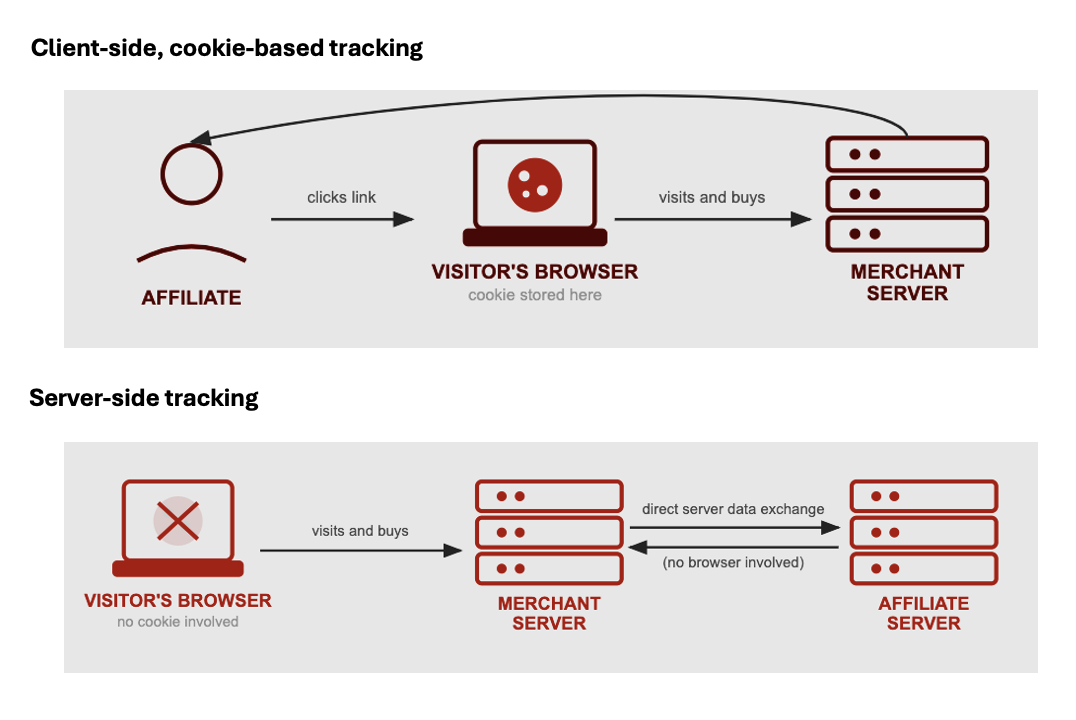
Traditional cookie-based tracking has therefore been supplemented by server-side attribution. It is more resilient to ad blockers and browser restrictions. For you as an affiliate, this usually means fewer lost sales.
Commissions are never guaranteed
Even with good tracking, commissions are never guaranteed. Cookie duration, device switching, user behavior and last click rules all affect the outcome. Expect that some of the sales you inspire will not be credited to you.
The last click rule in affiliate link tracking
Affiliate links are most often tracked using the so-called last click principle. Imagine a customer clicks your link, then later clicks another affiliate’s link for the same shop before buying. The other affiliate receives the commission, not you.
The commission always goes to the last referrer before the sale. Statistically, this will happen a portion of the time. Since the process is automated, what matters is your overall result over many sales.
What the last click rule means for your content
Content that people see shortly before deciding tends to win the last click. Reviews, comparisons, tutorials and “best of” lists are typical examples. General inspiration content still matters, because it builds your audience, but it may earn fewer direct commissions.
Affiliate codes: the alternative to links
If you want to be sure you are credited for every sale you bring, you can promote with affiliate codes instead of links. Codes work like coupons assigned only to you. Any sale using your code is always attributed to you.
The trade-off is that codes require the customer to take an extra manual step. They must remember and type the code at checkout. That is why tracking cannot happen as automatically as with links.
When codes work best
- In podcasts and spoken videos, where clicking a link is not easy.
- When your audience often buys days after seeing your content.
- When you work with a brand that offers your audience a discount through your code.
Many affiliates use both: a link for convenience and a code as a backup. Ask your program whether it offers both.
Affiliate link tracking: a quick comparison
| Method | How it works | Strength | Weakness |
|---|---|---|---|
| Cookies (client-side) | A file in the visitor’s browser remembers your referral | Automatic and widely used | Lost with device switching, blockers or expiry |
| Server-side tracking | Servers exchange the referral data directly | More reliable, resists blockers | Depends on the program supporting it |
| Affiliate codes | The customer enters your personal code | Always credited to you | Needs an extra manual step |
How to choose programs with good affiliate link tracking
Before you join a program, look at three things. First, the cookie duration: 30, 60 or 90 days gives you more chance than 24 hours. Second, whether the program offers server-side tracking or codes.
Third, check how and when the program shows your clicks and sales in its dashboard. Clear reporting lets you see which content actually earns. We explain how to compare programs in more detail in our article on choosing affiliate programs.
Starting small and staying private
Tracking works the same whether you show your face or not. If the idea of self-branding is what held you back so far, Lynnaider recaps the alternatives for you. We also recommend spending no more than about 20 dollars on your setup, with no monthly fees before you have traffic, and doing your own marketing without an agency.
How to check your affiliate link tracking
Before you share a new link widely, test it. Click it yourself in a private browser window and check that it leads to the right product. Then look in your program’s dashboard to see whether the click was recorded.
Check your dashboard regularly afterwards. If you see many clicks but no sales for a long time, the product, the page or the tracking may have a problem. Contact the program’s support if numbers look wrong.
Affiliate link tracking and your website’s privacy policy
If you send affiliate traffic through your own website, your site may set cookies too. Mention this in your privacy policy and, depending on your market’s rules, in a cookie banner. Our article on website cookies explains the basics.
Your next step
The next article explains where to post affiliate links: on your own website or on social media, and why marketplaces usually do not allow them. The complete module, alongside the other online income techniques, is in the book on our products page. If you would like help choosing programs with reliable tracking, see our services page.
Frequently asked questions
How are affiliate links tracked?
Either client-side, with cookies stored in the visitor’s browser after the click, or server-side, where the data is exchanged directly between servers.
What is server-side tracking?
A tracking method where the referral is recorded between servers instead of in the visitor’s browser. It is more resilient to ad blockers and browser restrictions.
Are affiliate commissions guaranteed if someone clicks my link?
No. Cookie duration, device switching, user behavior and last click rules all affect whether a sale is credited to you.
What is the last click rule in affiliate marketing?
If a customer clicks your link but later clicks another affiliate’s link before buying, the other affiliate gets the commission. The last referrer before the sale wins.
What is the difference between affiliate links and codes?
Links track automatically when clicked. Codes work like personal coupons: any sale using your code is credited to you, but the customer must enter it manually.
When should I use an affiliate code instead of a link?
When you want certainty that every sale you bring is credited to you, or when your content format makes clicking hard, such as podcasts or spoken videos.
What is cookie duration?
The number of days a cookie remembers your referral after the click. If the visitor buys after that period, you are not credited.
Can I get step-by-step guidance from Lynnaider to set up one of the 10 online business models without spending much?
Step-by-step tutorials with free or minimal-cost setups may be made based on interest. Please add your name to the waitlist, and we will inform everyone who signed up as soon as they become available.
What happens if a customer switches devices?
With cookie-based tracking, a click on a phone followed by a purchase on a laptop is often not linked to you, because the cookie sits only in the phone’s browser.
Can I start with the Affiliate Marketing technique at no or low cost?
Yes. Lynnaider teaches setup routes for the Affiliate Marketing technique that cost nothing, or very little (under 20 dollars), to go live, so you do not pay setup costs long before you earn. Our free AI agent, Lynnaider Compass, guides you through them step by step, in the same logic as the whole Lynnaider teaching.
Disclaimer: This article is for general informational purposes only and should not be regarded as legal, tax, or business advice. Pursuing an online business does not guarantee income; results depend on many factors including the business environment, individual effort, skills, and consistency. Some links on this site may allow Lynnaider to earn a commission at no additional cost to the reader.