
Audience Monetization Examples: 5 Creators Paid for the Attention They Earn
Would you like to read this article told by Lynnie, our fictional kid character? Jump here.
With the sharing economy module complete, ending with sharing economy setup, we move to the tenth online income technique, content as your core business model, starting with five example characters.
Content as your core business model is the tenth and last of Lynnaider’s ten online income techniques. It is also called audience monetization. In this article, we introduce five creators who earn directly from the attention their content attracts.
These audience monetization examples have one thing in common: none of them sells a product. They earn because people watch, read and stay.
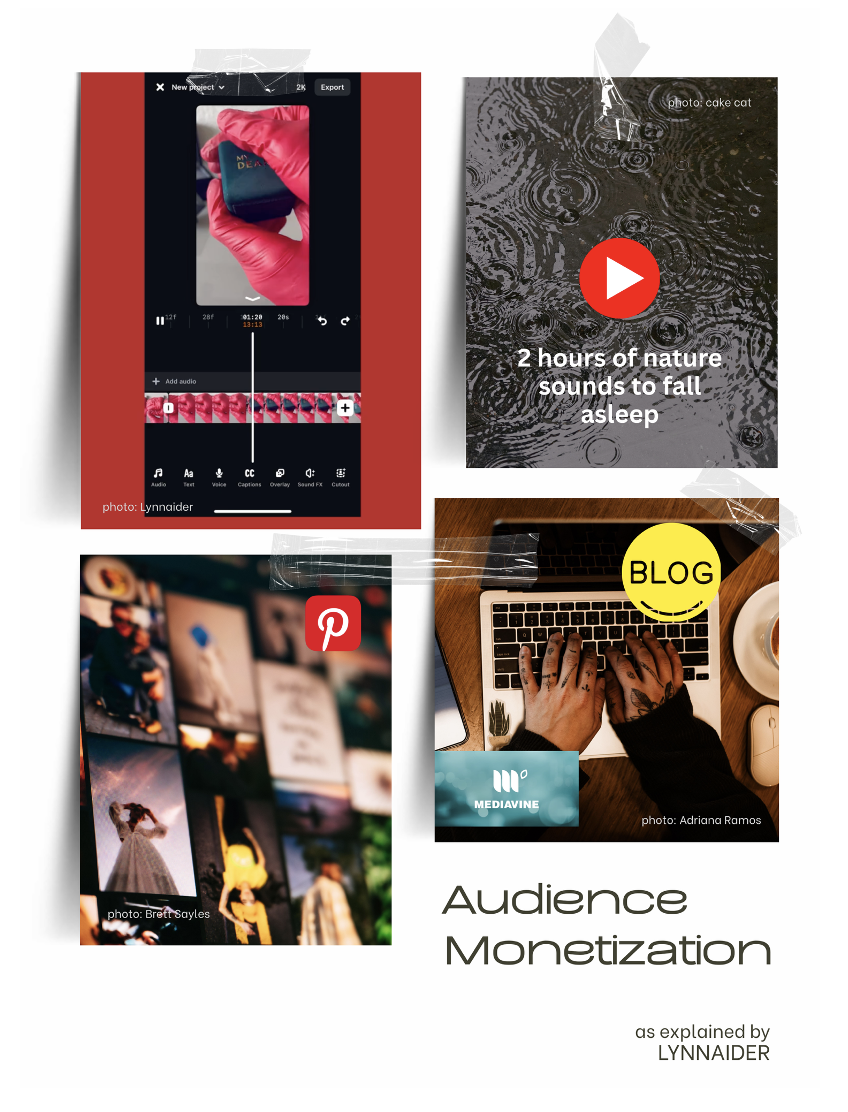
The characters in this article are invented and shown for educational purposes only. The real platforms and programs mentioned serve as illustrations and have no connection to these characters.
What the audience monetization examples have in common
Audience monetization means earning directly from your content, through platform monetization programs or ad networks on your website. Each creator below first built an audience, then qualified for a program. Each earns from ads shown around their content.
Look at each example with three questions in mind. Where do they publish? How did they grow? Which program pays them?
Five audience monetization examples
Nadia the Recipe Blogger, the first of our audience monetization examples
Nadia started a food blog three years ago, publishing two to three budget-friendly Mediterranean recipes per week. She grew her monthly traffic steadily through SEO-optimized posts and Pinterest. After reaching 55,000 monthly sessions, she applied to Mediavine and was accepted.
Her blog now earns passively through display ads while she keeps publishing.
Leon the YouTube Educator
Leon is a high school teacher who started making short history explainer videos on YouTube in his spare time. After two years of consistent uploads, he crossed 1,000 subscribers and 4,000 watch hours and joined the YouTube Partner Program. His channel now earns ad revenue on every video.
He does not sell anything; he earns from his audience’s attention. His videos keep earning long after publication, since search brings new viewers.
Zoe the TikTok Creator
Zoe is passionate about timeless fashion pieces, which together form her “All-timers Wardrobe.” She looks for very close alternatives to high-priced pieces, so her audience can get the timeless look at any budget. She posts short videos several times a week showing the piece and its alternatives.
After reaching TikTok’s follower and view requirements, she joined the Creator Rewards Program, from which she now earns.
Ben the Travel Writer
Ben spent years working abroad and decided to document destinations in long-form blog articles with his own photography. He grew his traffic by focusing on niche destinations that larger travel sites ignored. He first qualified for Ezoic, then for Mediavine as his traffic grew.
He now earns from ads on every article view. His best articles keep bringing in readers, and income, years after publication.
Gemma the Laughing Anyway
Gemma did not set out to build an audience. She started posting on Facebook during a difficult period in her life, because filming herself laughing helped. Her format is loose: sometimes a reaction over a funny post she found, sometimes her own spin on a trend, openly anxious and always a little chaotic.
Her audience grew because people recognized themselves in her. After reaching Meta’s eligibility requirements, she joined Meta’s content monetization program.
What these audience monetization examples teach beginners
First, consistency comes before income. Nadia published for three years and Leon for two before earning. Every program requires a minimum audience, and there is no shortcut.
Second, search-driven content keeps earning. Nadia’s and Ben’s blogs and Leon’s videos are found long after they are published. Third, authenticity attracts audiences, as Gemma’s story shows.
Blogs vs social media in the audience monetization examples
Nadia and Ben earn through ad networks on their own websites. Leon, Zoe and Gemma earn through platform programs on YouTube, TikTok and Facebook. Both routes work, with different requirements and earnings.
We compare them in our article on website or social media for monetization.
Common mistakes in audience monetization
The first mistake is expecting quick income. Building toward the thresholds takes time. The second is buying followers or views, which is forbidden by every major program and can get you banned.
The third mistake is changing topics constantly, which makes it hard for an audience to form.
Audience monetization examples you can adapt
Write your own version in three lines. “I would publish … about … on …”. Then ask yourself whether you could keep doing it for two years, even before earning.
Niches in the audience monetization examples
Notice the niches: budget Mediterranean food, history, timeless fashion, niche travel and humor. Some, like food and travel, attract advertisers who pay well. Others grow through strong emotion or entertainment.
A clear niche helps both people and algorithms understand what you offer. It also makes ad networks more interested in your audience.
Combining audience monetization with other techniques
Many creators like these later add other techniques. Nadia could sell a recipe e-book, Leon could offer study guides, and Zoe could add affiliate links to the alternatives she shows. Combining techniques spreads income across several sources.
What these creators did before qualifying
Before reaching their programs’ thresholds, each creator published consistently for months or years without ad income. They used that time to find their style and learn what their audience liked. That learning made their later content stronger.
If you start this technique, plan for this build-up period from the beginning.
Lessons for your own start
Choose a topic you can talk about for years, pick one platform, and publish on a fixed schedule. Track your numbers monthly and learn from your best-performing content.
Be patient: the examples above all spent long periods building before earning.
Starting small and staying private
Audience monetization needs no product and almost no setup budget. We recommend spending no more than about 20 dollars at the start, for example on a domain name, with no monthly fees before you have traffic. You build the audience yourself, with organic content, without an agency.
Many successful channels and blogs never show their creator’s face. If the idea of self-branding is what held you back so far, Lynnaider recaps the alternatives for you.
Your next step
The next article explains audience monetization in detail: content as your core business model, and why organic growth is required. The complete module is in the book on our products page. If you would like help planning your content business, see our services page.
Frequently asked questions
Do I need expensive equipment to start?
No. A smartphone and good natural light are enough for most beginners.
Can I earn before I qualify for monetization?
Not from ads, but you can add affiliate links or a digital product while you grow.
Which niches earn the most from ads?
Often finance, technology, travel, food and home, because advertisers pay more to reach those audiences.
What is audience monetization?
Earning directly from your content through platform monetization programs or ad networks on your website, once you reach the required audience size.
Are these audience monetization examples real people?
They are invented characters, shown for educational purposes only.
Do audience monetization creators sell anything?
No. They earn from the attention their content attracts, through ads shown by platforms or ad networks.
How long does it take to qualify for monetization?
Often months or years of consistent content, since every program has minimum audience requirements.
Can old content keep earning?
Yes. Blog posts and videos found through search can earn for years after they are published.
Which platforms pay creators for content?
YouTube, TikTok and Meta run monetization programs. Bloggers earn through ad networks such as Google AdSense, Ezoic, Mediavine and Raptive.
Do I need a niche for audience monetization?
It helps. Clear topics attract loyal audiences, and some niches earn more per view than others.
Does Lynnaider show step-by-step tutorials for the 10 online business models with no or minimal setup costs?
Based on interest, these tutorials may be made. If you would like to see them, please sign up to the waitlist, so we can see that there is interest. Everyone on the list will be informed as soon as the tutorials are available.
Can a personal, unplanned account be monetized?
Yes. Some creators, like Gemma in our examples, grow because people recognize themselves in their content.
Can I start with the Content as Your Core Business Model technique at no or low cost?
Yes. Lynnaider teaches setup routes for the Content as Your Core Business Model technique that cost nothing, or very little (under 20 dollars), to go live, so you do not pay setup costs long before you earn. Our free AI agent, Lynnaider Compass, guides you through them step by step, in the same logic as the whole Lynnaider teaching.
Disclaimer: This article is for general informational purposes only and should not be regarded as legal, tax, or business advice. Pursuing an online business does not guarantee income; results depend on many factors including the business environment, individual effort, skills, and consistency. Some links on this site may allow Lynnaider to earn a commission at no additional cost to the reader.