
Affiliate Marketing vs Sponsorships: Commission or Fixed Fee?
Would you like to read this article told by Lynnie, our fictional kid character? Jump here.
After comparing sponsorship vs UGC, we compare the two original influencer income techniques: affiliate marketing and sponsorships.
Affiliate marketing, technique number 2, and sponsorships, technique number 7, were the two core income techniques of the original influencers. They are often confused, but they work very differently. In this article, we compare affiliate marketing vs sponsorships side by side.
Affiliate marketing vs sponsorships: what they share
Both are paid by brands, never by your audience. In both, the content is published on your own channels. And in both, you must disclose the commercial relationship clearly.
Both also depend on the trust you build with your audience over time. Without credibility in your niche, neither technique earns.
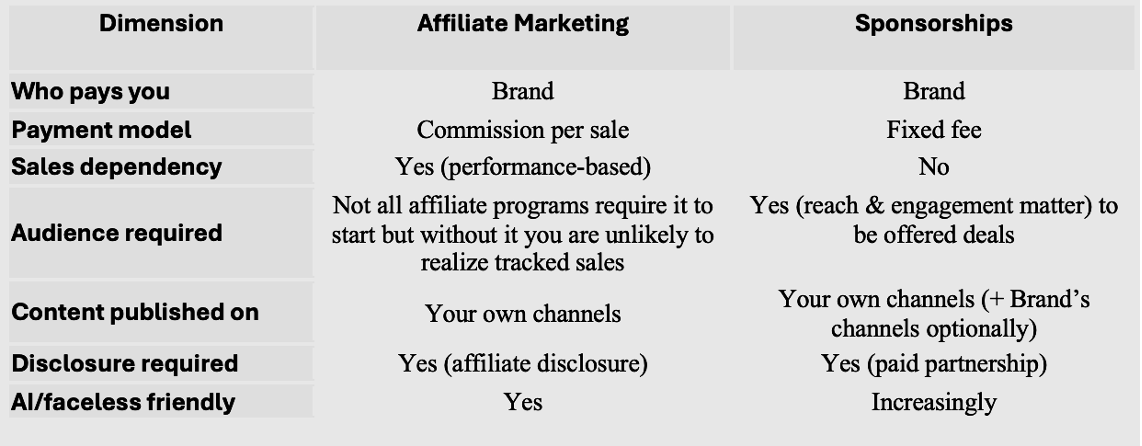
Affiliate marketing vs sponsorships: how you earn
Affiliate marketing vs sponsorships: a commission on sales
With affiliate marketing, your income depends entirely on sales. You earn a commission each time someone buys through your link. Results can therefore vary widely from month to month.
We explain the details in our article on affiliate marketing for beginners.
Sponsorships: a fixed fee
Sponsorships pay a fixed fee for the content itself and the exposure it creates. You are paid whether or not the content leads to sales for the brand. That makes income more predictable.
We explain the details in our article on sponsorships and UGC for beginners.
Affiliate marketing vs sponsorships: who can start
Sponsorships require a demonstrated audience before brands approach you or accept your pitch. Brands want proof that your content reaches and engages people. That usually takes time to build.
Affiliate programs, by contrast, are often open to anyone from the start. You can join, receive a link and share it right away. Your earnings then grow as your audience grows.
Affiliate marketing vs sponsorships at a glance
| Affiliate marketing | Sponsorships | |
|---|---|---|
| Who pays | The brand | The brand |
| How you earn | Commission per sale | Fixed fee per deal |
| Predictability | Varies with sales | Agreed in advance |
| Audience needed to start | No, often open to anyone | Yes, a demonstrated audience |
| Agreement | Mostly automated | Negotiated with each brand |
| Where published | Your channels | Your channels |
| Disclosure | Required | Required |
Which suits you?
If you are just starting and want to earn from your content right away, affiliate marketing is the more open door. Choose products you truly use and recommend them occasionally. Your earnings will grow with your audience.
If you already have an engaged audience and a strong style, sponsorships can bring larger, more predictable payments. Prepare a media kit and start pitching.
Using both together
Many creators combine both. They use affiliate links for products they love and accept sponsorships from brands that fit their content. Sometimes a brand even offers both: a fixed fee for a video plus a commission on resulting sales.
Common mistakes with affiliate marketing vs sponsorships
The first mistake is expecting sponsorship-level income from affiliate links on a small audience. Affiliate income usually starts slowly. The second is accepting sponsorships from brands that do not fit your content, which can damage your audience’s trust.
The third mistake is forgetting disclosure in either case. Both affiliate links and sponsored content must always be labeled.
An example of affiliate marketing vs sponsorships
Imagine a creator who reviews hiking gear. From the start, she shares affiliate links to the boots and backpacks she uses. Each month, she earns a varying amount depending on sales.
After two years, her audience is large and engaged. A backpack brand offers her a sponsorship: a fixed fee for one dedicated video. She keeps her affiliate links and adds sponsorships, now earning in both ways.
Agreements in affiliate marketing vs sponsorships
Affiliate agreements are mostly automated. You join a program online, accept its terms and receive your link, often without speaking to anyone. The terms are the same for every affiliate.
Sponsorship agreements are negotiated with each brand. You agree on deliverables, timelines, usage rights, exclusivity and payment. That takes more time, but you can shape the deal.
Content style in affiliate marketing vs sponsorships
Affiliate content works best when it helps people decide: reviews, comparisons and tutorials. People who are close to buying click your link. That is also why the last click rule matters.
Sponsored content can be more creative and story-driven, since you are paid regardless of sales. Brands want content that fits your style and reaches your audience naturally.
Income stability in affiliate marketing vs sponsorships
Affiliate income can grow quietly over time, as older content keeps bringing clicks. However, it can also drop when a program lowers commissions or a product disappears. Sponsorship income comes in clear amounts, but only when you land deals.
Combining both gives a steadier overall income.
Disclosure in affiliate marketing vs sponsorships
Both techniques require clear disclosure, but the wording differs. For affiliate links, say that you may earn a commission if people buy through your link. For sponsorships, label the content as an ad, sponsored or a paid partnership.
Use the platform’s own tools where available, such as paid partnership labels. Clear disclosure protects your audience’s trust and keeps you within advertising rules.
Starting with affiliate marketing, growing into sponsorships
A common path is to start with affiliate links from day one, since they need no audience to join. As your content grows, your audience and engagement become proof for brands. You can then add sponsorships on top.
The content you create for affiliate marketing, such as honest reviews, also becomes portfolio material for sponsorship pitches.
Starting small and staying private
Brand deals need no shop and no stock. We recommend spending no more than about 20 dollars on your setup, using free tools for your content and your media kit, with no monthly fees before brands know you. You can grow your audience yourself, without an agency.
Brands still often prefer creators they can see, but faceless creators can succeed too, especially with UGC. If the idea of self-branding is what held you back so far, Lynnaider recaps the alternatives for you.
Your next step
The next article explains how to get brand deals by driving traffic: to your audience and to brands. The complete module, alongside the other online income techniques, is in the book on our products page. If you would like help choosing between affiliate marketing vs sponsorships, see our services page.
Frequently asked questions
Do I need different content for affiliate marketing vs sponsorships?
Not entirely. Both work best with honest, useful content in your niche, though sponsored pieces follow the brand’s agreed brief.
Which earns more, affiliate marketing or sponsorships?
It depends on your audience and niche. Sponsorships often bring larger single payments, while affiliate income can add up steadily over time.
Can a brand offer both a fee and a commission?
Yes. Some deals combine a fixed fee for the content with a commission on resulting sales.
Which technique needs more pitching?
Sponsorships. Affiliate programs usually let you join online without pitching.
What is the main difference between affiliate marketing and sponsorships?
Affiliate marketing pays a commission on each sale through your link. Sponsorships pay a fixed fee for your content and exposure, regardless of sales.
Which is easier to start?
Affiliate marketing, since many programs are open to anyone. Sponsorships usually require a demonstrated audience first.
Which gives more predictable income?
Sponsorships, because the fee is agreed in advance. Affiliate income varies with sales.
Will Lynnaider publish step-by-step tutorials for setting up the 10 online business models for free or at a very low cost?
They may be created depending on how much interest there is. Please join the waitlist to show that you are interested, and we will let you know as soon as they are ready.
Do both need disclosure?
Yes. Both affiliate links and sponsored content must be clearly disclosed to your audience.
Where is the content published?
In both cases, on your own channels.
Can I combine affiliate marketing and sponsorships?
Yes. Many creators use affiliate links for products they love and accept sponsorships from brands that fit their content.
Who pays in each case?
In both, the brand pays you. The audience never pays you directly.
Why were these the original influencer income techniques?
Because both monetize an audience’s attention and trust, without the creator selling their own products.
Can I start with the Sponsorships & UGC technique at no or low cost?
Yes. Lynnaider teaches setup routes for the Sponsorships & UGC technique that cost nothing, or very little (under 20 dollars), to go live, so you do not pay setup costs long before you earn. Our free AI agent, Lynnaider Compass, guides you through them step by step, in the same logic as the whole Lynnaider teaching.
Disclaimer: This article is for general informational purposes only and should not be regarded as legal, tax, or business advice. Pursuing an online business does not guarantee income; results depend on many factors including the business environment, individual effort, skills, and consistency. Some links on this site may allow Lynnaider to earn a commission at no additional cost to the reader.