
Online Store Examples: 5 Solo Makers and How They Sell Online
Would you like to read this article told by Lynnie, our fictional kid character? Jump here.
After our introduction to the ten online income technique modules, we start with the first technique, the Own Online Shop, through five example characters.
The easiest way to understand an online income technique is to see it in action. In this article, we introduce five example characters who each run an Own Online Shop. They sell different products, use different profiles and bring traffic in different ways.
These online store examples are fictional, but each one is based on patterns we see in real solo businesses. You will notice that none of them needs a big team or a large budget to start. You will also notice that several of them never show their face.
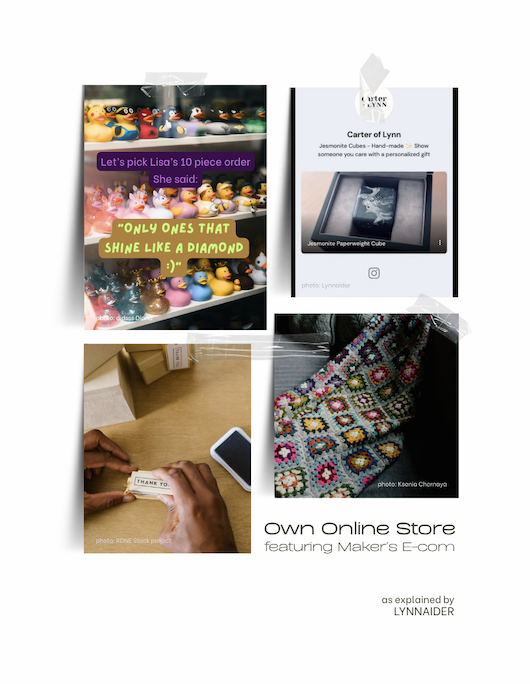
The characters in this article are invented and shown for educational purposes only.
What the online store examples have in common
An Own Online Shop means producing physical goods, or retailing goods you are authorized to sell, and selling them online. All five characters do exactly that. Their products are physical, so each of them also has to think about delivery.
What differs is how they set up and how they find customers. Some sell through a social store with payment links. Others use their own website or a marketplace with a fulfillment partner.
Look at each example with three questions in mind. What do they sell? Where do they sell it? How do people find them?
Five online store examples from different niches
Carter the Cube Crafter, the first of our online store examples
Carter makes hand-poured, marble-effect cubes from eco-friendly acrylic resin. Customers choose their own color mix, and Carter ships each order himself. His products are made to order, so he only produces once a sale is confirmed.
His key profile is a social store on Instagram, connected with Stripe payment links. He drives traffic by posting short, captivating video edits of himself producing his orders, every day. When free traffic slows down, he runs paid social media advertising campaigns.
Carter shows how little you need to start. A social profile, a payment link and a product people enjoy watching being made can be enough.
Giselle the Crystal Crusher
Giselle was always drawn to crystal bracelets, but standard round-bead bracelets never appealed to her. She guessed she was not alone. So she sources high-quality fillable medals and buys raw, vibrant crystal chunks, which she crushes and fills herself.
To drive traffic for free, she optimizes her content for algorithmic reach. She regularly creates short videos of her production process and adds an inspiring English voiceover generated by AI. This lets her reach an international audience without speaking on camera.
Giselle is a good example of going viral on social media with a faceless approach. Her product is the star, and the process itself is the content.
Steve the Plant Enthusiast
Steve fell in love with propagating houseplants and, after retiring, turned his passion into a business. He creates propagation starter kits with colorful, eco-friendly water vials, organic rooting powder and a mini plant care guide. He uses 3D printing to produce the custom vials.
Steve ships through a fulfillment partner operating in his country. He invests in marketplace advertising on the partner’s site to bring enough traffic to his kits. His work focuses on producing and improving the product, while the partner handles storage and delivery.
Steve also shows that an Own Online Shop is not only for young people. Retirement can be a great moment to turn a long-held hobby into a small business.
Illa the Planner Seller
Illa discovered a very useful memo board tool that is popular in Japan but less known elsewhere. She sources it in several versions and offers them in packs via her social store. In this case, she is a retailer, adding value through curation and bundling.
Her consistent social posting generates free traffic. She also asked her customers to sign up to her email newsletter at their first purchase. Email automation now brings them back to buy for friends and family, with loyalty perks.
Illa shows the power of audience retention. Winning a customer once is hard, but inviting them back by email costs almost nothing.
Caesar the Desk Harmonizer
Caesar is a carpenter obsessed with elegant, harmonized wood-design office spaces. He curates and sells well-matched sets of desk accessories and decorations, so his customers avoid clashing wood types. His expertise as a carpenter is what makes his curation trustworthy.
He uses his own website and drives traffic with Meta ads featuring simple slow-motion creatives. He also sells through Amazon FBA and uses marketplace ads there. Caesar combines two routes: direct sales on his website and sales through a fulfillment partner.
What these online store examples teach beginners
First, the product matters most. Each character offers something with a clear story: a custom color mix, an unusual crystal style, a plant kit, a rare memo board or a harmonized desk set. A clear story makes content easier to create.
Second, there is more than one way to set up. A social store with payment links is often free and quick to start. A website gives more control, and a marketplace with a fulfillment partner gives more reach and less shipping work.
Third, traffic is always part of the job. Free methods like short videos and social posts come first for most of them. Paid methods like social media ads or marketplace ads help when free traffic slows or when demand grows.
Online store examples you can adapt
You do not need to copy any of these characters. Instead, look at the combination they chose. A product you can make or source, a profile that fits your budget, and one traffic method you can keep up every week.
Write your own version in three lines. “I sell … through … and bring traffic with …”. If you can fill in all three, you have the outline of your own online store.
Starting small and staying private
None of these examples needed a big budget to begin. We recommend spending no more than about 20 dollars on your setup when you start, using free tools and avoiding monthly fees before you have traffic. You can do your own marketing too, without an agency, as the characters show.
Several of them never show their face. If the idea of self-branding is what held you back so far, Lynnaider recaps the alternatives for you.
Your next step
The next article explains the Own Online Shop in detail: what it is, who it suits and why it is having a comeback. The complete module, with all ten online income techniques, is in the book on our products page. If you would like help planning your own online store, see our services page.
Frequently asked questions
What is an Own Online Shop?
It is Lynnaider’s first online income technique: producing physical goods, or retailing goods you are authorized to sell, and selling them online.
Are these online store examples real people?
They are fictional characters. Each one is based on patterns we see in real solo businesses, to show how the technique works in different niches.
Do I need my own website to run an online store?
No. Several of the examples use a social store with payment links, which is often free to start. Others use a marketplace such as Amazon. A website is one option among three.
Which traffic method works best for an online store?
It depends on your product and audience. Short videos of the production process work well for handmade goods. Marketplace ads and social media ads help when free traffic slows down.
Does Lynnaider show step-by-step tutorials for the 10 online business models with no or minimal setup costs?
Based on interest, these tutorials may be made. If you would like to see them, please sign up to the waitlist, so we can see that there is interest. Everyone on the list will be informed as soon as the tutorials are available.
Can I run an online store without showing my face?
Yes. Many makers only show their hands, their workshop or the product itself. Some add an AI-generated voiceover instead of speaking on camera.
What is a fulfillment partner?
A company that stores your stock and ships orders for you, such as Amazon FBA or a smaller local warehouse. It is usually added once demand is established.
Can I sell products I did not make myself?
Yes, if you are officially authorized to sell them. Curating and bundling products from other brands is also part of the Own Online Shop technique.
How do online stores keep customers coming back?
Email is one of the strongest tools. Asking customers to sign up to a newsletter at their first purchase lets you invite them back with new products or loyalty perks.
Where can I get step-by-step help to set up the Own Online Shop technique on a small budget?
Yes. Lynnaider teaches setup routes for the Own Online Shop technique that cost nothing, or very little (under 20 dollars), to go live, so you do not pay setup costs long before you earn. Our free AI agent, Lynnaider Compass, guides you through them step by step, in the same logic as the whole Lynnaider teaching.
Disclaimer: This article is for general informational purposes only and should not be regarded as legal, tax, or business advice. Pursuing an online business does not guarantee income; results depend on many factors including the business environment, individual effort, skills, and consistency. Some links on this site may allow Lynnaider to earn a commission at no additional cost to the reader.