
Generative AI for Small Business: How Chat AI Works, in Plain Language
Would you like to read this article told by Lynnie, our fictional kid character? Jump here.
After explaining AI, machine learning and deep learning, we look at the type of AI most people now use every day: generative AI.
Generative AI for small business has gone from a novelty to an everyday tool in just a few years. Many solo entrepreneurs now use chat assistants to draft texts, plan content and answer questions. In this article we explain in plain language how generative AI produces its answers, why it spread so quickly, and how to use it wisely.
What is generative AI?
Generative AI covers a wide field. It includes tools that generate images, video, audio and more. The most widely known example, at least among the general public, is conversational AI.
Conversational AI is what you see Claude, ChatGPT and other chat-based AI apps do when you give them a prompt. You type or say a question, and the tool answers in natural language.
How generative AI produces its answers
These models were trained on a vast amount of text data, much of it from publicly available online content, up to a certain point in time. Based on that training, they generate the most statistically likely response to your prompt. They then present it in the format and through the lens you asked for.
In simple terms, the tool predicts which words are most likely to come next, again and again, until it has written a full answer. This is why the answers sound fluent and natural. It is also why they can sometimes be wrong, because a likely-sounding answer is not always a correct one.
Why the knowledge has a cut-off date
Because the models learn from data up to a certain point, they may not know about very recent events or changes. Some tools can search the web to fill this gap, while others cannot. Always check whether information about prices, rules or platforms is still current.
Why generative AI became so widely known
What was groundbreaking about large language models, and why they suddenly became so widely known, is how simple it became to interact with AI in everyday use. You no longer need technical skills or special software. You just ask.
Imagine how wide the world suddenly becomes for anyone with such a tool. This is especially true when it can be used by voice, in many of the more than 7,000 languages spoken around the globe. We will let engineers and governments work out the details properly, because the technology also has significant environmental and other potentially negative impacts.
Generative AI for small business: practical uses
For a solo entrepreneur, generative AI can save hours each week. Here are common ways small business owners use it.
- Writing drafts: product descriptions, emails, blog outlines and pin descriptions.
- Brainstorming: niche ideas, product names and content topics.
- Explaining: unfamiliar terms, platform features or basic concepts you want to understand.
- Organizing: turning messy notes into checklists, plans or schedules.
- Translating: first drafts of texts for customers in other languages.
Used this way, generative AI makes it much easier to do your own marketing. You do not need an agency to write your first descriptions or plan your first content calendar.
Generative AI for small business: what to watch out for
Generative AI can sound very confident and still be wrong. This is sometimes called hallucination. The model does not know what it does not know, and it will not always tell you when it is unsure.
Treat every answer as a starting point. Check facts and figures, and be especially careful with anything legal, financial or health-related. Also think about how your published content will affect the people who read it, because that responsibility stays with you.
Generative AI for small business: keep your own voice
Customers can often tell when a text was written entirely by AI without any editing. Use AI for structure and first drafts, then add your own experience, examples and tone. Your perspective is what makes your business recognizable, even if you stay in the background.
Writing good prompts
The quality of an answer depends a lot on the quality of your question. Give the tool context: who you are, who your customers are and what you need. Ask for a specific format, such as a list of five ideas or a 100-word description.
If the first answer is not right, ask the tool to change something specific. Small, clear instructions usually work better than long, vague ones. Over time, you will build a set of prompts that work well for your business.
Learning by doing
For now, thanks to automation and AI, we can already think about online solo entrepreneurship, and that is what we are here to do. This rather technical topic is probably where a beginner has the most room to grow in understanding. That is completely normal.
We believe that learning about automation in a tangible way, through online income techniques, gives you two advantages: learning by doing, and doing for a tangible purpose. Both tend to stick in people’s memories better than theory alone.
To be fair, you do not need to know the technical details of automation and AI to start an online activity. It is, however, always interesting to learn about.
How the four areas fit together
The relationship between these four smaller areas of computer science is illustrated in the figure you see here. Computer science as a whole covers much more, but these four are the ones most relevant to your online business.
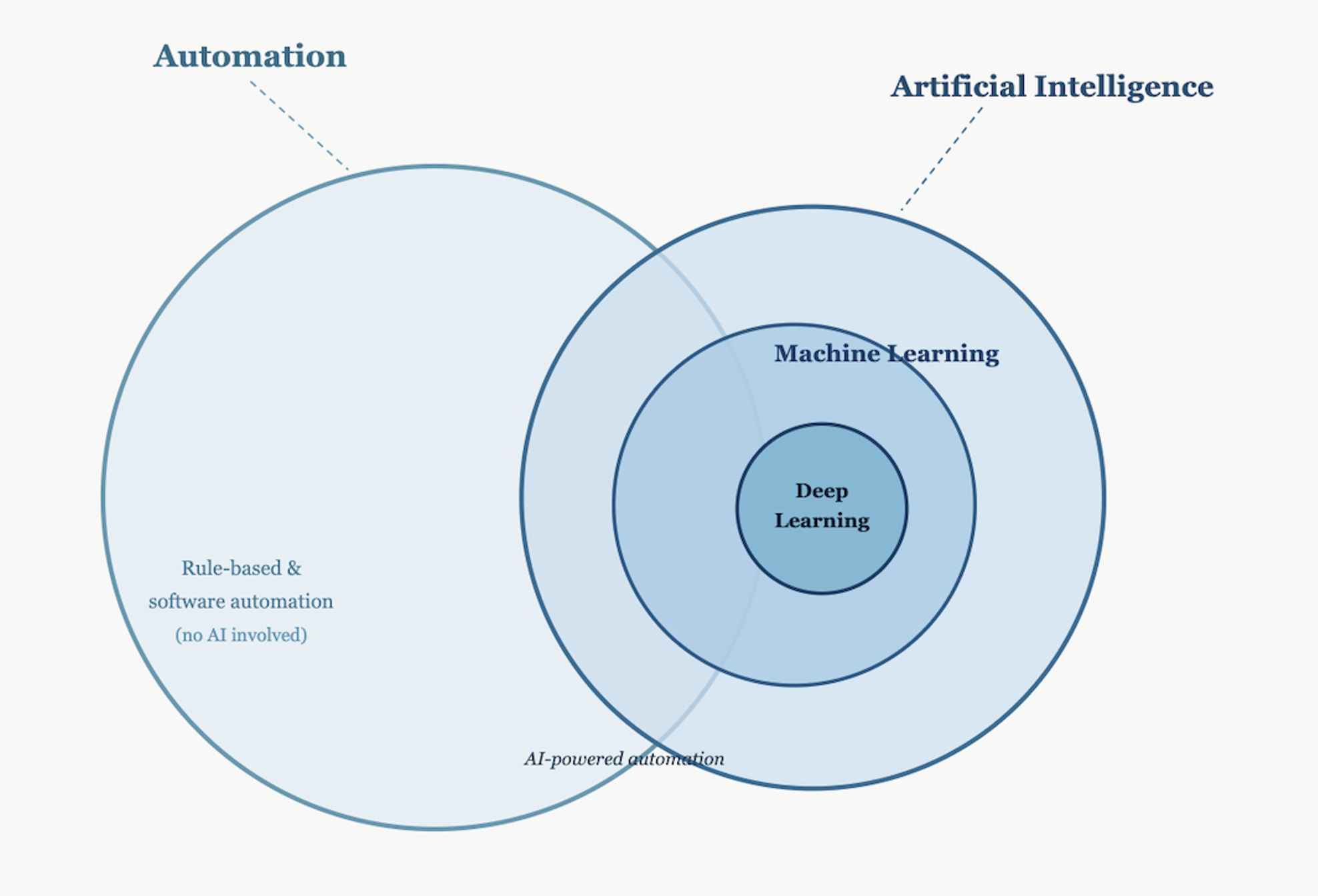
Automation is the largest and oldest circle. AI overlaps with it but is a separate field. Machine learning sits inside AI, and deep learning, the engine of generative AI, sits inside machine learning.
Using generative AI responsibly with customers
If you use AI to answer customer messages, read each answer before sending it. Customers expect correct information about orders, delivery and refunds. A quick check protects your reputation and keeps your service reliable.
Generative AI for small business on a small budget
The free versions of most generative AI tools are enough for a beginner. When you are just starting out, you do not need to spend more than about 20 dollars on your setup. Paid plans can wait until you know exactly which tasks they will save you time on.
Generative AI and privacy-first businesses
Generative AI also supports entrepreneurs who prefer to stay out of the spotlight. It can help create faceless content such as written guides, illustrations and voiceovers. If the idea of self-branding is what held you back so far, Lynnaider recaps the alternatives for you.
Your next step
The next article shares five truths that apply to all ten online income techniques, including why AI can be wrong. The complete chapter is in the book on our products page. If you would like help using generative AI in your small business, see our services page.
Frequently asked questions
What is generative AI?
AI that creates new output rather than just analysing existing data. This includes text, images, audio, video, code and more. The most widely known example is conversational AI, like Claude or ChatGPT.
How do chat-based AI tools actually generate answers?
They generate the most statistically likely response based on the vast amount of text data they were trained on, then present it in the format and through the lens you asked for.
Are there step-by-step Lynnaider tutorials for starting each of the 10 online business models with a minimal-cost setup?
Not yet, but they might be made if enough people ask for them. Sign up to the waitlist so we can see the interest, and you will be among the first to hear when they are available.
Why did generative AI become so widely known?
Because interacting with AI became suddenly simple in everyday use, including by voice in over 7,000 languages. That shift made powerful tools accessible to anyone, not only engineers.
Are there downsides to generative AI?
Yes. It has significant environmental and social costs, and its outputs are not always reliable. Lynnaider mentions this to keep the picture honest, not to discourage use.
Do I need to understand AI technically to use it in my business?
No. You can use these tools well without knowing the technical details. Learning by doing through a specific online income technique tends to stick better than studying the theory in isolation.
How do automation, AI, Machine Learning and Deep Learning fit together?
Automation is the largest and oldest circle. AI overlaps with automation but is a separate field. Machine Learning is a subset of AI, and Deep Learning is a subset of Machine Learning. The figure in this article maps them together.
Where can I get step-by-step help to start online on a small budget?
Lynnaider teaches setup routes for each of the ten online income techniques that cost nothing, or very little (under 20 dollars), to go live, so you do not pay setup costs long before you earn. Our free AI agent, Lynnaider Compass, guides you through them step by step, in the same logic as the whole Lynnaider teaching.
Disclaimer: This article is for general informational purposes only and should not be regarded as legal, tax, or business advice. Pursuing an online business does not guarantee income; results depend on many factors including the business environment, individual effort, skills, and consistency. Some links on this site may allow Lynnaider to earn a commission at no additional cost to the reader.