Selling on Marketplaces for Beginners: The Simplest Profile to Set Up and Start With
Would you like to read this article told by Lynnie, our fictional kid character? Jump here.
In the previous article we explained your online home and your lobby. Here is the first of the three profile types: the marketplace.
If you want the easiest way to start selling online, a marketplace is usually the answer. Selling on marketplaces for beginners means you open a shop inside a platform that already has buyers, payments and rules in place. In this article we explain what a marketplace profile is, why it is so beginner-friendly, which marketplaces fit which business models, and how to stay safe.
One key profile is enough
There are three key profiles we differentiate: Marketplace, Website or Social Store. You may be surprised to hear that one key profile is enough to set up your business. For many entrepreneurs, it stays enough throughout their whole journey.
Why? Because you can focus all your traffic efforts on one place, and if you do it well, you can be successful. Every extra profile means extra content to create and extra traffic to drive. Splitting your time across several profiles usually slows you down.
When we talk about setting up a profile, we only mean opening one. We do not mean posting or perfecting. Do not think about posting, blogging or any frequent activity for now, because everything you will do regularly is covered in Lesson T5: Traffic & Content.
What is a marketplace profile?
A marketplace profile is like a smaller online store within a larger platform. You list your products or services there, and people find them. Marketplaces bring buyers to you.
The marketplace profile can sound like the most complex option, but it is in fact the simplest to set up and manage. The reason is that it is a pre-developed, large market of buyers and sellers. Your profile will look similar to everyone else’s, and setting it up mostly means filling out the fields.
Why selling on marketplaces for beginners works so well
Marketplaces make it easier to get started and gain visibility without needing a website or any other online presence or setup.23 Here are the main reasons beginners benefit:
- Payments are handled for you. The platform processes payments, so you do not need to set up payment software.
- Customer service is partly handled. Many marketplaces have systems for messages, disputes and refunds.
- Some traffic is generated for you. Buyers already search inside the marketplace, and your listings can appear in those searches.
- Frequent content is not required. You do not necessarily need to post content every day to be found.
- Legal basics are partly covered. The marketplace’s terms apply to buyers on its platform.
For someone starting out, these advantages remove a lot of technical and administrative work. You can focus on your offer and your traffic instead.
You are not limited to the marketplace’s own audience
Just because your key profile is on a marketplace does not mean you can only reach people already signed up there. You can target anyone on the internet. You can share your listings on Pinterest, in a blog post or in an email.
This expands your reach far beyond the marketplace’s own audience. Many successful marketplace sellers bring a large share of their buyers from outside the platform.
Which marketplace fits which online business model?
There are large, all-encompassing marketplaces like Amazon. There are also specialized ones tailored to specific online income techniques. Choosing the right one helps you reach the right buyers.
- Freelancing: Fiverr and similar freelance platforms.
- Print-on-demand: Redbubble and similar platforms.
- Sharing economy: Facebook Marketplace and local resale platforms.
- Digital photography: Shutterstock and other stock photo sites.
- Handmade and digital products: Etsy and similar platforms for makers.
- Many product types: Amazon.
Each of the ten online income techniques has at least one marketplace that suits it. The individual modules in the book explain which ones we recommend and why.
How to set up a marketplace profile in a few steps
Step 1: Choose one marketplace
Pick the marketplace that best matches your offering and your niche. Start with only one, so you can learn its rules and search system well.
Step 2: Open your account and fill out the profile
Choose a shop name, add a simple logo or image, and write a short description. Do not spend days on it, because buyers will mostly see your listings.
Step 3: Create your first listing
Write a clear title with the words buyers would search for. Add good photos or mockups, an honest description and a fair price. This listing is your lobby.
Step 4: Bring visitors, the step guides to selling on marketplaces for beginners often skip
Share your listing where your audience already spends time. Pinterest is especially useful for marketplace sellers, because pins can bring visitors for months.
Costs of selling on marketplaces for beginners
Many marketplaces are free to join and charge only small listing fees or a commission per sale. That makes them ideal if you want to keep your setup under about 20 dollars when you start. There is no need for monthly subscriptions before anyone knows about your business.
Always read the fee structure before you list. Commissions, payment fees and shipping labels can add up. Include them in your pricing so each sale still makes sense.
A note on marketplace scams
It is quite easy to get scammed on marketplaces. Pay extra attention to suspicious requests for your bank account information or personal details. Scammers often pretend to be buyers or even the platform itself.
As a rule, never enter sensitive information on a site you reached from an email link, even if the sender seems to be a well-known platform. Always go directly into your well-protected account and check from there whether anything is required. Enable two-factor authentication wherever the marketplace offers it.
Selling on marketplaces for beginners without showing your face
Marketplaces are one of the easiest places to run a private business. Buyers see your shop name, your products and your reviews. If the idea of self-branding is what held you back so far, Lynnaider recaps the alternatives for you.
Is a marketplace a real business?
Yes. Many entrepreneurs run their entire business from a marketplace profile, sometimes for many years. It is a different route from having a website, with its own strengths, and not a lesser one.
You can always add a website later, once your traffic and sales justify it. Starting on a marketplace lets you test your idea with real buyers first.
Your next step
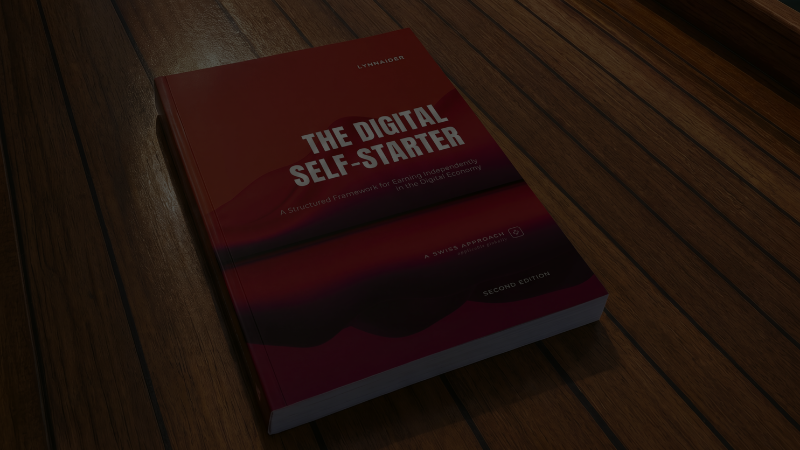
The next article explains the second profile type: having your own website. The complete Lesson T3 is in the book on our products page. If you would like help choosing the right marketplace for your business, see our services page.
Frequently asked questions
What is a marketplace profile?
A smaller online store within a larger platform, where you list your services or products for people to find. Marketplaces bring buyers to you and handle the platform mechanics of payments, service, and some traffic.
Why is a marketplace a good starting point for beginners?
Because the platform handles payments, customer service, generates some traffic, and does not require constant content. Setup is mostly a matter of filling out fields, and the format is similar for every seller, which speeds things up.
Which marketplaces fit which techniques?
Amazon is broad and covers many product types. Fiverr suits freelancing. Redbubble suits print-on-demand. Facebook Marketplace suits the sharing economy. Shutterstock suits digital photography. Each technique has a marketplace shaped for it.
Am I limited to people already on the marketplace?
No. Even with a marketplace profile, you can drive traffic to it from anywhere on the internet. The marketplace is your home; the audience does not have to arrive only through the marketplace’s front door.
What are the risks with marketplace profiles?
Scams are common. Watch for suspicious requests for bank account information or personal details. As a rule, never enter sensitive information on a site you arrived at from an email link, even if the sender seems to be a well-known platform.
Can I get step-by-step guidance from Lynnaider to set up one of the 10 online business models without spending much?
Step-by-step tutorials with free or minimal-cost setups may be made based on interest. Please add your name to the waitlist, and we will inform everyone who signed up as soon as they become available.
Does a marketplace profile still count as a real business?
Yes. Many successful online entrepreneurs run their entire business from a marketplace profile, sometimes for years. It is not a step down from having a website; it is a different route with its own strengths.
Is there a low-cost way to start an online business with Lynnaider?
Lynnaider teaches setup routes for each of the ten online income techniques that cost nothing, or very little (under 20 dollars), to go live, so you do not pay setup costs long before you earn. Our free AI agent, Lynnaider Compass, guides you through them step by step, in the same logic as the whole Lynnaider teaching.
References
23. Amazon. Seller University: learn how to sell on Amazon. Seattle (WA): Amazon.com, Inc.
Disclaimer: This article is for general informational purposes only and should not be regarded as legal, tax, or business advice. Pursuing an online business does not guarantee income; results depend on many factors including the business environment, individual effort, skills, and consistency. Some links on this site may allow Lynnaider to earn a commission at no additional cost to the reader.