
How Freelancing Works: The Process Flow in 5 Simple Steps
Would you like to read this article told by Lynnie, our fictional kid character? Jump here.
Following our article on freelancer customer service, this article shows the freelancing process flow, step by step.
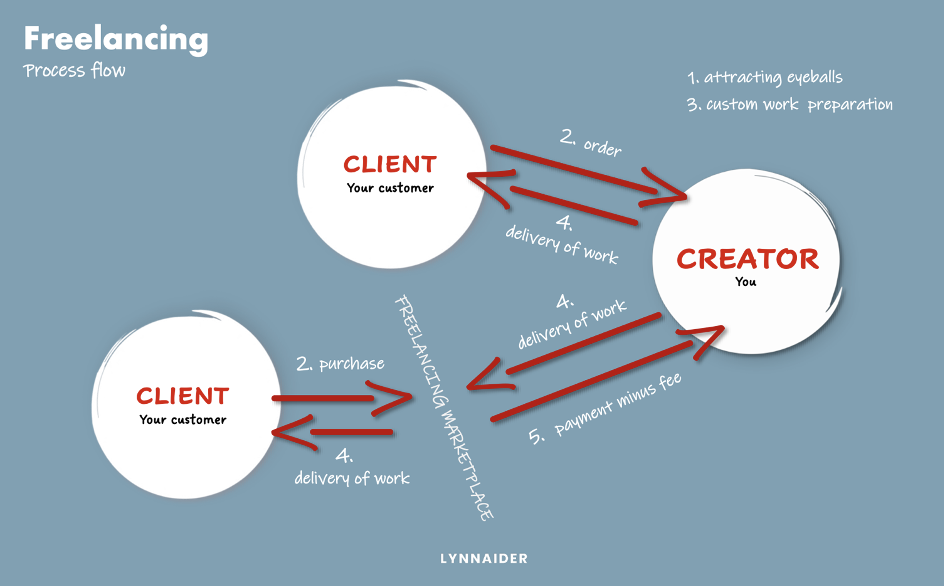
In Lynnaider’s teaching, we capture each online income technique in a simple process flow. The figure you see here shows how freelancing works when you offer a digital service. In this article, we walk through the five steps one by one.
How freelancing works compared with selling a product
In freelancing, you interact with every client to some degree before you are paid. This is how services usually work in the physical world too. You pay at the end of a hairdresser’s appointment, which is a service, while you pay upfront for a shampoo in a store, which is a product.
This difference shapes the whole process. You are not selling something ready-made. You are delivering a task that is customized for each client.
How freelancing works: the five steps
Step 1 of how freelancing works: attract traffic
Your first step is attracting traffic, or as we like to call it, “eyeballs,” to what you offer. That can happen through a marketplace’s own search, social media, your website, search engines or referrals. Without visitors, even an excellent offer stays unseen.
Step 2: a client orders
Responding to your traffic efforts, a client notices your offer and orders from you. They can order directly, for example through your website, or through the freelancing marketplace where you are registered.
Step 3: you prepare the custom work
Since your service is unique to each client, you then prepare the custom work. This is where there may be several rounds of communication about exactly how the client imagines the result. Asking good questions early saves time later.
This is both the beauty and the challenge of services. You are not selling a pre-made product. You are delivering a customizable task.
Step 4: you deliver the service
Once the work is ready, you deliver it fully. That might be a file, a recorded video, a completed task or a live session. Delivery often includes a revision round, as agreed upfront.
Step 5: you get paid
After delivery, you get paid. On the marketplace route, you receive the payment minus the site’s fee, typically between ten and twenty percent. On your own website, you receive the full amount minus your payment provider’s small fee.
Customer service in how freelancing works
Since freelancing is a service, customer service is part of the work at every step. It starts with your first reply to an inquiry and continues through updates, revisions and delivery. It often ends with a request for a review.
We share four key habits in our article on freelancer customer service. They make a real difference to repeat business and referrals.
Where your time goes in freelancing
Looking at the five steps, most of your time goes into step 3: preparing the custom work. Step 1, attracting traffic, also needs regular attention, especially at the start. Steps 2, 4 and 5 are usually quick.
Because your income depends on your hours, it is worth making step 3 efficient. Templates, clear briefs and AI tools for repetitive parts can help. Many freelancers also raise their prices as their reviews grow.
How freelancing works on a marketplace vs your own website
| Step | On a marketplace | On your own website |
|---|---|---|
| Traffic | Partly from the marketplace’s own search | Entirely from your own efforts |
| Order | Through the platform | Through a form, booking page or payment link |
| Payment | Held by the platform, released after delivery, minus a fee | Collected by you through Stripe or PayPal |
| Disputes | Handled by the platform’s rules | Handled by you and your terms |
An example of how freelancing works
Imagine a freelance copywriter on a marketplace. A small skincare brand finds her through the platform’s search and orders five product descriptions. She asks three questions about the brand’s tone and customers.
She drafts the descriptions, sends them on time and makes one round of small changes. The client approves, the platform releases the payment minus its fee, and the brand leaves a review. A month later, the same brand orders ten more.
How freelancing works with other income techniques
Freelancing combines well with other online income techniques. A freelance designer might turn her most requested templates into a digital product. A freelance consultant might add affiliate links to the tools he recommends to clients.
Starting small and staying private
You can start freelancing on a free marketplace with no upfront cost. We recommend spending no more than about 20 dollars on your setup, with no monthly fees before you have clients. You can attract traffic yourself, without an agency.
The whole process can run through written messages and delivered files. If the idea of self-branding is what held you back so far, Lynnaider recaps the alternatives for you.
Common mistakes in the freelancing process
The first mistake is starting work before the request is clear. A few questions at step 3 can save hours of rework later. Summarize the request in writing and ask the client to confirm it.
The second mistake is stopping step 1 once the first clients arrive. When projects end, new ones need to be waiting. Keep a small, regular routine for attracting traffic, even when you are busy.
The third mistake is delivering late without warning. If something delays your work, tell the client early. Most clients accept a short delay when they hear about it in advance.
How long each step of freelancing takes
Attracting your first clients can take a few weeks, especially on a new marketplace profile. Once orders come in, a simple project might take a day, while larger ones take weeks. Payment on marketplaces is usually released a few days after delivery.
Plan your capacity honestly. Accept only as many projects as you can deliver well and on time.
Your next step
The next article explains where to find freelance clients: on a marketplace, your own website or a social store. The complete module is in the book on our products page. If you would like help mapping out how freelancing works for your service, see our services page.
Frequently asked questions
Do I need a contract for each freelance project?
On a marketplace, the platform’s terms and your offer usually cover it. Outside marketplaces, a short written agreement or project brief is strongly recommended.
Can I ask for a deposit before starting?
Yes, outside marketplaces many freelancers ask for part of the fee upfront, especially for larger projects. On marketplaces, the platform usually holds the payment.
How does freelancing work step by step?
You attract traffic to your offer, a client orders, you prepare the custom work, you deliver it, and you get paid. Customer service runs through every step.
When do freelancers get paid?
Usually after delivering the service, similar to paying a hairdresser after the appointment. On marketplaces, the client often pays upfront to the platform, which releases the money after delivery.
How much do freelancing marketplaces take?
It varies by platform, typically between ten and twenty percent of each payment.
Why is there back-and-forth communication in freelancing?
Because each service is custom. You need to understand exactly how the client imagines the result, which often takes a few rounds of questions and feedback.
Are there step-by-step Lynnaider tutorials for starting each of the 10 online business models with a minimal-cost setup?
Not yet, but they might be made if enough people ask for them. Sign up to the waitlist so we can see the interest, and you will be among the first to hear when they are available.
Can clients order from me directly instead of through a marketplace?
Yes. Clients can order through your own website or social store, or through a marketplace where you are registered.
What does eyeballs mean?
It is an informal word for attention: the people who see your offer. Attracting eyeballs means attracting traffic.
Is customer service a separate step in freelancing?
No. Because freelancing is a service, customer service is part of the work at every step.
What is the difference between selling a service and a product?
A product is made in advance and paid for at purchase. A service is created for the client and usually paid for after it is delivered.
Can I start with the Freelancing Online technique at no or low cost?
Yes. Lynnaider teaches setup routes for the Freelancing Online technique that cost nothing, or very little (under 20 dollars), to go live, so you do not pay setup costs long before you earn. Our free AI agent, Lynnaider Compass, guides you through them step by step, in the same logic as the whole Lynnaider teaching.
Disclaimer: This article is for general informational purposes only and should not be regarded as legal, tax, or business advice. Pursuing an online business does not guarantee income; results depend on many factors including the business environment, individual effort, skills, and consistency. Some links on this site may allow Lynnaider to earn a commission at no additional cost to the reader.