What Each Online Business Model Needs to Start: Setup Requirements at a Glance
Would you like to read this article told by Lynnie, our fictional kid character? Jump here.
In the previous article we listed the five setup to-dos. This one shows which of them each business model needs.
Before you choose an income technique, it helps to know how much setup it really needs. Some online business models need only a profile and an offer, while others need partners, payments, legal pages and shipping. In this article we present a figure that shows the online business model setup requirements for all ten techniques at a glance, and explain how to read it.
Online business model setup requirements at a glance
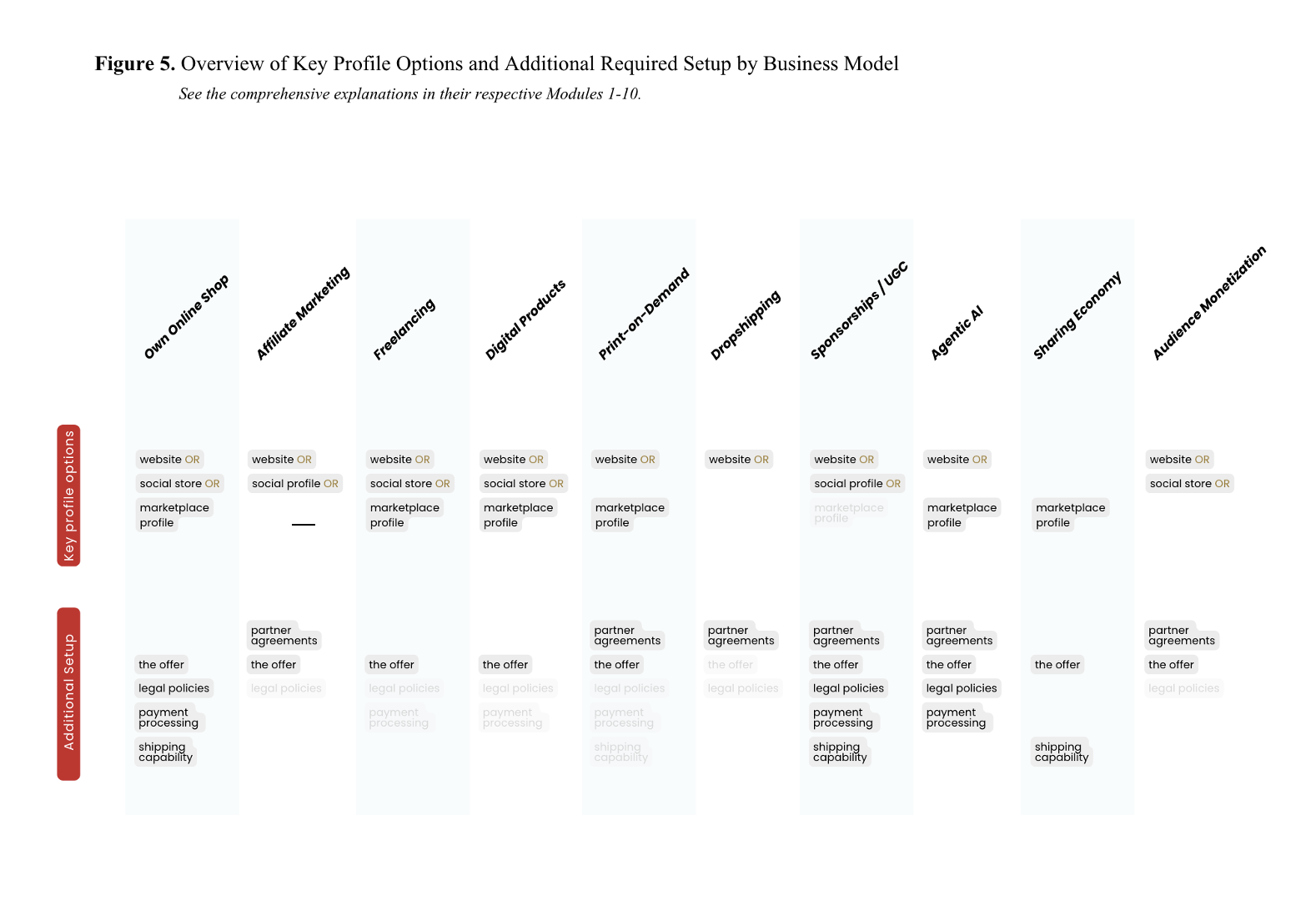
With the figure you see here, our aim is to illustrate two things visually. First, the key profile options available for each business model. Second, the relative “heaviness” of each income technique, based on the additional setup it requires.
How to read the online business model setup requirements
If a setup type is marked among the additional programs, it is mandatory for that business model to function. If it is shown in light grey, it is required only in certain cases. If an element is not marked at all, that income technique does not use it.
Read the figure one row at a time. For each business model, look first at the profile options, then at the setup types to its right. Count how many are fully marked, and you have a quick sense of how heavy that model is to start.
The profile options per business model
As you learned in our article on online business setup for beginners, there are three key profile types: marketplace, website and social media with a social store. Some business models work with all three. Others fit naturally with one or two.
For example, freelancing works very well on a freelance marketplace, and can also run from a website. Affiliate marketing, sponsorships and audience monetization lean strongly on social media or content sites. An own online shop can run on a marketplace, a website or a social store.
The five setup types, revisited
The additional setup types shown in the figure are the five to-dos from the previous article:
- Partner agreements: affiliate programs, brand deals, print suppliers, dropshipping suppliers or monetization programs.
- Your offer: the landing page, checkout page or pitch that makes your offering purchasable.
- Legal policies: terms, privacy policy and cookie consent where a platform does not provide them.
- Payment processing: collecting money directly from buyers, through providers like Stripe or PayPal.
- Shipping capability: packaging and delivering physical products, yourself or through a partner.
Light and heavy online business models
Lighter online business model setup requirements
Models with few marked setup types are lighter to start. They usually need a profile, an offer and perhaps one partner agreement. Freelancing on a marketplace and affiliate marketing on a social profile are typical examples, because the platform or the partner handles payments and delivery.
Heavier models
Models with many marked setup types are heavier. An own online shop on a website, for example, needs an offer, legal policies, payment processing and shipping. Dropshipping needs all five: a supplier agreement, an offer, legal policies, payment processing and, from the customer’s point of view, full responsibility for delivery.
Situational requirements
The light grey elements depend on your specific setup. Print-on-demand needs shipping arrangements if it runs on your own website, but not on a print-on-demand marketplace. The dedicated modules explain each case in detail.
Should you start with the lightest model?
Not necessarily. The heaviness of a model is one factor, but not the only one. Your interests, your existing skills and the audience you want to serve matter just as much.
A lighter model you cannot stay motivated for is a worse choice than a heavier one you love. Use the figure to understand the work involved, and then choose with your whole situation in mind.
Light models fit well alongside a job
If you are starting alongside employment, lighter models are often easier to manage in a few hours per week. You can always add a heavier model later, once your first business is running and you have more experience.
Questions to ask while reading the figure
As you study the figure, ask yourself a few practical questions. Which setup types am I already comfortable with? Which ones would I rather avoid, such as shipping or payment processing? Is there a profile option that would remove some setup types for me?
Write down two or three business models whose setup feels manageable. Then read their modules first. This keeps your research focused and saves time.
How online business model setup requirements affect your costs
The more setup types a model needs, the more opportunities there are to spend money. That does not mean you have to. When you are just starting out, you do not need to spend more than about 20 dollars on your setup, even for heavier models, because most setup types have free or low-cost options.
Choosing a marketplace as your profile can also reduce your setup, because it covers legal terms and payments for you. Monthly tools before anyone knows about your business are not necessary. Set up for free, focus on traffic, and add paid tools only when your sales justify them.
Setup requirements and traffic
The figure shows what you need to start, but every model also needs the fifth stage: traffic. A perfect setup with no visitors does not earn. Whichever model you choose, plan your first traffic source at the same time as your setup.
Marketing your business is something you can learn and do yourself. You no longer need an agency to bring your first customers.
Setup requirements change over time
Platforms add and remove features, and the setup a model needs can change. A marketplace might start handling taxes, or a social store might add shipping labels. We update the figure in each new edition of the book, and we recommend checking the current platform features when you set up.
Using the figure to plan combinations
The figure also helps you combine models. If two models share the same profile and setup types, they are easy to run together. For example, a website with legal pages and payment processing can host both digital product sales and affiliate content without much extra work.
Look for models that reuse what you have already built. Each new model then adds income without doubling your setup.
Private setups for every model
None of the setup types requires you to be the public face of your business. If the idea of self-branding is what held you back so far, Lynnaider recaps the alternatives for you.
Your next step
This closes Lesson T3. The next lesson, T4, covers the legal and safety basics of being present online. Each of the ten online income techniques has its full setup explained in its own module, in the book on our products page. If you would like help choosing a model based on its setup requirements, see our services page.
Frequently asked questions
Does Lynnaider show step-by-step tutorials for the 10 online business models with no or minimal setup costs?
Based on interest, these tutorials may be made. If you would like to see them, please sign up to the waitlist, so we can see that there is interest. Everyone on the list will be informed as soon as the tutorials are available.
What does the setup requirements figure show?
The key profile options available for each of the ten online business models, alongside the relative heaviness of each model based on the additional setup it requires. It is the visual summary of the whole T3 lesson.
What do the marks in the figure mean?
If a setup type is marked among the additional programs, it is mandatory for that business model to function. If it is shown in light grey, it is required only in certain cases. If it is not marked, the technique does not use it.
What does ‘heaviness’ of a business model mean?
How many additional setup types the model requires to actually operate. A model needing partner agreements, an offer, payments and shipping is heavier than one needing only a partner and an offer.
Are the light-grey elements optional?
Situational rather than fully optional. They are required when the specific setup calls for them, and not required otherwise. The dedicated income technique modules explain each case.
Should I pick the lightest model to start?
Not necessarily. The heaviness is a factor, but so is your interest, your existing skills, and the audience you want to serve. A lighter model you cannot stay motivated for beats a heavier one you love.
Where do I find the detail for each model?
In the dedicated Income Technique Module for that model. The figure is the overview; each module fills in the specifics of the setup for its technique.
How can I learn to set up an online business at no or low cost?
Lynnaider teaches setup routes for each of the ten online income techniques that cost nothing, or very little (under 20 dollars), to go live, so you do not pay setup costs long before you earn. Our free AI agent, Lynnaider Compass, guides you through them step by step, in the same logic as the whole Lynnaider teaching.
Disclaimer: This article is for general informational purposes only and should not be regarded as legal, tax, or business advice. Pursuing an online business does not guarantee income; results depend on many factors including the business environment, individual effort, skills, and consistency. Some links on this site may allow Lynnaider to earn a commission at no additional cost to the reader.