How to Find Your Niche: The Room-in-a-House Method for Beginners
Would you like to read this article told by Lynnie, our fictional kid character? Jump here.
Once you have noticed the everyday signals that point to your business idea, the next question is where your idea fits. That is your niche.
“Find your niche” is one of the most repeated pieces of online business advice, and one of the least explained. Lynnaider uses a simple picture to make it clear: a niche is a room inside a house. In this article you will learn how to find your niche with this method, how to describe it in two words, and why niching down helps you succeed.
Finding your room
We talk about niches only after the business idea, on purpose. We wanted to establish the context first, instead of jumping straight into the often-heard advice to “find your niche” or “just pick a niche.” Now that you know about your version of a simple idea and the everyday signals that point to it, the niche question becomes much easier.
What is a niche? Lynnaider’s definition
Lynnaider’s definition of a niche: A niche is like a room inside a large house, where everything is about the same topic. You should already feel at home in the house, but once you also choose a room that your offer fits into, that is when you have found a niche.
In practice, a niche is the topic or area you will immerse yourself in once you begin an online activity. Every product or service falls into some kind of niche. Your job is to choose the one where your offer feels most relevant.
Examples of niches for products and services
Take a digital product such as a time-management template, a beginner’s photography guide or a workout plan. Each of these can belong to very different niches, such as productive lifestyle, creative hobbies or active lifestyle. The same is true for services, whether it is logo design, personalized crocheted blankets or personal training.
There is always a specific niche whose problem you are solving. Naming that niche clearly helps you speak to the right people.
The house, the room and the items inside
In Lynnaider’s thinking, we use a simple visual logic. If the niche is a small room inside a large house, then the items inside the room are what you offer: your product or service.
The theme of the room, for example “animal-loving family” or “minimalist life,” is the narrower area you focus on. The name of the house, such as Pets or Budgeting, is the broader world that this room belongs to. This picture shows you that the same offering can fit into several rooms, because it can connect to several niches later.
Think of niches as doors, not as one right answer
Instead of searching for a single correct niche, think of niches as several doors. Each door shows you a world in which your offering can be valuable. Start with the one that feels most relevant to you and simplest to work with.
You will always be able to shift later. Many successful entrepreneurs changed their niche once or twice in their first year, based on what they learned from customers.
How to find your niche in two words
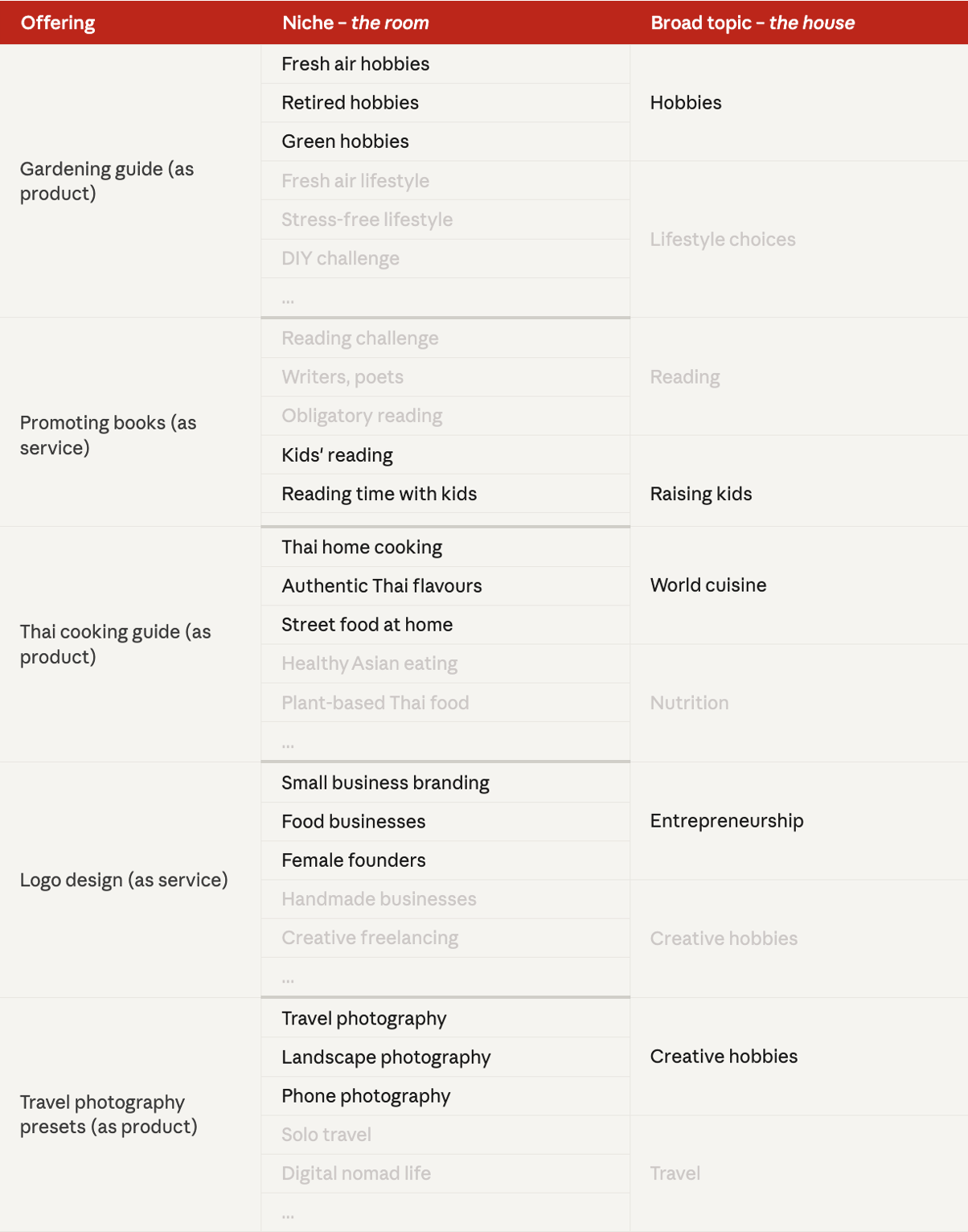
Here is a practical method you can use with the example table in the Lynnaider book. You can start from either end.
Option 1: How to find your niche from what you can offer
Begin with something concrete you know you can offer. Then define which niche it belongs to, using two words. Two words help you describe the room precisely, for example “minimalist budgeting” or “beginner gardening.”
Then try removing one of the two words. This opens up the picture and shows you the broader house your idea belongs to, such as “budgeting” or “gardening.” Later, it helps you see how you could expand into another room in the same house.
Option 2: Start from the broad theme
If it is clearer for you, start from the broad theme, the house. Then narrow it down step by step, asking what more specific type of value your offering should create. Keep going until you reach a room with a clear two-word name.
You can begin anywhere, but always aim to arrive in the room, in the middle. That is where you respond to concrete needs.
Why learning how to find your niche matters
Think of it this way. The internet will show your offering to people interested in, for example, football-related sports, or even more narrowly, children’s football activities. It will not show it to everyone generally interested in sports.
There are simply too many creators across a large topic like sports, and you would not be relevant to most of that audience. When you narrow down, the share of people who find your offer and marketing relevant becomes much bigger. Your chances of success increase significantly.
Algorithms, advertising platforms and viewers all appreciate this precision. Search engines and Pinterest, in particular, reward pages that clearly match a specific search.
An example of how to find your niche
Let us say you enjoy sewing and have made clothes for your children. The house could be “sewing.” A room could be “children’s sewing patterns,” or even more precisely, “beginner sewing patterns for toddler clothes.”
Your items in the room could be digital sewing patterns, short video tutorials or a printable fabric guide. Later, you could expand into another room in the same house, such as “sewing patterns for adults.” The house stays the same, and your skills carry over.
Common niche mistakes
The first common mistake is choosing a house instead of a room. “Wellness” or “lifestyle” are houses, and they are too broad to stand out in. A second mistake is choosing a room you do not enjoy, because it seems profitable. You will spend a lot of time in your niche, so it should feel like home.
A third mistake is waiting too long to choose. A niche becomes clear through action, so pick a reasonable room and start. You can move later.
Testing your niche cheaply
You can test a niche with almost no budget. When you are starting out, you do not need to spend more than about 20 dollars on your setup, thanks to free routes and small one-time fees. Monthly fees before anyone knows about your business are not necessary.
Publish a few pieces of content or a first listing for your room, and watch what people respond to. Driving that first traffic yourself is a skill you can learn, without an agency.
A niche without self-branding
Your niche can be about the topic and not about you. If the idea of self-branding is what held you back so far, Lynnaider recaps the alternatives for you.
Your next step
Once you have a room in mind, the next question is your purpose. The next article covers the three parallel purposes for your online activity. For the full lesson, see our products page. If you would like help to find your niche, visit our services page.
Frequently asked questions
What is Lynnaider’s definition of a niche?
A niche is like a room inside a large house, where everything in the room is about the same topic. You should already feel at home in the house. Choosing a room your offer fits into is finding your niche.
Can my offering fit into more than one niche?
Yes, almost always. Most offerings live comfortably in several different rooms. The task is not to pick the “correct” niche but to walk through the door that feels most relevant right now.
How specific should a niche be?
Specific enough to describe in two words. Vague labels like “lifestyle” or “wellness” are houses, not rooms. Algorithms and readers both need more precision than a broad theme.
What if my niche feels too small?
A small niche is usually an advantage. It brings less competition, a clearer audience, and faster recognition. You can expand into a related room once results appear.
Does niching down really matter for algorithms?
Yes. The narrower the niche, the higher the ratio of people who find your offer genuinely relevant among all those who see it. Algorithms, ad platforms, and human viewers all reward that precision.
Can I get step-by-step guidance from Lynnaider to set up one of the 10 online business models without spending much?
Step-by-step tutorials with free or minimal-cost setups may be made based on interest. Please add your name to the waitlist, and we will inform everyone who signed up as soon as they become available.
What if I change my niche later?
Adjustment is normal. Most entrepreneurs sharpen or shift their niche within the first year of practising it. The starting niche is a beginning, not a commitment.
How can I learn to set up an online business at no or low cost?
Lynnaider teaches setup routes for each of the ten online income techniques that cost nothing, or very little (under 20 dollars), to go live, so you do not pay setup costs long before you earn. Our free AI agent, Lynnaider Compass, guides you through them step by step, in the same logic as the whole Lynnaider teaching.
Disclaimer: This article is for general informational purposes only and should not be regarded as legal, tax, or business advice. Pursuing an online business does not guarantee income; results depend on many factors including the business environment, individual effort, skills, and consistency. Some links on this site may allow Lynnaider to earn a commission at no additional cost to the reader.