
How an Online Shop Works: The Process Flow, Step by Step
Would you like to read this article told by Lynnie, our fictional kid character? Jump here.
After covering the offering of an online shop, this article shows the process flow, step by step, with two routes.
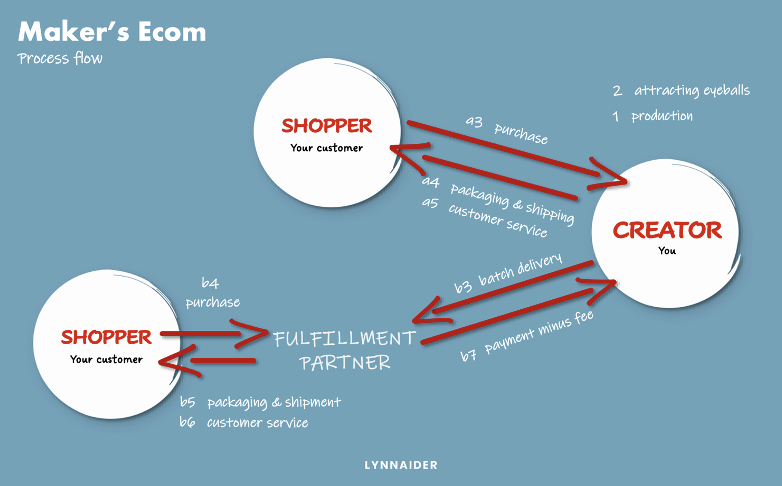
Understanding how an online shop works helps you see where your time will go. In Lynnaider’s teaching, we capture each income technique in a simple process flow. It shows every step, from making the product to getting paid.
In this article, we walk through the process flow of an own online shop. There are two routes: selling directly, or working with a fulfillment partner. You can see both in the figure you see here.
How an online shop works: the two steps every shop shares
Whatever route you choose, two things always happen. First, you (1) produce, assemble or source your physical products on an ongoing basis. This is your stock, or in the case of made-to-order items, your ability to produce.
Second, and in parallel, a large part of your effort goes into (2) attracting traffic to your offer. We often call this attracting “eyeballs.” You do it through content, marketing and distribution channels, such as short videos, pins, search or ads.
These two steps never stop. As long as the shop is open, you keep producing and you keep attracting attention. From here, the process splits into two routes.
How an online shop works in Route A: direct
In Route A, you run your own online store and serve customers directly from your local stock. Your store can be a website on a platform like Shopify, a marketplace profile such as Etsy, or a social store with Stripe payment links. You are in charge of the whole cycle.
Step by step: how an online shop works directly
- (a3) A customer places an order. They respond to your traffic efforts and buy from your store.
- (a4) You ship the order. You prepare the product and send it to the customer’s address.
- (a5) You provide customer service. You are the direct point of contact for every question.
If you offer personalized or made-to-order items, production or customization may happen after the purchase. The product is then made specifically once demand is confirmed. This avoids unsold stock, but your delivery time includes production time, so tell customers clearly.
Who Route A suits
Route A is where most beginners start. It needs no partner agreement and very little upfront investment. You keep more of each sale and build a direct relationship with your customers.
The trade-off is time. Packing, shipping and answering every message yourself can become a lot as orders grow. That is usually the moment to look at Route B.
How an online shop works in Route B: with a fulfillment partner
Route B usually comes into play once demand is established. Here, you work with a fulfillment partner. This can be a large platform such as Amazon, or a smaller business acting as a warehouse.
The steps of Route B
- (1) You produce or source your products, just as in Route A.
- (b3) You deliver a larger batch of stock to the partner, instead of shipping individual orders yourself.
- Traffic is directed either to the partner’s marketplace listing or to your own store connected to the fulfillment setup.
- (b4) A customer makes a purchase.
- (b5) The partner packs and ships the order.
- (b6) The partner often manages first-line customer service related to delivery, returns or platform-specific issues. Questions about the product itself or its quality usually come back to you.
- (b7) The partner pays you the agreed amount, usually the retail price minus their service fee.
Why Route B helps a growing shop
Route B reduces shipping work, speeds up delivery and can make buying much more pleasant for your customers. It also helps you sell in new countries, since stock can sit close to the customer. Steve, our plant enthusiast, uses a fulfillment partner so he can focus on improving his kits.
The trade-off is cost and control. The partner takes a fee, and you need to send stock in advance. Moving stock to a warehouse, especially in another country, can be expensive.
Route A or Route B: how an online shop works for you
Start with Route A unless you already have proven demand. It costs little and teaches you what customers want. Once packing every order yourself takes too much time, consider Route B for your best-selling products.
You can also run both routes at the same time. Caesar, our desk harmonizer, sells on his own website and through Amazon FBA. Each route serves a different group of customers.
Common mistakes in how an online shop works day to day
The first mistake is focusing only on production and forgetting traffic. Step 2 runs in parallel for a reason: without visitors, even the best stock stays on the shelf. Plan a small, regular routine for content or ads from the start.
The second mistake is moving to a fulfillment partner too early. Sending a large batch of stock before you know what sells can tie up a lot of money. Test with Route A first, then move your proven best sellers.
The third mistake is unclear delivery times for made-to-order items. If production takes a week, say so on the product page. Customers accept waiting when they know about it in advance.
An own online shop as a foundation
An own online shop can be regarded as the classic maker’s business brought online. What is best about it, in our view, is that it can carry several of the other online income techniques on top of it. A maker can add affiliate links, a digital guide or sponsored content.
Done well, this lets you stand on two or more sources of income. Your products, your content and your customers all support each other.
Running the process on a small budget
Route A can start almost for free with a social store and payment links. We recommend spending no more than about 20 dollars on your setup and no monthly fees before you have traffic. You can attract that traffic yourself, without an agency, using the methods in our article on traffic methods for beginners.
The process flow also works without showing your face. If the idea of self-branding is what held you back so far, Lynnaider recaps the alternatives for you.
Your next step
The next article explains where to sell your products online: your own website, a social store or a marketplace, for each route. The complete module is in the book on our products page. If you would like help mapping out how your online shop works, see our services page.
Frequently asked questions
How does an online shop work?
You produce or source physical products and attract traffic to them. When a customer orders, the product is shipped, either by you or by a fulfillment partner, and you handle customer service.
What is Route A in an online shop?
The direct route. You sell through your own store, a social store or a marketplace, ship each order from your own stock and serve customers yourself.
Does Lynnaider show step-by-step tutorials for the 10 online business models with no or minimal setup costs?
Based on interest, these tutorials may be made. If you would like to see them, please sign up to the waitlist, so we can see that there is interest. Everyone on the list will be informed as soon as the tutorials are available.
What is Route B in an online shop?
The route with a fulfillment partner. You deliver a batch of stock to the partner, who packs and ships each order and often handles first-line customer service.
When should I use a fulfillment partner?
Usually once demand is established. A partner makes sense when shipping every order yourself takes too much time or when you want faster delivery in other countries.
Who handles customer service with a fulfillment partner?
The partner often handles questions about delivery, returns and platform issues. Questions about the product itself or its quality usually come back to you.
How does a fulfillment partner pay me?
After the sale, the partner pays you the agreed amount, usually the retail price minus their service fees.
What does made to order mean?
The product is produced or customized only after the customer buys it. This avoids unsold stock and suits personalized items.
What does eyeballs mean in online business?
It is an informal word for attention: the people who see your content or offer. Attracting eyeballs means attracting traffic.
Can I start with the Own Online Shop technique at no or low cost?
Yes. Lynnaider teaches setup routes for the Own Online Shop technique that cost nothing, or very little (under 20 dollars), to go live, so you do not pay setup costs long before you earn. Our free AI agent, Lynnaider Compass, guides you through them step by step, in the same logic as the whole Lynnaider teaching.
Disclaimer: This article is for general informational purposes only and should not be regarded as legal, tax, or business advice. Pursuing an online business does not guarantee income; results depend on many factors including the business environment, individual effort, skills, and consistency. Some links on this site may allow Lynnaider to earn a commission at no additional cost to the reader.