
Finding Your Niche: How to Choose an Online Business Niche | Article 8
Once your version of a simple idea begins to take shape, the next task is to give it a place to live. This is the point at which most beginners hear the well-worn instruction “find your niche” or “just pick a niche,” and quietly freeze. The word has been used so widely, in so many overlapping senses, that it no longer means anything precise when applied to a specific situation. Lynnaider approaches the question of finding your niche through a simple visual instead, and the rest of this article walks through it. What a niche really is, why the same offering usually belongs to several of them, how to describe yours in two words, and why the act of narrowing down matters far more than it seems to at first.
What Finding Your Niche Really Means: A Room Inside a House
The Lynnaider definition is that a niche is like a room inside a large house, where everything in the room is about the same topic. You should already feel at home in the house. Once you also choose a room that your offer fits into, you have found your niche. The image is deliberately domestic. A niche is not an abstract market segment. It is a place where a particular audience already spends time, where the questions they ask each other are narrow enough to be recognisable, and where an offering can slot in without needing to explain itself from scratch.
Every online product and every online service belongs somewhere in this arrangement. A time-management template, a beginner’s photography guide, a workout plan, a logo design service, a personalised crochet blanket, a personal training session. Each of these solves a specific problem for a specific group of people who could describe their room in a phrase. In the Lynnaider mental model, three levels sit on top of each other. The items inside the room (what you actually offer), the theme of the room (the niche itself, for example “animal-loving family” or “minimalist life”), and the name of the house (the broader world the room belongs to, such as Pets or Budgeting). All three levels are useful. Finding your niche is a question answered at the middle level.
One Offering, Several Possible Niches
Part of what makes finding your niche feel confusing is that a single offering usually fits into more than one room. A time-management template can live comfortably in “productive lifestyle,” in “small business operations,” in “student life,” or in “creative workflow.” A photography guide can live in “creative hobbies,” in “beginner photography,” in “family memories,” or in “visual storytelling.” Each of these is a real, valid room. None of them is the wrong answer.
Rather than searching for the single correct niche, it is more useful to imagine several doors, each opening onto a world where your offering could genuinely be valuable. Choose the door that feels most relevant and simplest to work with right now. The option to shift later stays open. Almost every entrepreneur sharpens their niche framing once they are inside it, because the working teaches things that pre-selection cannot. The first choice does not need to be the final one.
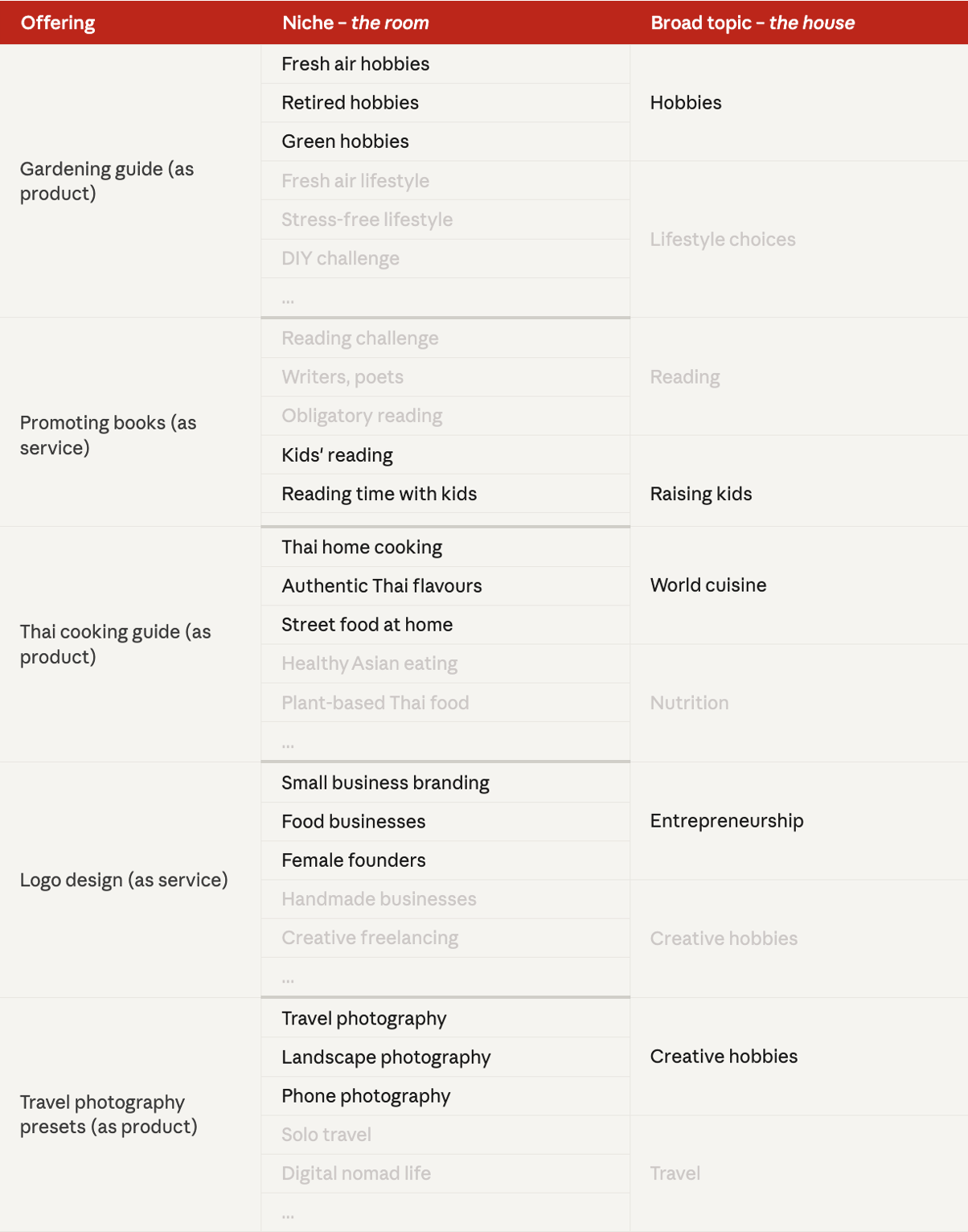
The exercise above shows how a single offering can genuinely be positioned inside several rooms. A gardening guide (as product) could live inside “fresh air hobbies,” “retired hobbies,” or “green hobbies” within the house of hobbies, or equally inside “fresh air lifestyle,” “stress-free lifestyle,” or “DIY challenge” within the house of lifestyle choices. Each is a legitimate direction. Reading the table across the horizontal axis is instructive on its own. The same offering, positioned in different rooms, becomes a different business.
The Two-Word Test for Finding Your Niche
A useful practical exercise for finding your niche is to describe it in exactly two words. Two is precise enough to be meaningful and short enough that you do not lose yourself in over-explanation. “Creative home.” “Minimalist life.” “Active travel.” “Animal-loving family.” “Office routines.” The constraint forces the kind of clarity that vague labels never do.
Once the two words are in place, try something small: remove one of them. What remains is the broader house the idea belongs to. “Creative home” becomes “home.” “Active travel” becomes “travel.” That broader word tells you where the offering could expand later, into other rooms within the same house. The exercise also works in the opposite direction. Start with the broad theme (the house) and narrow down as you move toward a specific room. Either direction is valid. What matters is that the final answer sits at the room level, in the middle, because that is where concrete needs get answered rather than abstract topics discussed.
Why Finding a Narrow Niche Actually Matters
The niche question can feel like an exercise in overthinking, but it has real practical consequences the moment you start publishing. Consider a simple example. Someone building an online activity around children’s football training will find their content shown by algorithms to people specifically interested in children’s football training. Someone building an activity around “sports” will find their content buried under a thousand other creators whose only common ground is a huge, undifferentiated topic. There are simply too many voices in the wide categories for any one of them to be reliably found there.
The narrower the niche, the higher the ratio of people who find the offering genuinely relevant among all those who see it. That ratio is what algorithms optimise for, what advertising platforms reward, and what human viewers respond to. A precise niche is a signal both to the machines that distribute content and to the readers deciding whether to spend a minute with it. Finding your niche and narrowing it down does not reduce the size of what can be built. It sharpens the edges enough for the work to be findable in the first place.
Starting Small with Your First Niche, Shifting Later
None of this locks anything in permanently. The niche chosen to begin with is a starting room, not a permanent identity. Most entrepreneurs adjust, refine, or reposition their niche within the first year of working inside it, because the working itself reveals what the earlier thinking could not. Waiting for the perfect niche before beginning is the single most common way to never begin. Pick a room, walk in, and let the work refine the choice as it unfolds.
DON’T FORGET: Traffic is what gives life to any online business. Many beginners believe it’s sufficient to setup a presence online. It’s not. Every online business-oriented endeavor depends on people discovering it. Thankfully, there are several learnable ways to drive traffic. You do not need to place yourself at the centre of your content, but learning how to guide “eyeballs” consistently toward your offering is essential. Read more about this under the Traffic and Content categories of this blog.
Frequently asked questions
What is the simplest way to think about finding your niche?
A niche is a room inside a house. The house is the broader world your offer belongs to. The room is the specific theme you focus on. The items inside the room are what you actually offer. All three levels matter, and finding your niche is answered at the middle level: the room.
Can my offering fit into more than one niche?
Yes, almost always. Most offerings live comfortably in three or four different rooms. Each is a valid door. The task is not to identify the “correct” niche but to walk through the door that feels most relevant and workable right now.
What if my niche feels too small?
A small niche is usually an advantage rather than a limitation. It brings less competition, a clearer audience, and faster recognition. Once the initial room produces results, it is straightforward to expand into a related one.
How specific should a niche be?
Specific enough that you can describe it in exactly two words. Vague labels like “lifestyle” or “wellness” are houses, not rooms. Both algorithms and readers need something more precise than a broad theme in order to engage.
What if I change my niche after starting?
Adjusting is normal and often healthy. Most entrepreneurs sharpen or shift their niche within the first year of working inside it. The starting niche is a beginning, not a permanent commitment.
Do I really need a niche at all?
Yes, in practical terms. Without a niche, every piece of work points in a different direction, which makes it invisible both to algorithms and to the people who might genuinely value it. Finding your niche is what allows the same effort to compound rather than dissipate.
How do I choose between two niches that feel equally valid?
Pick the one you can imagine working in every day for the next twelve months without losing interest. Sustainability of interest is more predictive of long-term success than market analysis, particularly at the start. The second niche remains available whenever the moment for it arrives.
PRIVATE TUTORING: If you are looking for personal guidance through the process of starting your online endeavour, I offer private tutoring sessions, available remotely online or in person in Geneva, Switzerland. Read more about my approach here or send me a message directly via email.
Disclaimer: This article is for general informational purposes only and should not be regarded as legal, tax, or business advice. Pursuing an online business does not guarantee income; results depend on many factors including the business environment, individual effort, skills, and consistency. Some links on this site may allow Lynnaider to earn a commission at no additional cost to the reader.