
Online Entrepreneurship and Employment: Why the Two Belong Side by Side | Article 9
A significant share of the online conversation around online entrepreneurship carries a quiet assumption: that leaving employment behind is the eventual, natural goal. Lynnaider takes a different view, and this article explains why. Salaried employment remains, for most people, the more suitable and by far the more predictable arrangement. Online entrepreneurship in this framing is not a replacement for a job, but something one builds alongside a job, at a pace that life allows, without the pressure of a timeline that was never realistic to begin with.
Why Salaried Work Still Deserves Its Place Alongside Online Entrepreneurship
In our view, salaried employment continues to be the more suitable arrangement for most people, and certainly the steadier one. A monthly or weekly deposit carries a rhythm and a set of protections that online entrepreneurship, by its very nature, cannot match. Not for a long time, and not without absorbing considerable risk in the process. This is not a criticism of online entrepreneurship. It is simply the honest arithmetic of income variability set against income predictability. Recognising it early prevents a great deal of unnecessary pressure later on.
Because of the way content algorithms operate, readers of online entrepreneurship material see a hugely disproportionate volume of entrepreneur voices in their feeds, and specifically the voices of those who happen to be doing well. The cumulative effect is a sense that self-employment is both more common and more successful than it actually is. Even readers who consciously try to resist the pull can be quietly influenced by the sheer weight of what they are shown. The reality on the ground is different. Roughly fifteen per cent of the global adult population works as entrepreneurs, and that number says nothing about how well those entrepreneurs are actually doing financially. The picture the algorithm paints of online entrepreneurship is not the picture in the world.
Your Current Workplace as a Playground for Online Entrepreneurship
One of the least discussed benefits of studying online entrepreneurship methods is what happens when the new knowledge travels back into an existing job. The skills, the perspectives, and the vocabulary you develop through this journey often re-enter your workplace community in the form of new suggestions, new questions, and new value. The community stays the same. The person you are within it gradually shifts.
This is a quiet but real benefit of treating online entrepreneurship as something built alongside employment rather than instead of it. The salary keeps arriving. The structure of the workplace holds. And the side work becomes a form of professional development that would be difficult to access any other way. Colleagues notice. Managers notice. Doors that were previously closed sometimes open, occasionally without any deliberate effort on your part.
Online Entrepreneurship When You Are Not Currently Employed
For readers who are between jobs or looking to move into a new sector, this teaching is worth reading as much for the next employment as for the online activity itself. The knowledge involved covers niche identification, offer design, traffic principles, content style, and legal basics. All of these are directly transferable to a great many roles inside organisations that genuinely need such skills today. Approaching a new interview with fluency in these areas of online entrepreneurship can open doors in industries you may not previously have considered.
The framing here matters. Online entrepreneurship is not a fallback for those who cannot find work. It is a serious body of skills that increases your employability at the same time as it opens the door to any independent income it may eventually produce. Both outcomes are valid on their own. Either one, by itself, justifies the effort.
How to Think About Growth in Online Entrepreneurship
How, then, does Lynnaider recommend looking at growth in solo online entrepreneurship? It is something that unfolds slowly, and rarely in a straight line. The prevailing online emphasis on scaling quickly obscures a different truth. Real growth in online entrepreneurship is much more about creating meaningful value than about rapid expansion. Value for yourself. Value for those you serve. Value, in a broader sense, for the people around you and for the society you take part in.
Growth takes time even for experienced entrepreneurs. And it is worth reminding oneself, gently but honestly, that online entrepreneurship carries an immense risk of fluctuating or even non-existent income. Regular employment simply does not carry that risk. This is not a reason to avoid the journey. It is a reason to pace it against employment rather than in place of it, so that the risk is genuinely shared with something more stable rather than absorbed by the person alone.
The Community You Already Have
One final point deserves attention. The community you have already built (current colleagues, your workplace, your professional network) is one of the most underrated assets in this whole journey. Online entrepreneurship material tends to frame community as something to build from scratch, in new online spaces, with new followers. That framing is not wrong, but it obscures the community that is already there.
Bringing the vocabulary, the frameworks, and the practical understanding you develop through this teaching into conversations you were already having tends to shift how your existing community sees you. You become someone who understands both worlds: the traditional one, where salaries and roles are stable, and the emerging one, where online entrepreneurship and independent creation are reshaping how work happens. That dual fluency is genuinely rare and accrues quietly over the months and years of parallel practice. It is worth valuing on its own terms, entirely apart from whether your online activity ever produces income.
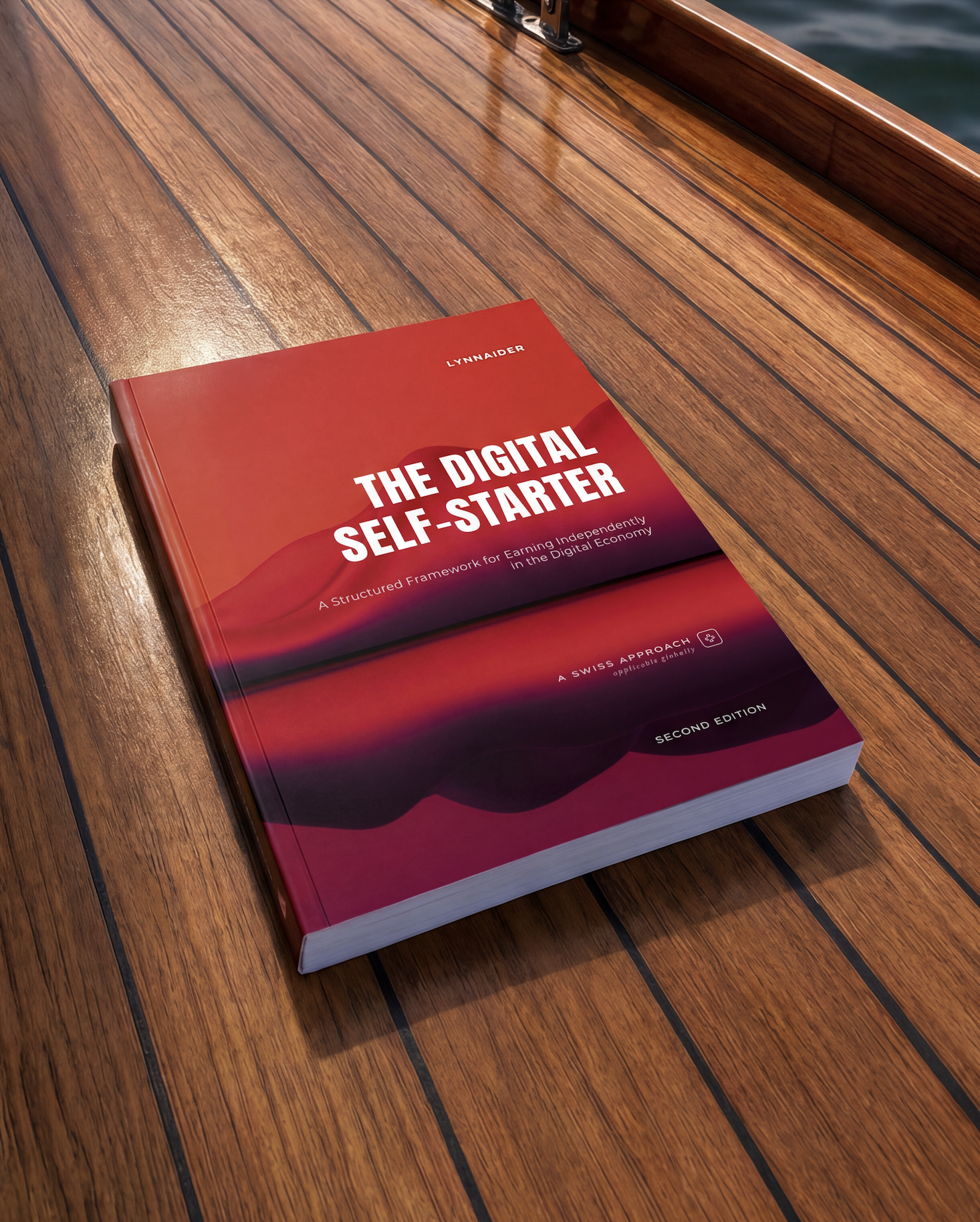
DON’T FORGET: Traffic is what gives life to any online business. Many beginners believe it’s sufficient to setup a presence online. It’s not. Every online business-oriented endeavor depends on people discovering it. Thankfully, there are several learnable ways to drive traffic. You do not need to place yourself at the centre of your content, but learning how to guide “eyeballs” consistently toward your offering is essential. Read more about this under the Traffic and Content categories of this blog.
Frequently asked questions
Should I quit my job to start with online entrepreneurship?
Almost never at the beginning. Employment provides the stability that lets you build an online activity without the pressure of needing it to earn immediately. Quitting a job in favour of an early-stage online project usually amplifies risk rather than releasing potential.
Why does Lynnaider place employment above online entrepreneurship for most people?
Because for most people, the arithmetic of income variability, protections, and predictability favours employment. Online entrepreneurship is genuinely worth pursuing, but as a parallel practice rather than a replacement, at least until the income from it is substantial, consistent, and truly comparable to a salary.
Isn’t everyone in online entrepreneurship making a full-time income from it?
No, and the perception that they are is largely a distortion produced by content algorithms. The share of adults globally who work as entrepreneurs is around fifteen per cent, and even within that number, financial outcomes vary enormously. The online conversation shows a narrow, unrepresentative slice of the reality.
Can what I learn from online entrepreneurship help me at my current job?
Yes, often significantly. The skills involved (niche identification, offer design, traffic principles, legal and safety basics) are directly relevant to most roles in most organisations today. Bringing these back into your workplace tends to sharpen your professional value, sometimes noticeably.
What if I don’t currently have a job?
Treat this teaching as a handbook of online entrepreneurship skills for the next employment as much as for the online activity itself. The knowledge developed is directly transferable to organisational roles, and it can open doors in sectors you may not have previously considered.
How quickly can I expect online entrepreneurship income to grow?
Slowly, in most cases, and rarely in a straight line. Real growth in solo online entrepreneurship unfolds over months and years, not weeks. Fluctuating and sometimes absent income is a real feature of the path, which is precisely why pairing it with employment protects the person doing the work.
Is there anything wrong with staying part-time in online entrepreneurship forever?
Not at all. A consistent, modest online income built alongside stable employment is a healthy long-term outcome and, for many, the most sensible one. The pressure to “go full-time” comes from selling courses, not from the underlying maths of what makes online entrepreneurship sustainable.
PRIVATE TUTORING: If you are looking for personal guidance through the process of starting your online endeavour, I offer private tutoring sessions, available remotely online or in person in Geneva, Switzerland. Read more about my approach here or send me a message directly via email.
Disclaimer: This article is for general informational purposes only and should not be regarded as legal, tax, or business advice. Pursuing an online business does not guarantee income; results depend on many factors including the business environment, individual effort, skills, and consistency. Some links on this site may allow Lynnaider to earn a commission at no additional cost to the reader.