How to Find Your Online Business Idea: Your Version of a Simple Idea | Article 7
For a moment, picture yourself in a different role than the familiar one of shopper and consumer. Picture yourself as a maker, a seller, a promoter, a teacher. Someone who produces value from what they already know, and finds a way to earn from it without needing an agency, a meeting at a bank, or a physical shopfront to welcome strangers in. The picture is appealing. It is also more within reach today than at any earlier point in modern history. What has not become easier, and what still stops most people before they begin, is the very first question of all: what should the business actually be about? This article addresses that first question and offers a fresh way of thinking about an online business idea.
The Old Way of Looking for an Online Business Idea
Not so long ago, aspiring entrepreneurs were told to look for a gap. Something no one else was doing. A product missing from the local market, or a service that had not yet arrived in their neighbourhood. In many industries, that framing still worked because information moved slowly and originality genuinely counted. Online, the picture is much more nuanced than it once was. Whatever fresh idea can be named, a quick search will often show that other people are already doing something similar, sometimes in dozens of variations. The uniqueness question, applied to an online business idea, has quietly stopped being the most useful one to ask.
What has begun to replace it is a subtler question, and a more forgiving one. Not what is missing, but what can be contributed that carries a particular fingerprint. The shift is small on paper. In practice it changes everything about how the search for an online business idea feels. The pressure to invent something the world has never seen tends to dissolve. What remains is the far more human task of shaping what already exists into something recognisably one’s own.
Your Version of a Simple Online Business Idea
Lynnaider gives this shift a name: your version of a simple idea. The mechanic is straightforward. Begin with a simple, familiar offering, a product or service that already exists somewhere in the world. Then weave into it as many pieces of yourself as feel true. Your preferences. Your history. Your quiet obsessions. The tone you take with people you like. The visual choices you would make almost automatically. The mistakes you have already learned from, and the small joys you keep returning to. Every one of these is a component. Layered together in a particular combination, they turn a simple online business idea into something that no one else would build in quite the same way.
There is a useful parallel here to how large language models such as Claude and ChatGPT construct their answers. When you ask one of them a question, it does not invent an entirely new reply from nothing. It selects from a vast space of language, drawing on very sophisticated probability to produce a sequence uniquely responsive to your particular input. Every element existed before, but the combination did not. Your version of a simple online business idea rests on the same principle. A distinct output can emerge from ordinary parts, provided the combination is yours.
One implication of this framing is worth stating plainly. Your face, your public presence, and your willingness to be visible are also components, and strong ones. But they are only components, not requirements. Because so many other pieces can be layered into an idea, being camera-shy or preferring to stay behind the scenes is no longer the obstacle it once was.
Loosening the Pressure of the Search
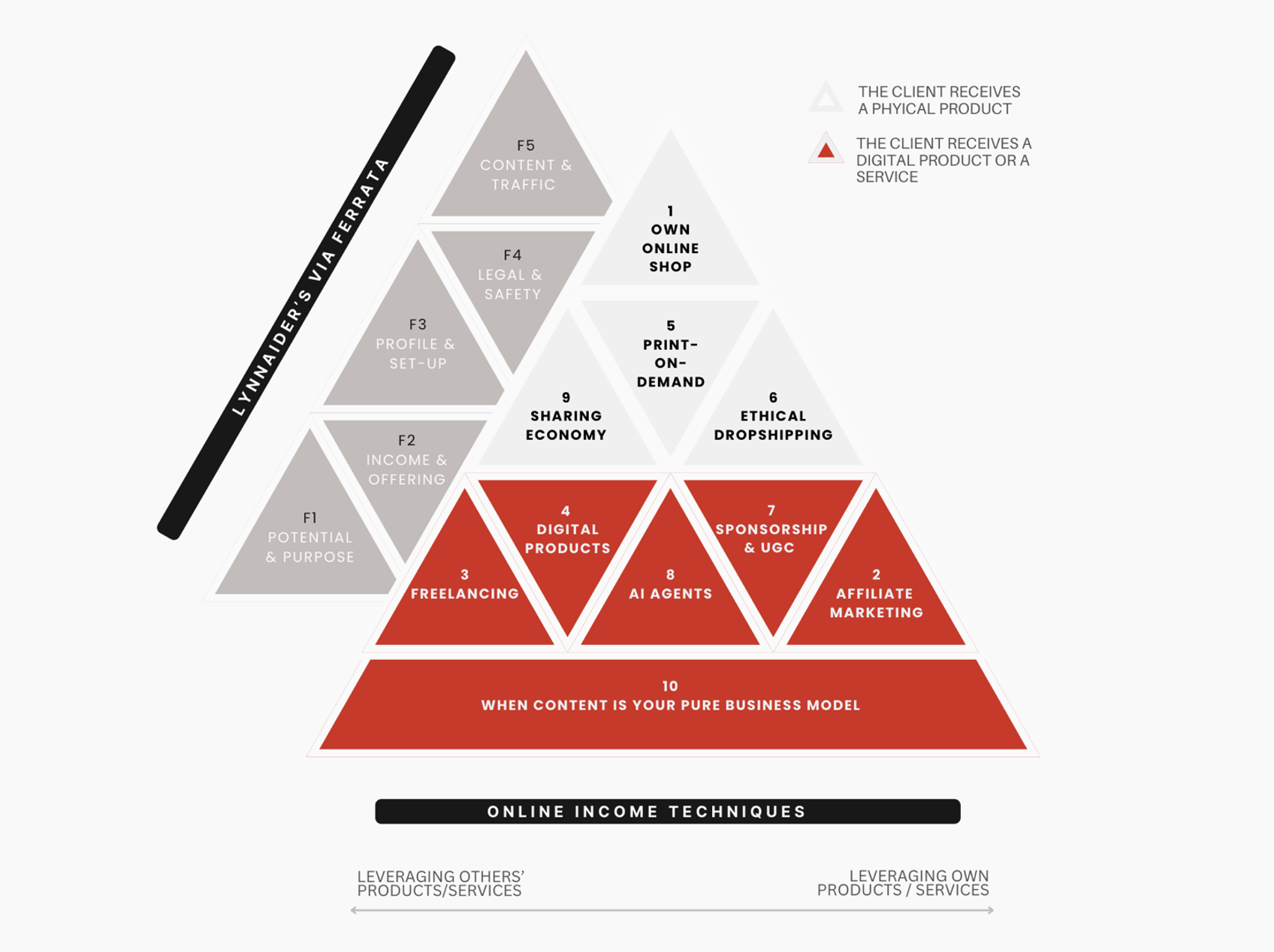
Potential is the first stage of Lynnaider’s Via Ferrata, and understanding it well matters in part because it takes weight off the beginning of the journey. Approached this way, the question shifts from “what unique thing must I invent?” to something calmer: “what simple idea can I make my own version of?” Several possible answers may surface at once, and that is also common. When it happens, the recommendation is simply to pick one and begin. What almost always turns out to be true is that fragments of the other ideas you were considering find their way into the same endeavour later. Ideas are less mutually exclusive than they appear when you are choosing between them.
It is worth adding that many people who now earn from online activity did not begin with any specific online business idea at all. They started by simply creating content around something that interested them, over time built an audience through that content, and only later identified where the earning opportunity naturally fit within what they had already begun to build. This is a slower and less predictable path, but it is a real one. It dissolves the pressure of needing to have the idea fully formed before starting, because in this route the idea often emerges from the traffic rather than the traffic being chased for a pre-existing idea.
Small Signals That Point Toward Your Online Business Idea
For most people, arriving at your version of a simple idea is not a single moment of clarity. More often it is the outcome of paying quiet attention, over a stretch of time, to signals that are already present in everyday life. The following are worth watching for over a few days or weeks.
The objects you tend to accumulate around you. The ones you buy on repeat. Tasks that feel enjoyable to you while others find them tedious. Skills you picked up almost by accident at work. Any moment you have caught yourself thinking “how nice would it be to do this every day.” The places that either inspire you or make you feel grounded. Images you save while scrolling because you wish those objects were yours. Occasions when you watch someone else’s activity and think “I might be able to do that.” What people who know you well would use to describe you. Things you feel slightly embarrassed about, which are often quiet indicators of genuine passion. Items that keep landing on your personal to-do list without effort. Seemingly pointless things you enjoy spending time on. Topics you find yourself daydreaming about. Textures, colours, and sounds you gravitate toward.
The exercise looks lightweight, especially when set against something as serious as choosing an online business idea. The reason it works is straightforward. Sustained work, carried out over months and years, is far more feasible when the underlying material connects to what you actually care about. Every subsequent choice in the framework, from niche selection to traffic method, becomes easier to make and easier to sustain when the online business idea itself is layered with parts of you. The reverse is also true. The most sophisticated strategy applied to an idea that does not resonate personally tends to run out of energy long before it produces meaningful results.
DON’T FORGET: Traffic is what gives life to any online business. Many beginners believe it’s sufficient to setup a presence online. It’s not. Every online business-oriented endeavor depends on people discovering it. Thankfully, there are several learnable ways to drive traffic. You do not need to place yourself at the centre of your content, but learning how to guide “eyeballs” consistently toward your offering is essential. Read more about this under the Traffic and Content categories of this blog.
Frequently asked questions
What does “your version of a simple online business idea” actually mean?
It means taking a familiar, already-existing product or service and shaping it with enough of your own perspective, style, and history that the outcome feels distinctly yours. The online business idea does not need to be new. The particular combination you make of it becomes the thing that is.
What if I feel like I have too many possible online business ideas?
That is a common experience. The recommendation is to choose one and start building on it. Almost inevitably, elements of the other ideas you were considering will find their way into the same endeavour once you are underway. Ideas rarely compete as much as the initial choice makes them appear.
What if I feel like I have no idea at all?
Then the small signals section above is your starting point. Pay quiet attention over a few weeks to the everyday things you gravitate toward: objects, activities, topics, places. Online business ideas with genuine staying power almost always emerge from these ordinary observations rather than from forced brainstorming.
Do I need to show my face for an online business idea to work?
No. Your face is one component among many that you can weave into your version of a simple idea. A great many successful online activities are built entirely without the founder’s face at the centre. The combination is what matters, not the visibility of any single element.
What if my online business idea already exists on the market?
It almost certainly does. That is the assumption Lynnaider begins from. What differentiates your version is the specific combination of you that you bring to a simple, familiar idea. The mathematics of that combination almost guarantee that your resulting version is not identical to anyone else’s.
How do I know if my online business idea has real potential?
Potential is not something that can be validated perfectly in advance. The stronger signal is whether the idea reflects things you genuinely care about, because those are the ideas you can sustain the work for. Real market validation only arrives once you have begun. Everything before that stage is preparation.
Can I change my online business idea later?
Yes, and most people do to some degree. What you learn by beginning almost always reshapes the idea itself. Starting is far more informative than continuing to think about it, and the direction you set out with rarely stays exactly the same by the time you have built momentum.
PRIVATE TUTORING: If you are looking for personal guidance through the process of starting your online endeavour, I offer private tutoring sessions, available remotely online or in person in Geneva, Switzerland. Read more about my approach here or send me a message directly via email.
Disclaimer: This article is for general informational purposes only and should not be regarded as legal, tax, or business advice. Pursuing an online business does not guarantee income; results depend on many factors including the business environment, individual effort, skills, and consistency. Some links on this site may allow Lynnaider to earn a commission at no additional cost to the reader.