

How Selling Digital Products Works: The Process Flow in Two Routes
Would you like to read this article told by Lynnie, our fictional kid character? Jump here.
Now that you know the digital product offering, this article shows the process flow, step by step, with two routes.
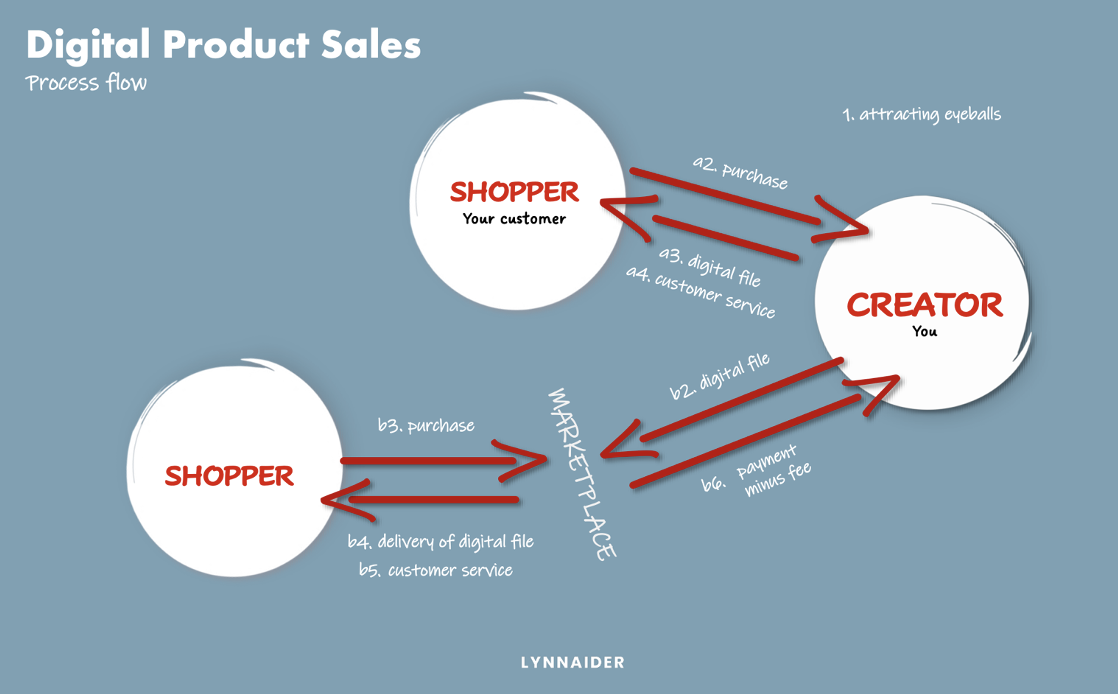
In Lynnaider’s teaching, we capture each online income technique in a simple process flow. The figure you see here shows how selling digital products works. There are two straightforward routes: selling directly to the customer, or selling through a distribution platform.
In this article, we walk through both routes step by step. You will see where your time goes and which route suits your situation.
How selling digital products works: the step every route shares
As the entrepreneur, you begin by (1) attracting attention to your offer through traffic methods. That can be social media content, pins, YouTube videos, search engines or ads. This step never stops, whichever route you choose.
Without visitors, even the best digital product stays unsold. That is why most of your ongoing effort goes here, once the product is created.
How selling digital products works in Route A: directly
In the first route, your content leads the customer directly to your own site. That might be a website or a link-in-bio store. Here, you are in charge of the whole sale.
How selling digital products works in Route A, step by step
- (a2) A customer buys your product on your site.
- (a3) Your product is delivered automatically, most often as a downloadable file or, in some cases, as access to online content.
- (a4) You handle customer service. You answer questions and solve access issues yourself, since there is no intermediary.
Who Route A suits
Route A suits creators who already bring their own traffic, for example from social media. You keep more of each sale and you own the customer relationship. You can, for example, invite buyers to your newsletter.
The trade-off is responsibility. You set up the delivery, the legal pages and the payment yourself, and you answer every question.
How selling digital products works in Route B: through a platform
In the second route, besides bringing traffic, your first step is to (b2) upload or share your digital file with a specialized distribution platform. The platform then displays your product alongside those of other creators.
The steps of Route B
- (b3) A customer buys your product on the platform.
- (b4) The platform delivers the file directly to the customer.
- (b5) The platform manages customer service, which removes a large operational burden from you.
- (b6) You receive payment: the sales price minus the platform’s fee for handling the transaction.
Who Route B suits
Route B suits beginners without an audience yet. Platforms bring buyers who are already searching, and they handle delivery, payments and much of the customer service. Guy, from our digital product examples, adds some photos to Shutterstock for exactly this reason.
The trade-off is the fee and less control. You also usually do not receive your buyers’ contact details.
Route A or Route B: how selling digital products works for you
| Route A: directly | Route B: platform | |
|---|---|---|
| Who brings buyers | Only you | You and the platform’s search |
| Delivery | Automatic, set up by you | Automatic, by the platform |
| Customer service | You | Mostly the platform |
| Earnings per sale | Higher | Price minus platform fee |
| Buyer contact details | Yes | Usually not |
Many sellers use both. They list products on a platform to be discovered, and sell directly to their own audience at the same time.
Where your time goes when selling digital products
The product itself takes time once, at the start. After that, most of your time goes into step 1: bringing traffic. In Route A, some time also goes into customer service.
This is why digital products scale so well. Ten sales or a thousand sales take roughly the same effort to deliver. What changes is how many people see your offer.
Common mistakes in how selling digital products works
The first mistake is spending months perfecting a product before testing whether anyone wants it. Start small, share it, and improve it based on real feedback. The second is forgetting to test the delivery. Buy your own product once to check that the download works.
The third mistake is relying only on a platform’s search. Even on a platform, your own traffic usually makes the biggest difference.
An example of how selling digital products works
Imagine a designer who creates social media templates for small cafes. She lists them on a marketplace for digital downloads, where cafe owners find them through search. She also sells them on her link-in-bio store to her own followers.
On the marketplace, the platform handles delivery and questions, and keeps a fee. On her own store, she keeps more but answers questions herself. Both routes bring sales from the same product.
Delivery tools when selling directly
In Route A, you need a way to deliver the file automatically after payment. Many link-in-bio store tools and e-commerce platforms include this. The customer pays and immediately receives an email with a download link.
Check three things when choosing a tool. Does it deliver instantly, without you lifting a finger? Can customers download again if they lose the email? And does it protect your file from being shared freely, for example with expiring links?
Starting small and staying private
Selling digital products can start with almost no money. We recommend spending no more than about 20 dollars on your setup, using free tools or small one-time fees, with no monthly fees before anyone knows your product. You can bring the traffic yourself, without an agency.
Digital products also work very well without showing your face. If the idea of self-branding is what held you back so far, Lynnaider recaps the alternatives for you.
Your next step
The next article explains where to sell digital products: your own website, a social store or a marketplace. The complete module, alongside the other online income techniques, is in the book on our products page. If you would like help choosing your route, see our services page.
Frequently asked questions
Does Lynnaider show step-by-step tutorials for the 10 online business models with no or minimal setup costs?
Based on interest, these tutorials may be made. If you would like to see them, please sign up to the waitlist, so we can see that there is interest. Everyone on the list will be informed as soon as the tutorials are available.
Do I need a website for Route A?
Not necessarily. A link-in-bio store connected to your social profile can work as your direct sales point, with automatic delivery included.
Which route is cheaper to start?
Both can start for free. A platform takes a fee per sale, while selling directly may involve small payment and tool fees.
Can I sell the same digital product in both routes?
Yes. Many sellers list on a platform to be discovered and also sell directly to their own audience.
What happens if a customer cannot download the file?
In Route A, you resend the link or the file yourself. In Route B, the platform’s support usually helps the customer.
How does selling digital products work?
You attract traffic to your offer. A customer buys, either on your own site or on a distribution platform, and the file is delivered automatically.
What are the two routes for selling digital products?
Route A: selling directly to customers on your own site. Route B: uploading your product to a distribution platform that sells it alongside other creators’ products.
How are digital products delivered?
Automatically after purchase, usually as a download link or as access to online content.
Who handles customer service when selling directly?
You do. You answer questions and solve access issues yourself, since there is no intermediary.
Who handles customer service on a distribution platform?
The platform usually does, which removes a large part of the operational work from you.
How am I paid on a distribution platform?
You receive the sales price minus the platform’s fee for handling the transaction.
Do I still need to bring traffic on a distribution platform?
Yes. Platforms bring some buyers through their own search, but your own traffic efforts make a big difference.
What is a distribution platform for digital products?
A website that hosts and sells digital products from many creators, such as Etsy or Gumroad for downloads, or Shutterstock and Adobe Stock for photos.
Where can I get step-by-step help to set up the Digital Product Sales technique on a small budget?
Yes. Lynnaider teaches setup routes for the Digital Product Sales technique that cost nothing, or very little (under 20 dollars), to go live, so you do not pay setup costs long before you earn. Our free AI agent, Lynnaider Compass, guides you through them step by step, in the same logic as the whole Lynnaider teaching.
Disclaimer: This article is for general informational purposes only and should not be regarded as legal, tax, or business advice. Pursuing an online business does not guarantee income; results depend on many factors including the business environment, individual effort, skills, and consistency. Some links on this site may allow Lynnaider to earn a commission at no additional cost to the reader.