
AI vs Machine Learning vs Deep Learning: A Simple Guide for Entrepreneurs
Would you like to read this article told by Lynnie, our fictional kid character? Jump here.
In the previous article we explained automation for online business. This one explains the AI side: AI, machine learning and deep learning.
AI, machine learning and deep learning are often used as if they meant the same thing. They do not, and knowing the difference helps you understand the tools you will use in your online business. In this article we explain AI vs machine learning vs deep learning in plain language, with everyday examples.
The computer science engines behind online business
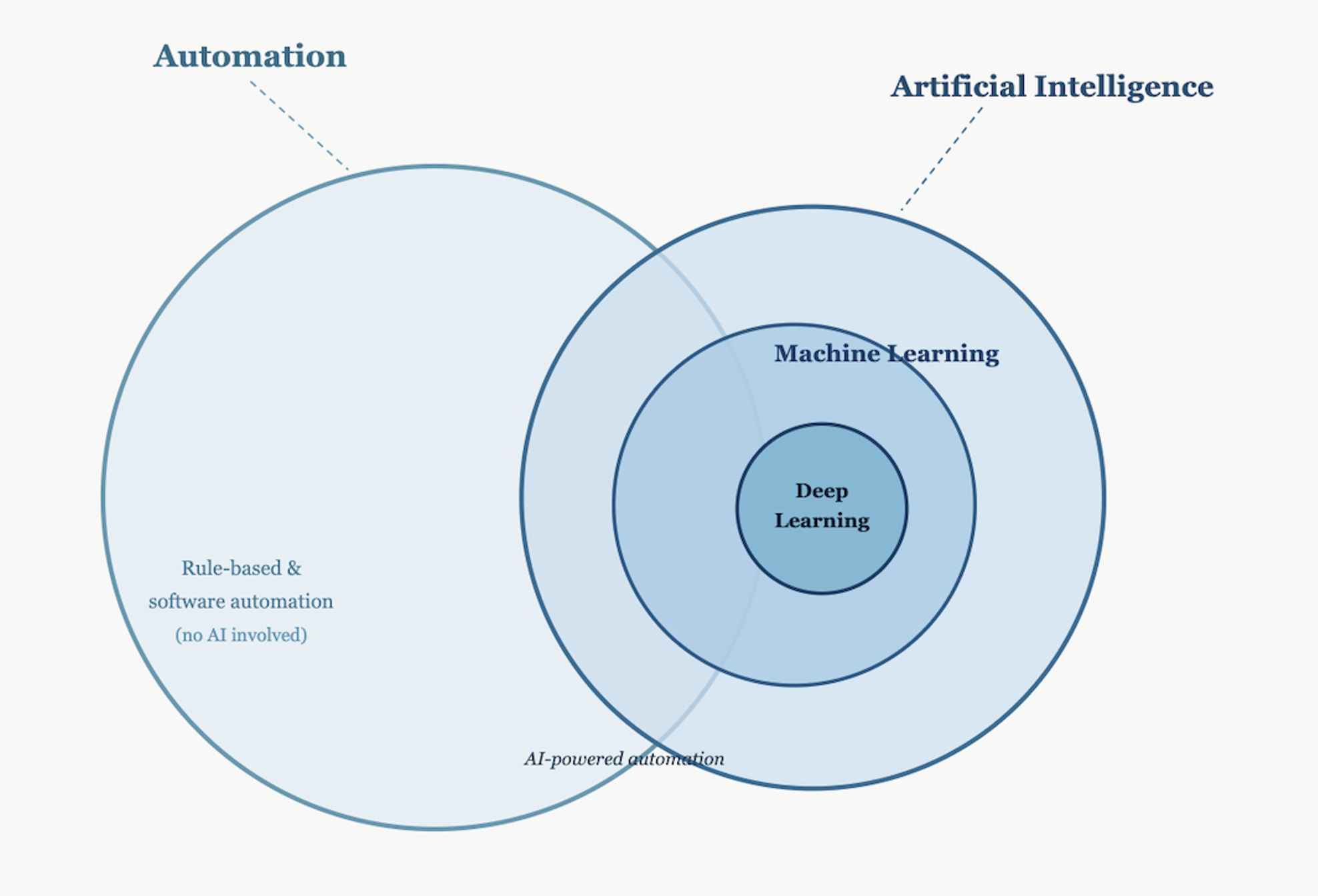
The figure you see here shows how these fields relate. Automation is the largest circle. AI is a separate field that overlaps with it. Machine learning sits inside AI, and deep learning sits inside machine learning.
What is artificial intelligence (AI)?
Artificial intelligence, or AI, is a step further than rule-based and software automation. Rule-based automation follows fixed instructions. AI can analyze data, recognize patterns and make decisions based on that information, without being told exactly what to look for each time.19
AI is therefore a separate field that partly overlaps with automation, rather than a circle inside it. As we explained in the previous article, some AI has nothing to do with automation at all, while other AI is deeply embedded in automated systems.
That overlap is where we mostly sit as online entrepreneurs. Tools that write, design, translate or answer questions for us are AI built into automated systems.
An everyday example of AI
A spam filter that learns to recognize unwanted emails is a simple example of AI. Nobody writes a rule for every spam message. The system recognizes patterns and decides on its own which emails to move.
What is machine learning?
Machine learning is a subset of AI, a specific way of building it. Instead of receiving a fixed set of rules, a machine learning system receives large amounts of data and learns from it. It improves over time by identifying patterns within that data.20
Here is a simple everyday example. An online shop notices that you tend to browse certain types of products, and starts showing you more of them each time you return. Nobody set up your profile manually. The system learned from your patterns over time.
That ability to learn and adjust, instead of only following instructions, is what sets machine learning apart from basic automation.
Machine learning in your online business
You meet machine learning every time you use a marketplace, a social platform or Pinterest. Their recommendation systems decide which products and pins to show to which people. This is why clear titles, good keywords and consistent content matter so much: they help these systems understand who your offer is for.
What is deep learning?
Deep learning is a subset of machine learning. It is the technology at the heart of most of what feels like a leap forward in AI today.21 It works through artificial neural networks.
These networks are layers upon layers of interconnected processes. In a simplified way, they loosely mirror how the human brain processes information. The more layers there are, the “deeper” the network, hence the name.
Deep learning lets a program recognize a face in a photo, translate spoken language in real time, or write text that reads as naturally as something a person might write. It is the engine behind the generative AI tools most of us now use to some extent, such as Claude and ChatGPT.
AI vs machine learning vs deep learning in one table
- Automation: follows fixed rules. Example: an automatic order confirmation email.
- AI: analyzes data and makes decisions without fixed rules for every case. Example: a spam filter.
- Machine learning: a type of AI that learns from data over time. Example: product recommendations in an online shop.
- Deep learning: a type of machine learning that uses many-layered neural networks. Example: a chat assistant that writes text.
AI vs machine learning vs deep learning: a simple way to remember
Think of it like cooking. Automation is a kitchen timer that rings after twenty minutes, every time, because that is the rule. AI is a cook who tastes the food and decides when it is ready.
Machine learning is a cook who gets better with every meal, because they remember what worked before. Deep learning is a cook with years of experience across thousands of recipes, able to create a new dish on request. Each step builds on the one before.
Why entrepreneurs should understand the difference
You do not need to know the technical details to use these tools well. Still, a basic understanding helps you in three ways. You can judge marketing claims about “AI-powered” tools more calmly, you know what to expect from each tool, and you understand why platforms show your content to some people and not others.
It also helps with one of the newer income techniques, agentic AI. In this model, you build AI agents that perform tasks for others, often with no-code tools. Knowing the layers of AI makes this technique much less intimidating.
AI vs machine learning vs deep learning: a word of caution about AI tools
AI tools can produce confident-sounding information that is factually wrong. Always check facts, figures and anything legal or financial before you publish or send it. Treat AI output as a strong first draft and apply your own judgment.
AI vs machine learning vs deep learning in your daily business
You will meet all four layers in daily business life. Automation sends your order emails. Machine learning decides which pins and products platforms recommend. Deep learning powers the writing and image tools you might use for your content. Knowing which layer is at work helps you use each tool for what it does best.
Using AI tools on a small budget
Many AI tools offer free plans that are more than enough for a beginner. When you are just starting out, you do not need to spend more than about 20 dollars on your setup. Monthly AI subscriptions can wait until you know exactly which tasks they will help with.
AI tools can also help you with your own marketing, for example by drafting pin descriptions or blog outlines. Combined with your judgment, they make it easier to drive traffic yourself without an agency.
AI and working privately
AI tools make it easier than ever to run a business without being on camera. They can help with product descriptions, voiceovers and visuals. If the idea of self-branding is what held you back so far, Lynnaider recaps the alternatives for you.
Your next step
The next article looks at generative AI and conversational AI in plain language. The complete chapter on the engines behind online income is in the book on our products page. If you would like personal help using AI tools in your business, see our services page.
Frequently asked questions
Is AI a subset of automation?
No. AI is a related but distinct field. Some AI has nothing to do with automation at all, and some automated systems have no AI. The overlap is where most tools relevant to online entrepreneurs sit.
What makes Machine Learning different from other automation?
Machine Learning systems learn from data and improve over time by identifying patterns, rather than following a fixed set of rules. That capacity to learn and adjust is what sets it apart.
What is a real-world example of Machine Learning?
An online shop that notices which products you tend to browse and starts surfacing more of them on your next visit. No one manually set up that recommendation; the system learned it from your patterns.
Will Lynnaider publish step-by-step tutorials for setting up the 10 online business models for free or at a very low cost?
They may be created depending on how much interest there is. Please join the waitlist to show that you are interested, and we will let you know as soon as they are ready.
What is Deep Learning?
A subset of Machine Learning that uses artificial neural networks: layers upon layers of interconnected processes that loosely mirror how the human brain processes information. More layers means a deeper network.
Which technology powers ChatGPT and Claude?
Deep Learning. It is the engine behind the generative AI tools that most people have used or seen in recent years, including chat-based tools like Claude and ChatGPT.
Do I need to distinguish between these terms to use them?
Not to use them, no. Knowing the layered structure just helps you make sense of what different tools can and can’t do.
Is there a low-cost way to start an online business with Lynnaider?
Lynnaider teaches setup routes for each of the ten online income techniques that cost nothing, or very little (under 20 dollars), to go live, so you do not pay setup costs long before you earn. Our free AI agent, Lynnaider Compass, guides you through them step by step, in the same logic as the whole Lynnaider teaching.
References
19. McKinsey & Company. What is AI? New York (NY): McKinsey; 2023.
20. International Institute in Geneva. What is machine learning? Computer Science Program. Geneva, Switzerland: IIG; [cited 2026 Oct 9].
21. Stanford University Human-Centered Artificial Intelligence. What is deep learning? Stanford (CA): Stanford University; [cited 2026 May 19]. Available from: https://hai.stanford.edu/ai-definitions/what-is-deep-learning
Disclaimer: This article is for general informational purposes only and should not be regarded as legal, tax, or business advice. Pursuing an online business does not guarantee income; results depend on many factors including the business environment, individual effort, skills, and consistency. Some links on this site may allow Lynnaider to earn a commission at no additional cost to the reader.