
Automation for Online Business: The Engine Behind Every Online Income
Would you like to read this article told by Lynnie, our fictional kid character? Jump here.
After comparing what each business model delivers, we look at the engines that make online income possible, starting with automation.
Automation for online business is what makes it possible for one person to run a shop, a service or a content business alone. Many beginners think automation means artificial intelligence, but most automation has nothing to do with AI. In this article, the start of section 2.2 on income, we explain what automation is, where it meets AI, and how much of it you actually need.
2.2 Income: which techniques fit your idea?
In the Income stage of your online journey, you are essentially answering one question. Which income techniques could let me earn around my own version of a simple idea? You created your version of a simple idea in Lesson T1, or perhaps you already had one before reading this article.
Your version of a simple idea might still feel a bit open, and that is okay. It might even be an advantage. Having several interpretations of what products and services your idea could become is useful before you learn about the ten online income techniques.
In the end, it is the income technique you choose that shapes the exact product or service you deliver. That is your offering, as summarized in our articles on what you can sell online and online business models compared.
The engines behind online income
In this article, we look at what makes online income systems possible in the first place. We explain each income technique in depth in its own module. In the theory part, we first paint a topline picture of the engines behind them: automation and AI.
What is automation?
Automation is the use of technology to carry out tasks without someone needing to do them manually each time. It is a broad and old concept. Think of mechanical assembly lines, or the software systems quietly running most of the world’s businesses today.
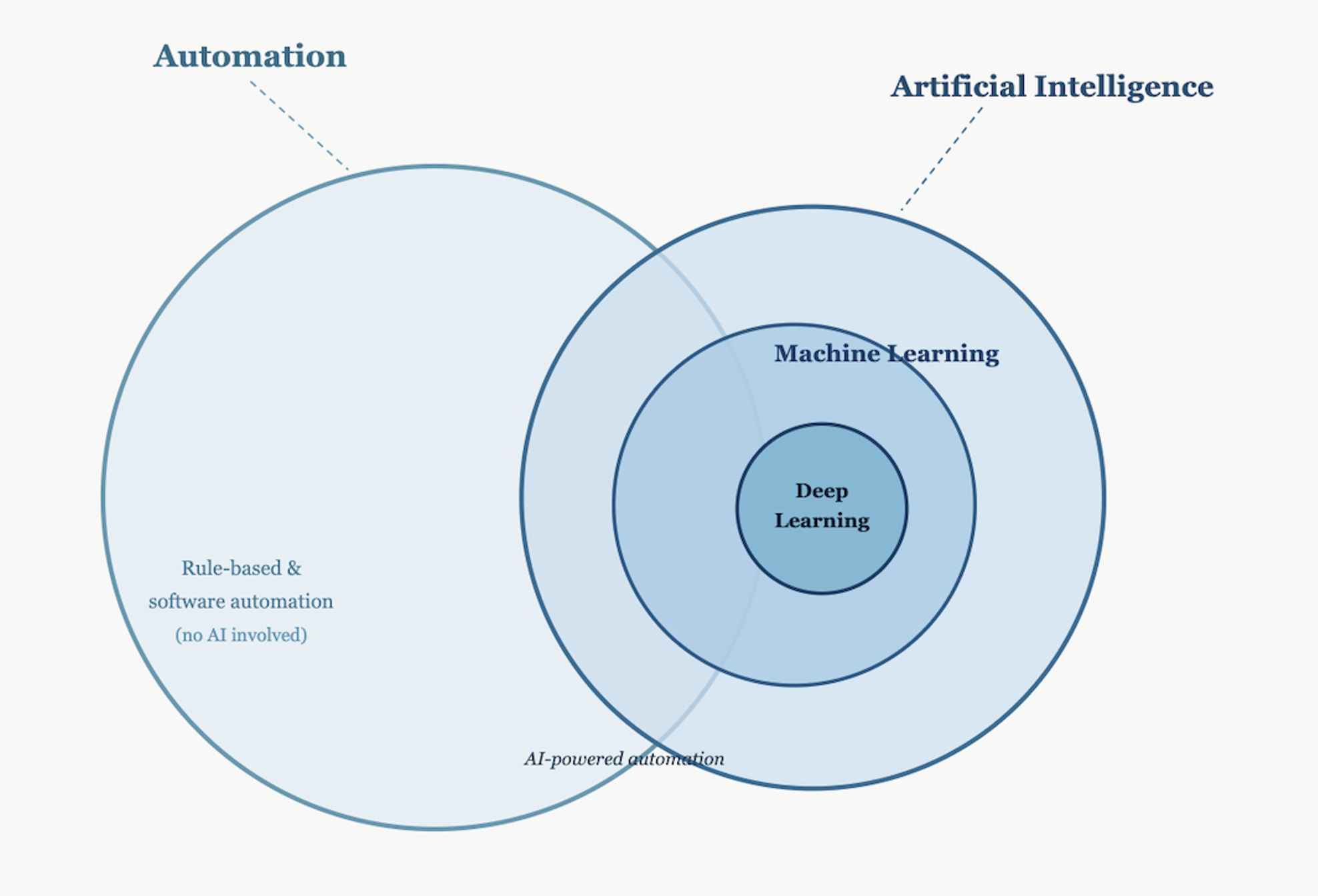
Most of this is what we call rule-based and software automation. These are programs that follow a fixed set of instructions, triggered by a condition or a schedule. There is no intelligence involved whatsoever.18
Everyday examples of rule-based automation
A payment that processes automatically at the end of the month is automation. So is a confirmation email that is sent when someone places an order. A conveyor belt that starts when a sensor is triggered is automation too.
In these cases, no AI is involved. A set of rules is simply followed precisely. In the figure you see here, the automation circle is in reality far larger than the AI circle, because most automated systems running today have no AI in them at all.
Where automation and AI meet
Where automation and AI overlap, we speak of AI-powered automation. This is where much of what you will use as an aspiring online entrepreneur lives. These are tools that automate tasks which used to require human thinking, such as writing, designing or answering customers.
For example, a design tool that suggests layouts, a writing assistant that drafts product descriptions, or a chatbot that answers common questions are all AI-powered automation. They save time on creative and communication tasks.
How automation for online business helps you
Automation will not run your business by itself, because you are the key to it. It will, however, give you the framework you need to get started. It is present in almost everything relevant to your journey.
It handles the shipping notifications, the order tracking, the payment processing, the advertising delivery and parts of the design work, to name just a few. Without automation, a solo online business would need a whole team.
Automation for online business tasks you can do for free
Many automations come built into the platforms you will use, at no extra cost. Marketplaces send order confirmations and handle payments. Email tools send a welcome message when someone joins your list. Scheduling tools publish your pins or posts at set times.
When you are just starting out, you do not need to spend more than about 20 dollars on your setup. Free plans of most tools include the basic automations a beginner needs. Paid automation tools with monthly fees can wait until your traffic and sales show you which tasks really take your time.
You do not have to automate everything
Please know, and perhaps it is a relief, that it is not mandatory to use a program for every single task. In fact, too many programs can feel overwhelming. Each new tool needs to be learned, connected and maintained.
You can carry out some tasks yourself. At any point, you can also have someone you trust work alongside you. A simple setup that you understand is better than a complex one you are afraid to touch.
A simple rule for deciding what to automate
Automate a task when you do it often, it follows the same steps each time, and it does not need your personal judgment. Keep doing a task yourself when it involves care, creativity or a personal relationship with a customer. This rule keeps your business efficient and human at the same time.
An example of a simple automated setup
Picture a beginner selling digital planners. A customer finds a pin, clicks to the marketplace listing and pays. The marketplace processes the payment, delivers the file and sends a receipt, all automatically. The seller only needs to create the product and keep bringing new visitors.
Automation for online business marketing and traffic
Automation can help with marketing too. You can schedule content in advance, send automatic emails to new subscribers and track which pages bring visitors. These tools make it easier to do your own marketing without hiring an agency.
Automation cannot replace the decision of what to publish and where. That remains your job, and it is what turns automated systems into real traffic.
Automation lets you stay in the background
Automation is also a good friend to private entrepreneurs. Checkout pages, emails and scheduling tools communicate with customers on your behalf. If the idea of self-branding is what held you back so far, Lynnaider recaps the alternatives for you.
Automation for online business in each income technique
Every one of the ten online income techniques relies on automation in some way. Affiliate marketing relies on tracking links that record sales automatically. Digital product sales rely on automatic file delivery after payment.
Print-on-demand relies on automatic order forwarding to the printer. Content as a business model relies on platforms that count views and pay out automatically. Understanding this helps you see why one person can run these businesses alone.
Your next step
The next article explains the AI side of this figure: artificial intelligence, machine learning and deep learning. The complete lesson on income and its engines is in the book on our products page. If you would like help choosing which tasks to automate in your online business, see our services page.
Frequently asked questions
What is the difference between automation and AI?
Automation is any technology that carries out tasks without someone doing them manually. AI is one specific approach to automation, where the system can analyse data and make decisions rather than just following fixed rules. Most automation in the world is not AI.
Do I need to understand AI to build an online business?
No, not the technical details. It helps to know what your tools are doing behind the scenes, but every technique in Lynnaider’s framework can be practised without deep AI knowledge.
What is rule-based automation?
Programs that follow a fixed set of instructions, triggered by a condition or a schedule. A payment that processes at month-end, an order confirmation email, a conveyor belt started by a sensor. No intelligence, just rules followed precisely.
Where does AI meet automation for entrepreneurs?
In AI-powered automation: tools that automate tasks that previously required human thinking, such as writing, designing, or responding to customers. This is where most of the AI you’ll use as an aspiring online entrepreneur lives.
Does Lynnaider show step-by-step tutorials for the 10 online business models with no or minimal setup costs?
Based on interest, these tutorials may be made. If you would like to see them, please sign up to the waitlist, so we can see that there is interest. Everyone on the list will be informed as soon as the tutorials are available.
Do I have to automate every task in my business?
No, and too much software often feels overwhelming. Some tasks are worth carrying out yourself, and at any point you can bring in someone you trust to work alongside you.
Why is automation introduced before the ten income techniques?
Because every income technique sits on top of some form of automation. Understanding the engine before the vehicle makes the individual technique modules easier to follow.
How can I learn to set up an online business at no or low cost?
Lynnaider teaches setup routes for each of the ten online income techniques that cost nothing, or very little (under 20 dollars), to go live, so you do not pay setup costs long before you earn. Our free AI agent, Lynnaider Compass, guides you through them step by step, in the same logic as the whole Lynnaider teaching.
References
18. Shopify. Ecommerce automation: streamline operations and scale your business. Ottawa (CA): Shopify Inc.; 2024.
Disclaimer: This article is for general informational purposes only and should not be regarded as legal, tax, or business advice. Pursuing an online business does not guarantee income; results depend on many factors including the business environment, individual effort, skills, and consistency. Some links on this site may allow Lynnaider to earn a commission at no additional cost to the reader.