
What Can You Sell Online? The 4 Types of Offerings Every Business Delivers
Would you like to read this article told by Lynnie, our fictional kid character? Jump here.
With Lesson T1 on potential and purpose complete, Lesson T2 begins with the question every beginner asks: what can you sell?
“What can you sell online?” is one of the first questions every aspiring entrepreneur asks. The answer is simpler than it looks: every online business delivers one of four types of offerings, or a combination. In this article, the start of Lesson T2, we explain the four types, give examples of each, and help you decide which one fits you.
2.1 Offering: the most tangible value of your business
If you already have a running business, you probably have your first products and services figured out. That is your offering. Even so, we invite you to read this section, because it may show you new options.
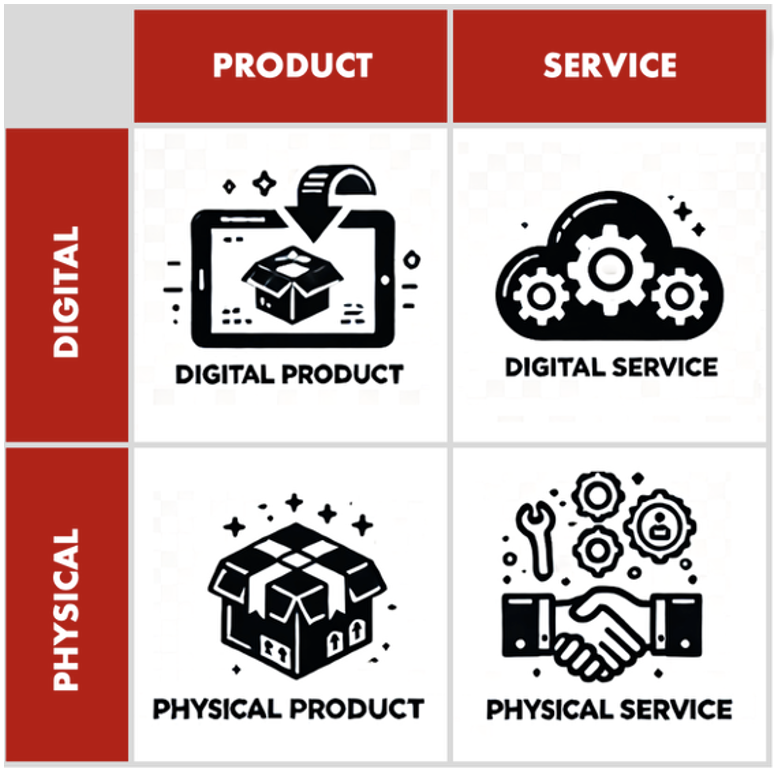
If you are starting from scratch, it is very useful to understand the four types of offerings entrepreneurs deliver in order to earn. This is the most tangible value of any business. There is more value behind the scenes of an online business, but from a business perspective, the four things you can deliver as tangible value to your customers are shown in the figure you see here.
What can you sell online? The four types of offerings
1. Digital product
A downloadable or accessible file. Examples include an e-book, a template, an online course recording or a piece of digital artwork. Once created, a digital product can be sold many times without extra production work.
2. Digital service
A task or skill delivered remotely. Examples include graphic design, translation, consulting and writing. You deliver it with your time and expertise, usually for one client at a time.
3. Physical product
A tangible item that is produced or sourced, and then shipped to the customer. Examples include handmade jewelry, printed clothing or home decor. Physical products involve packaging and delivery, done by you or by a partner.
4. Physical service
A service delivered in person. Examples include a photography session, a guided tour or the hand-off of a rental item. The booking and payment can happen online, while the service itself happens in the real world.
The four offerings and the Lynnaider framework
These categories are also reflected in the color coding of our mountain illustration. Techniques shown in red mostly deliver digital offerings. Techniques shown in white involve physical delivery.
We recommend using the coloring as guidance. Still, do not rule out either color based on your current idea of what you could deliver. Many people discover they enjoy a type of offering they had not considered at first.
What can you sell online? How to decide
What can you sell online with your skills and time?
If you have a skill people already ask you for, a digital service is often the fastest start. If you prefer to create something once and sell it repeatedly, a digital product may suit you better. If you love making things with your hands, physical products can be very rewarding.
Think about responsibility
Each offering type brings its own responsibilities. Digital products need good files and clear descriptions. Services need reliable communication and deadlines. Physical products need stock, packaging, shipping and returns.
Consider combining offerings
Many businesses combine two types. A photographer may deliver a physical service, the shoot, and a digital product, the edited files. A designer may offer freelance design work and also sell templates.
Combining offerings can also bring more stable income. When one type is slow, the other can keep your business running.
What can you sell online? Pros and cons of each type
Each type of offering has clear advantages and challenges. Knowing them helps you answer the question of what you can sell online with more confidence.
- Digital products: high margins and no shipping, but they need good presentation and steady traffic to keep selling.
- Digital services: fast to start and easy to price, but your income is limited by your available hours.
- Physical products: tangible and often very satisfying, but they involve stock, packaging and shipping costs.
- Physical services: personal and often well paid, but tied to a location and to your physical presence.
There is no perfect type. The best offering for you is the one whose advantages you value and whose challenges you can handle today.
Pricing your offering
Pricing depends on the type. Digital products are often priced low to sell in volume. Services are usually priced by the hour or by project. Physical products need a price that covers materials, fees and shipping. Look at what similar offerings cost in your niche before setting your first price.
Examples by type of online business
Here are some simple examples to make the four types concrete. A teacher could sell lesson plans as a digital product, or tutoring sessions as a digital service. A gardener could sell seed kits as a physical product, or garden consultations as a physical service.
A writer could sell an e-book as a digital product, or editing as a digital service. A crafter could sell handmade goods as physical products, or workshops as a physical service. In each case, the same person has several options, and can choose the one that fits best.
Questions to choose your offering type
Ask yourself a few simple questions. Do I want to work with my hands or on a screen? Do I prefer to be paid for my time or for something I create once? Am I comfortable shipping things, or would I rather avoid it? Your answers will point clearly to one or two of the four types.
Keep your first offering simple and affordable
Your first offering does not need to be perfect or expensive to produce. When you are just starting out, you do not need to spend more than about 20 dollars on your setup. Free marketplace listings, free design tools and small one-time fees are enough for most first offerings.
Avoid monthly subscriptions before anyone knows about your business. Put your energy into showing your offering to people, because traffic is what turns an offering into sales. Marketing is something you can learn and do yourself, without an agency.
Testing your offering before you invest
Before producing a lot of stock or recording a full course, test a small version. List one product, offer one service package or publish one digital file. See whether people click, ask questions or buy. A small test tells you a lot with very little risk.
Selling online without self-branding
All four types of offerings can be sold without becoming the face of your business. Your product photos, your service descriptions and your reviews can build trust. If the idea of self-branding is what held you back so far, Lynnaider recaps the alternatives for you.
Your next step
The next article shows what each of the ten online income techniques delivers, using these four offering types. It is a helpful way to connect what you could sell online with the business model that suits it.
The complete Lesson T2 is in the book on our products page. If you would like help choosing your first offering, visit our services page.
Frequently asked questions
Does Lynnaider show step-by-step tutorials for the 10 online business models with no or minimal setup costs?
Based on interest, these tutorials may be made. If you would like to see them, please sign up to the waitlist, so we can see that there is interest. Everyone on the list will be informed as soon as the tutorials are available.
What are the four types of offerings?
Digital product, digital service, physical product, and physical service. Every online business delivers one of these or a combination. They are the most tangible forms of value your customer receives.
What is the difference between a digital product and a digital service?
A digital product is a downloadable or accessible file that can be delivered without your ongoing involvement. A digital service is a task or skill you deliver remotely, requiring your time and attention.
Can one business deliver more than one type?
Yes. Many online businesses combine offerings. A photographer, for example, may deliver both a physical service (the shoot) and a digital product (the edited files).
Are physical offerings harder than digital ones?
Not inherently. Physical offerings carry more operational complexity, but many entrepreneurs find them more enjoyable in the long run precisely because of their tangible nature.
How do I decide which type of offering fits me?
Notice what you naturally enjoy delivering. Some people thrive on tangible objects, others on services, others on file-based products. The type that matches your temperament tends to be sustainable.
Do the four types correspond to the framework’s colours?
Yes, indirectly. Techniques that deliver mainly digital offerings are shown in red, and those with physical delivery in white. The colour helps you see at a glance where each technique sits.
Where can I get step-by-step help to start online on a small budget?
Lynnaider teaches setup routes for each of the ten online income techniques that cost nothing, or very little (under 20 dollars), to go live, so you do not pay setup costs long before you earn. Our free AI agent, Lynnaider Compass, guides you through them step by step, in the same logic as the whole Lynnaider teaching.
Disclaimer: This article is for general informational purposes only and should not be regarded as legal, tax, or business advice. Pursuing an online business does not guarantee income; results depend on many factors including the business environment, individual effort, skills, and consistency. Some links on this site may allow Lynnaider to earn a commission at no additional cost to the reader.