Types of Online Business Models: Physical vs Digital, Your Own vs Others’
Would you like to read this article told by Lynnie, our fictional kid character? Jump here.
Once you know the five stages of starting an online business, the next step is to understand how the ten business models are grouped.
There are many types of online business models, but two simple dividing lines help you understand almost all of them. The first line separates models with physical delivery from fully digital ones. The second separates models built on your own products from models built on other people’s products. In this article we explain both, using Lynnaider’s Digital Economy Framework.
The income technique modules
After understanding the five theory lessons, you are in a good position to explore the ten online income techniques. These are the techniques we researched, use and summarize in our teaching. They are numbered from 1 to 10, in the order we recommend you study them.
This sequence does not necessarily mean one is easier than another. Ease depends on everyone’s preferences, ideas and capabilities. The order simply helps you understand the techniques one after the other.
Of course, you can read them independently. If you understand them all, though, you will see how they can be combined around the same business idea. On one single idea, several income techniques can be layered.
Lynnaider’s Digital Economy Framework
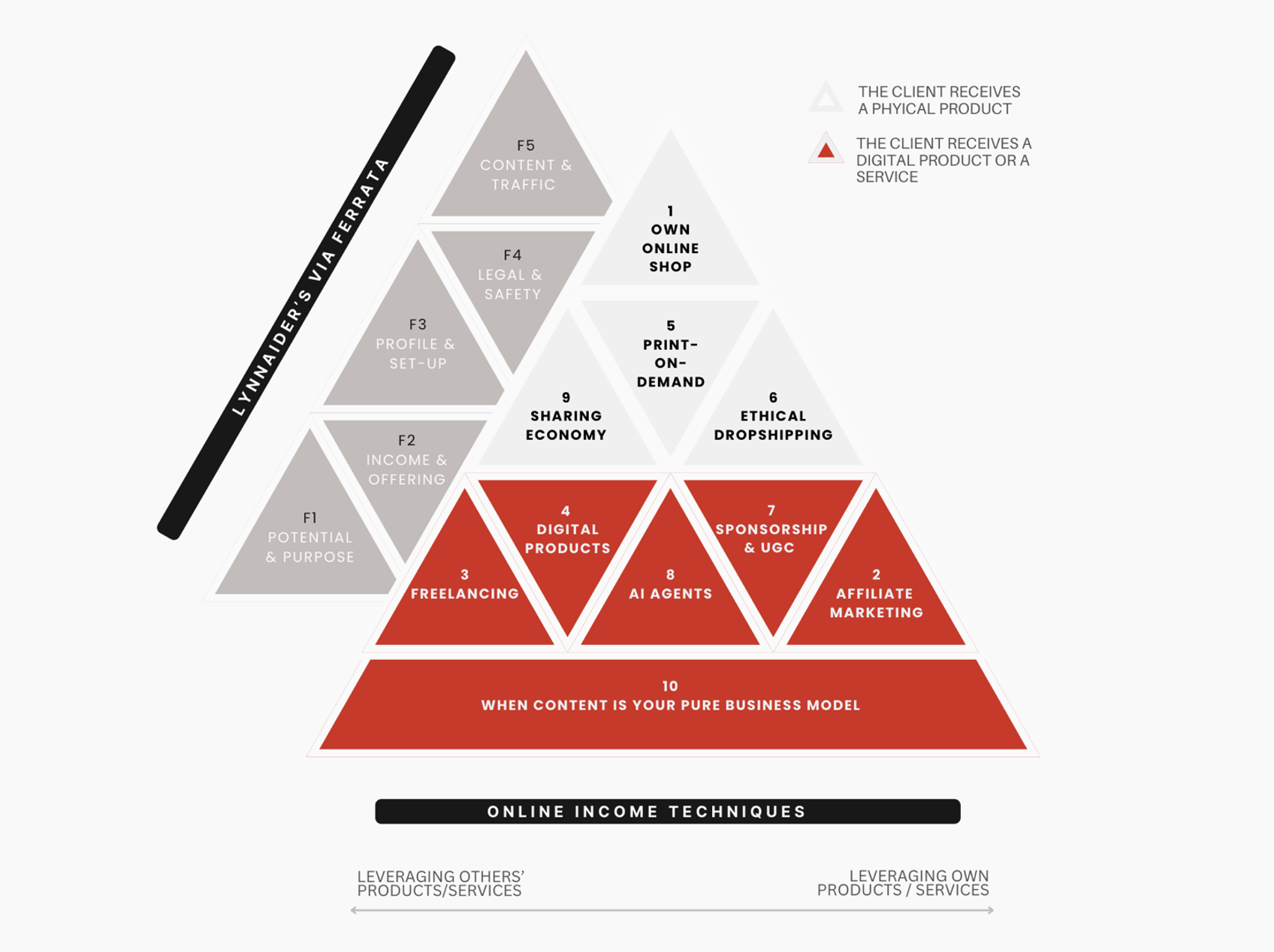
The framework places all ten types of online business models on one illustration. Two features of the illustration carry most of the meaning: the color of each technique, and its position from left to right.
Red vs white: digital and physical types of online business models
The color coding on the front mountain makes it easier to see two groups among the ten approaches. Techniques colored red (or dark grey, depending on the print) are those in which you do not deliver physical products. This removes one layer of responsibility from your shoulders.
Techniques colored white, toward the peak of the front mountain, involve delivering physical products. This means packaging, shipping and handling returns become part of the work, either by you or by a partner.
The white techniques are not necessarily more complex than the ones below. In fact, working with physical products makes the work more enjoyable in the long run for many people. Holding a real product in your hands can be very motivating.
Examples of both types of online business models
Fully digital models include freelancing, digital product sales, affiliate marketing and audience monetization. Models with physical delivery include an own online shop and parts of the sharing economy. Print-on-demand and dropshipping sit in between, because a supplier produces or ships the physical product for you.
Own vs others’: whose products you build on
The techniques are also arranged on a scale from left to right. On the left side, you leverage your own products or services. On the right side, you leverage other people’s or businesses’ products and services.
Toward the right, you can start with promotional efforts or by working with suppliers, instead of creating products yourself. Affiliate marketing is a clear example, because you earn by recommending products someone else made. Sponsorships work in a similar way, since you promote a brand’s offer.
Toward the left, you create and sell your own products and services. Freelancing, digital products and an own online shop belong here. You have more control over the offer, and also more responsibility for creating it.
Which side should you start on?
It depends on what you already have. If you have a product idea or a skill you can sell, the left side may feel natural. If you would rather promote what already exists, the right side is a good entry point.
Many entrepreneurs eventually work on both sides. For example, someone selling their own course might also earn affiliate commissions on tools they recommend inside it.
The four corners: four types of online business models
When you combine both dividing lines, you get four broad types of online business models. Each corner has its own typical work and risks.
- Your own product, digital delivery. Digital product sales and freelancing sit here. You create the value yourself, and nothing needs to be shipped.
- Your own product, physical delivery. An own online shop sits here. You create or stock the goods, and you handle packaging and shipping.
- Others’ products, digital delivery. Affiliate marketing, sponsorships and audience monetization sit here. You earn by promoting or by attracting attention.
- Others’ products, physical delivery. Dropshipping sits closest to this corner, and print-on-demand nearby. A supplier handles the physical side, but you remain responsible to the customer.
Seeing the corners helps you decide quickly which ones feel comfortable. Some people love creating their own products, while others prefer to curate and recommend. Some enjoy the tangible side of shipping, while others want a fully digital business.
Responsibility follows the corner you choose
Every corner comes with its own responsibilities. Physical delivery brings shipping costs, returns and stock. Working with others’ products brings partner agreements and the need to choose trustworthy partners.
Knowing these responsibilities in advance is useful. It helps you choose a corner where the daily tasks match your strengths.
Using the two lines to choose between types of online business models
Combining the two lines gives you four simple questions. Do I want to handle physical products? Do I want to create my own products? How much responsibility can I take on today? And which kind of work would I enjoy every week?
Your answers will narrow the ten types of online business models down to two or three. From there, the individual modules help you make a final choice.
A common misunderstanding about the framework
Some readers assume the techniques at the top of the mountain are the most advanced or the most profitable. The position on the mountain mostly reflects delivery and ownership, not difficulty or income. A technique at the bottom can earn more than one at the top, depending on how well it is done and how much traffic it receives.
Use the framework as a map of differences, and the individual modules as the place to judge which technique suits you.
Starting cheaply on either side
On both sides of the framework, you can start with very little money. When you are starting out, you do not need to spend more than about 20 dollars on your setup. There are free routes, or small one-time fees, for most techniques, so there is no need for monthly subscriptions before anyone knows about your business.
Set up for free first, then focus on bringing visitors to your offer. Marketing your business is something you can learn yourself, without hiring an agency. Once traffic arrives, you will know where it makes sense to invest.
Staying private on either side
Neither side of the framework requires you to be the face of your business. If the idea of self-branding is what held you back so far, Lynnaider recaps the alternatives for you. Your products, your recommendations and your service can carry your brand.
Your next step
The next article defines all ten online income techniques in one line each. It is the quickest way to get an overview before you read the individual modules.
The complete book is available on our products page. For personal help choosing between the types of online business models, see our services page.
Frequently asked questions
What does the red versus white colour coding mean?
Red techniques do not involve delivering a physical product to your customer, which removes one layer of operational responsibility. White techniques, closer to the mountain peak, do involve physical product delivery.
Are the white techniques harder than the red ones?
Not necessarily. In fact, working with physical products can make the work itself more enjoyable in the long run for many entrepreneurs. The choice reflects temperament more than difficulty.
What does the left-to-right axis show?
It shows whether you are leveraging your own products or services (left) or leveraging other people’s or businesses’ products and services (right). Both directions are valid.
What does “leveraging others” look like in practice?
It usually starts with promotional efforts, partnerships with suppliers, or reselling. Affiliate marketing, dropshipping, and sponsorships all sit toward the right side of the axis.
Do I have to pick one side of the framework and stick with it?
No. Many online activities combine techniques from both sides once they are running. The framework helps you begin somewhere, not commit forever.
Should I start on the left or the right?
That depends on what you already have. If you already have a product idea, the left side may fit. If you would rather promote what already exists, the right side is a natural entry point.
Are there step-by-step Lynnaider tutorials for starting each of the 10 online business models with a minimal-cost setup?
Not yet, but they might be made if enough people ask for them. Sign up to the waitlist so we can see the interest, and you will be among the first to hear when they are available.
How can I learn to set up an online business at no or low cost?
Lynnaider teaches setup routes for each of the ten online income techniques that cost nothing, or very little (under 20 dollars), to go live, so you do not pay setup costs long before you earn. Our free AI agent, Lynnaider Compass, guides you through them step by step, in the same logic as the whole Lynnaider teaching.
Disclaimer: This article is for general informational purposes only and should not be regarded as legal, tax, or business advice. Pursuing an online business does not guarantee income; results depend on many factors including the business environment, individual effort, skills, and consistency. Some links on this site may allow Lynnaider to earn a commission at no additional cost to the reader.