How to Compare Online Business Models: Five Lessons and Ten Modules
Would you like to read this article told by Lynnie, our fictional kid character? Jump here.
Now that you know why we keep our explanations simple, here is how the whole Lynnaider teaching is structured.
If you want to compare online business models properly, you need to see them explained along the same logic. Most courses present one model at a time, which makes a fair comparison almost impossible. In this article we explain how the Lynnaider teaching is structured, and how the structure helps you choose the right model for you.
The Lynnaider teaching structure
This guide consists of five theory lessons in one module, and ten additional modules. The theory lessons detail the key stages of building any online endeavor. Each of the ten modules then covers one online income technique in full.
The theory comes first for a reason. It gives you a shared vocabulary and a set of questions you can ask about every business model. Once you have that, comparing the models becomes much easier.
Why most people cannot compare online business models
Income techniques are rarely taught in school.8 Still, people come across them quite often, in videos, posts and courses. The problem is that they are usually presented in isolation, each one as if it were the best or only option.
When you only ever hear about one model at a time, you cannot weigh it against the others. You do not know whether its costs are high or low, whether its workload is heavy or light, or whether it fits your skills. That is how many beginners end up choosing a model because it was the first one they heard about.
This is why we created teaching that walks you through several major and viable online revenue approaches at once. We present all of them along the same logic, so you can compare them on equal terms.
The questions we ask to compare online business models
For each of the ten online business models, the modules follow the same stages. What potential and purpose fit this model? What exactly is the offering, and how does the income arrive? Which profile and setup do you need? Which legal and safety topics apply? And how will you drive traffic to it?
Because every model answers the same questions, you can place them next to each other. You will quickly see which ones match your time, your budget and your personality.
Lynnaider’s Digital Economy Framework
Upon completing the Lynnaider teaching, you will be able to streamline your thoughts about which online income technique is right for you. You can then go on to learn more about the ones you chose, from more specialized sources if you wish.
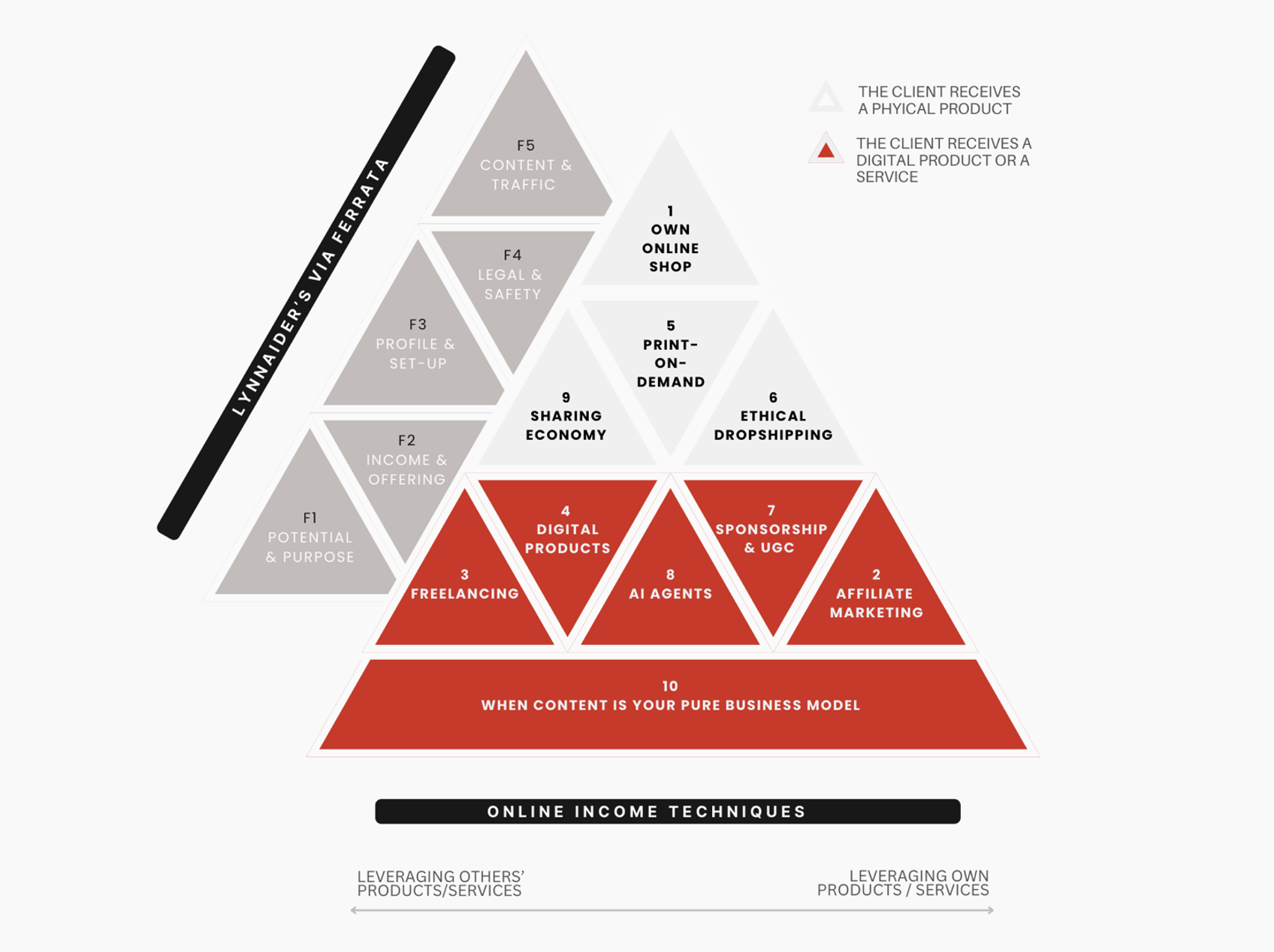
The Lynnaider brand was conceptualized and developed among the mountains of Switzerland. The mountains helped us symbolize and visually structure our teaching, as the figure you see here shows. The ten income techniques are illustrated in a mountain shape, in an order that is helpful for learning.
The theory lessons are shown on a trail along a second mountain. It is a trail somewhat like the ones hikers take on steeper routes. We call it Lynnaider’s Via Ferrata, and you will read more about it in the next article.
How to read the framework at a glance
The framework shows you two things at once. The front mountain holds the ten business models, numbered from one to ten in the order we recommend studying them. The trail on the second mountain holds the five theory stages that apply to all of them.
Colors and positions on the mountain also carry meaning. They show which models involve physical products, and which ones use your own products versus other people’s. We explain this in detail in a later article about reading the framework.
What you avoid when you compare online business models
Comparing models before you start saves you from several costly detours. You avoid paying for tools that belong to a model you will not use. You avoid building a large social media presence for a model that does not need one.
You also avoid choosing a model only because it promises fast income. Each model has a different rhythm, and some need months before the first results appear. Knowing this in advance keeps your expectations realistic.
Finally, comparing helps you see combinations. Many solo entrepreneurs build one business idea and layer two or three income techniques on top of it. For example, a person selling a digital guide might also earn through affiliate links in the same guide.
Comparing costs: start for under 20 dollars
One of the most useful comparisons is cost. When you are just starting out, you do not need to spend more than about 20 dollars on your setup. For most of the ten models there are free routes, or small one-time fees, that let you make a first sale or a first promotion.
Monthly fees for platforms and tools before anyone knows about your business are not necessary. They can create pressure and anxiety at the very moment you need calm. We recommend setting up for free, driving your first traffic, and improving your setup once you see where it is worth investing.
Comparing visibility: you can stay private
Another important comparison is how visible each model requires you to be. Some models are often associated with personal branding, but all ten can be practiced from behind the scenes. If the idea of self-branding is what held you back so far, Lynnaider recaps the alternatives for you.
A simple example: how to compare online business models in practice
Imagine you enjoy drawing and have a small budget. Print-on-demand lets you upload your designs to a supplier’s products, and the supplier prints and ships only when someone orders. Digital product sales let you turn the same drawings into printable files that customers download.
Comparing the two shows the trade-offs clearly. Print-on-demand gives customers a physical item but leaves you a smaller margin per sale. Digital products give you a higher margin and instant delivery, but customers print the item themselves. Neither choice is wrong, and you can even offer both.
Do you have to read all ten modules?
You do not have to read all ten modules to begin. Once you understand the five theory lessons, you can read the income modules in any order that interests you. Reading all ten becomes valuable when you want to see how they can work together.
We suggest keeping a simple comparison table as you read. Write each model in a row, and add columns for setup cost, time per week, need for shipping, and how much you would enjoy the daily work. Once you have compared all ten models, the table will show you clearly where to start.
Your next step
Continue with the article on Lynnaider’s Via Ferrata, the guided path through the theory module. It explains why we treat the theory as a safety system for your online journey.
If you would like the full teaching in one book, it is available on our products page. If you would like personal help to compare online business models for your situation, see our services page.
Frequently asked questions
What does the Lynnaider teaching contain?
Five theory lessons in one module covering the key stages of building an online endeavour, and ten additional modules each covering one of the ten online income techniques in full. Together they form a complete introduction to the field.
Why present all ten techniques with the same logic?
So they can be genuinely compared. Most teaching presents income techniques in isolation, which makes it hard to weigh them against each other. Lynnaider’s structure lets you compare like with like and choose accordingly.
Are there step-by-step Lynnaider tutorials for starting each of the 10 online business models with a minimal-cost setup?
Not yet, but they might be made if enough people ask for them. Sign up to the waitlist so we can see the interest, and you will be among the first to hear when they are available.
What is the Digital Economy Framework?
A visual model, shaped like two mountains, that organises the theory lessons on one side and the ten income techniques on the other. It helps you see the whole landscape at once instead of piece by piece.
Where does the mountain imagery come from?
The Lynnaider brand was conceptualised in the Swiss mountains, and the visual structure of the teaching draws directly from that landscape. The theory trail is called Lynnaider’s Via Ferrata.
Do I have to read all ten modules?
Not to begin. Once you have understood the five theory lessons, you can read the income modules in any order that fits your interest. Reading all ten becomes valuable once you want to see how they can combine.
What is the point of completing the Lynnaider teaching?
You will be able to streamline your thoughts about which technique is right for you and know where to go next for deeper, more specialised learning on your chosen path.
Where can I get step-by-step help to start online on a small budget?
Lynnaider teaches setup routes for each of the ten online income techniques that cost nothing, or very little (under 20 dollars), to go live, so you do not pay setup costs long before you earn. Our free AI agent, Lynnaider Compass, guides you through them step by step, in the same logic as the whole Lynnaider teaching.
References
8. Sitaridis I, Kitsios F. Digital entrepreneurship and entrepreneurship education: a review of the literature. Int J Entrepreneur Behav Res. 2024;30(2/3):277-304.
Disclaimer: This article is for general informational purposes only and should not be regarded as legal, tax, or business advice. Pursuing an online business does not guarantee income; results depend on many factors including the business environment, individual effort, skills, and consistency. Some links on this site may allow Lynnaider to earn a commission at no additional cost to the reader.