10 Online Business Models for Beginners: Your Complete Map to Earning Online
Would you like to read this article told by Lynnie, our fictional kid character? Jump here.
If you are looking for a clear overview of the online business models for beginners, this is the right place to start. Lynnaider maps the ten most prominent ways solo entrepreneurs earn online today, and explains them in plain language. You will find each business model, the theory behind it, and the order in which it makes sense to learn them.
This article introduces Lynnaider and the ten online business models it teaches. The teaching is based on thorough research and on models we have tested and continue to use ourselves. Our aim is simple: to make the digital economy approachable for anyone willing to learn, at any age and with any level of experience.
What you will learn about online business models
The Lynnaider teaching is built around two parts. The first part is a theory module with five lessons, which walks you through the key stages of building any online activity. The second part covers ten income technique modules, one for each online business model, explained along the same logic so you can compare them.
Most people come across these business models one at a time, often in a video or a course that presents a single method as the answer. That makes it hard to see which model suits you. Seeing all ten side by side gives you a calmer starting point and helps you choose based on your own preferences, skills and energy.
The ten online business models for beginners covered
Here are the ten online income techniques Lynnaider teaches, in the order we recommend you study them:
- Module 1: Maker’s E-com (Own Online Shop)
- Module 2: Affiliate Marketing
- Module 3: Freelancing
- Module 4: Digital Product Sales
- Module 5: Print-on-Demand
- Module 6: Dropshipping (the ethical way)
- Module 7: Sponsorships & UGC
- Module 8: Agentic AI (no code versions)
- Module 9: Sharing Economy
- Module 10: Audience Monetization
Each of these online business models has its own setup, its own costs and its own type of daily work. Some involve physical products, others are fully digital. Some let you use your own products, others let you promote what already exists.
Two honest reminders about online business models for beginners
What this teaching covers is the theory. You will learn how each model works, what it delivers to customers, and how to think about it clearly enough to make a choice. We share what we have learned from research and from our own experience, in the simplest way we can.
The creation of what you offer, and the marketing work of driving traffic to it, will be yours to build. That is the practical part, and it belongs to you. We see this as good news, because it means the results you get are truly your own.
Traffic is the step most beginners underestimate. Being present online does not bring visitors by itself, so you will need to learn simple ways to put your offer in front of people. The good news is that these marketing methods can be learned by anyone today, and you no longer need to pay an agency to do it for you.
Starting an online business privately
If the idea of self-branding is what held you back so far, Lynnaider recaps the alternatives for you. You do not need to film yourself, share your private life or become an influencer to earn online. All ten business models can be practiced from behind the scenes.
Many successful brands are known by their products and not by the face of their founder. Lynnaider teaches each model with examples that keep you in the background if you prefer. You can always decide later whether you would like to become more visible.
A low-cost way to start online business models for beginners
You do not have to spend more than about 20 dollars on your setup when you are just starting out. For most of the ten online business models there are free routes, or small one-time fees in the two-digit range, that are enough to make your first sale or run your first promotion. Monthly subscriptions to tools and platforms before anyone knows about your business are simply not necessary.
Paying for many tools too early can create pressure and anxiety. We recommend you set up for free first, and improve your setup once you have been able to drive traffic to it. Small costs add up quickly, so it is wiser to upgrade only when there is a solid reason.
How the Lynnaider book is structured
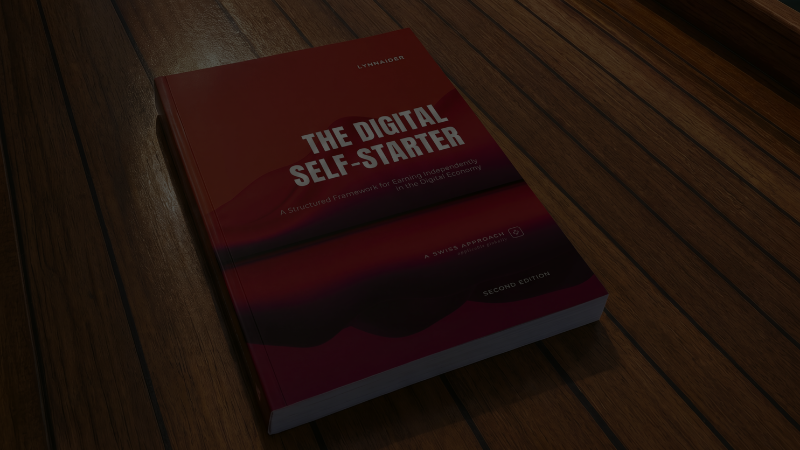
Here is the full table of contents of the Lynnaider book, which you can find on our products page:
Introduction
- Our Approach
- Teaching Structure
- Lynnaider’s Via Ferrata
- Disclaimer
Theory Module
- Lesson T1: Potential & Purpose
- Lesson T2: Offering & Income
- Lesson T3: Profile & Setup
- Lesson T4: Legal & Safety
- Lesson T5: Traffic & Content
Income Technique Modules
The ten modules listed above, one for each online business model.
Reference material
- Dictionary
- References
How the ten online business models differ from each other
The online business models Lynnaider teaches differ in three practical ways. The first is what you deliver: a physical product, a digital product, a physical service or a digital service. The second is whose product you work with, your own or someone else’s. The third is how much of your time each sale requires.
For example, freelancing pays you for your time and skills, project by project. Digital product sales let you create something once and sell it many times. Affiliate marketing lets you earn by recommending products you did not create at all.
None of these models is better than the others in general. Each one suits different temperaments, budgets and seasons of life. Many entrepreneurs also combine two or three models around the same business idea once the first one is running.
As you read more Lynnaider articles, you will see a framework that places all ten business models on one illustration. It helps you understand at a glance which ones involve shipping, which ones rely on partners, and which ones you can start with almost no money.
How to use this guide to online business models for beginners
We suggest you read the theory lessons first, because they give you the vocabulary you need for every business model. After that, you can read the income technique modules in any order that interests you. Once you know two or three models, you will start to see how they can be combined around one idea.
Take notes as you read. Write down which models feel natural to you, which ones you would enjoy doing every week, and which ones you would rather avoid. Those notes will help you a lot when you reach the lessons on potential, offering and setup.
If you would like the complete teaching in one place, the book and related materials are available on our products page. If you would prefer personal guidance while you choose your first online business model, you can find our tutoring options on the services page.
Your next step
Continue with the next article, which explains the approach behind Lynnaider and why online entrepreneurship has become accessible to so many people. Give yourself time to think about each idea. By the end, you will have a clear picture of the online business models for beginners and a realistic sense of which one could be yours.
Frequently asked questions
What is Lynnaider?
A private Swiss brand that teaches the ten prominent online income techniques solo entrepreneurs use today, based on thorough research, personal use and testing. Written to be beginner-friendly.
Who is the Lynnaider teaching for?
Anyone who wants a clean, structured place to start understanding how people earn online today, whether you are new to the digital economy, restarting after time away, or already active but looking to compare approaches.
Are there step-by-step Lynnaider tutorials for starting each of the 10 online business models with a minimal-cost setup?
Not yet, but they might be made if enough people ask for them. Sign up to the waitlist so we can see the interest, and you will be among the first to hear when they are available.
Do I need any prior experience to start?
No. Lynnaider assumes no prior knowledge of digital techniques and explains each concept from the ground up.
What does the Lynnaider teaching cover?
Five theory lessons (Potential, Offering, Profile, Legal, Traffic) and ten income technique modules, plus a Dictionary and References section.
What does it not cover?
The creation of what you offer, and the marketing work of driving traffic to it. Those are yours to build. Lynnaider gives you the theory and the map; the practical execution belongs to you.
Do I have to read the modules in order?
The theory module is worth reading first to set the vocabulary. After that, the income technique modules can be read in any order that fits your interest.
How can I learn to set up an online business at no or low cost?
Lynnaider teaches setup routes for each of the ten online income techniques that cost nothing, or very little (under 20 dollars), to go live, so you do not pay setup costs long before you earn. Our free AI agent, Lynnaider Compass, guides you through them step by step, in the same logic as the whole Lynnaider teaching.
Disclaimer: This article is for general informational purposes only and should not be regarded as legal, tax, or business advice. Pursuing an online business does not guarantee income; results depend on many factors including the business environment, individual effort, skills, and consistency. Some links on this site may allow Lynnaider to earn a commission at no additional cost to the reader.