
AI, Machine Learning, Deep Learning: The Three Layers Behind Modern Tools
Key Term: Artificial Intelligence (AI)
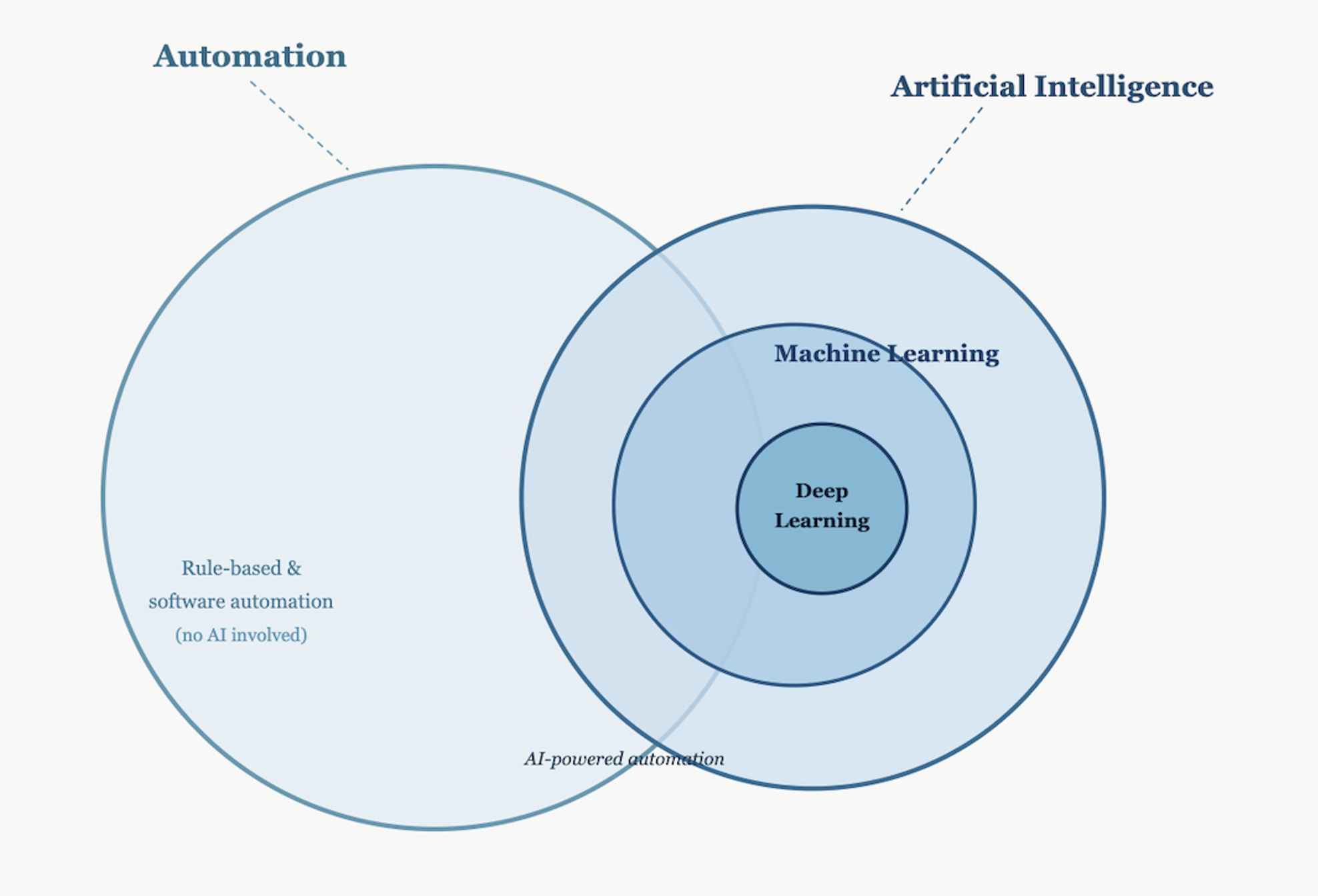
Artificial intelligence, or AI, is a step further than rule-based & software automation. While rule-based automation follows fixed instructions, AI can analyze data, recognize patterns, and make decisions based on that information, without being told exactly what to look for each time.19 Artificial Intelligence therefore is not a circle within Automation; it sits as a separate but somewhat overlapping field alongside Automation. As explained earlier, some AI has nothing to do with automation at all, but other AI is deeply embedded in automated systems, and that is the intersection we essentially sit over as online entrepreneurs.
Key Term: Machine Learning
Machine Learning is a subset of AI, a specific way of building it. Rather than being given a fixed set of rules to follow, a Machine Learning system is given large amounts of data and learns from it, improving over time by identifying patterns within that data.20 A simple everyday example: an online shop that notices you tend to browse certain types of products and begins surfacing more of them each time you return, not because someone set up your profile manually, but because the system learned from your patterns over time. That capacity to learn and adjust, rather than simply follow instructions, is what sets Machine Learning apart from basic automation.
Key Term: Deep Learning
Deep Learning is a subset of Machine Learning, and it is the technology sitting at the heart of most of what feels like a leap forward in AI today.21 It works through artificial neural networks: layers upon layers of interconnected processes that loosely mirror, in a simplified way, how the human brain processes information. The more layers, the “deeper” the network, hence the name. Deep Learning is what allows a program to recognize a face in a photo, translate spoken language in real time, or generate a piece of written text that reads as naturally as something a person might write. It is, in other words, the engine behind the generative AI tools most of us to some extent use by now: the Claudes and ChatGPT’s of our times.
Frequently asked questions
Is AI a subset of automation?
No. AI is a related but distinct field. Some AI has nothing to do with automation at all, and some automated systems have no AI. The overlap is where most tools relevant to online entrepreneurs sit.
What makes Machine Learning different from other automation?
Machine Learning systems learn from data and improve over time by identifying patterns, rather than following a fixed set of rules. That capacity to learn and adjust is what sets it apart.
What is a real-world example of Machine Learning?
An online shop that notices which products you tend to browse and starts surfacing more of them on your next visit. No one manually set up that recommendation; the system learned it from your patterns.
What is Deep Learning?
A subset of Machine Learning that uses artificial neural networks: layers upon layers of interconnected processes that loosely mirror how the human brain processes information. More layers means a deeper network.
Which technology powers ChatGPT and Claude?
Deep Learning. It is the engine behind the generative AI tools that most people have used or seen in recent years, including chat-based tools like Claude and ChatGPT.
Do I need to distinguish between these terms to use them?
Not to use them, no. Knowing the layered structure just helps you make sense of what different tools can and can’t do.
References
19. McKinsey & Company. What is AI? New York (NY): McKinsey; 2023.
20. International Institute in Geneva. What is machine learning? Computer Science Program. Geneva, Switzerland: IIG; [cited 2026 Oct 9].
21. Stanford University Human-Centered Artificial Intelligence. What is deep learning? Stanford (CA): Stanford University; [cited 2026 May 19]. Available from: https://hai.stanford.edu/ai-definitions/what-is-deep-learning
Disclaimer: This article is for general informational purposes only and should not be regarded as legal, tax, or business advice. Pursuing an online business does not guarantee income; results depend on many factors including the business environment, individual effort, skills, and consistency. Some links on this site may allow Lynnaider to earn a commission at no additional cost to the reader.