
Lynnaider’s Via Ferrata Framework: The Guided Online Income Framework | Article 12
Every teaching benefits from a guiding image. For Lynnaider, that image is the Via Ferrata framework, named after the Italian term meaning “iron path.” The phrase describes a protected climbing route equipped with fixed iron ladders, cables, and bridges. Such equipment makes challenging terrain safe enough to traverse for anyone willing to learn. Ten years ago, a real climb of this kind in the Swiss Alps inspired the founder of Lynnaider to name the stages of building an online activity after this metaphor. This article walks through why that image was chosen, what the Via Ferrata framework looks like on paper, and how to read the two visual signals, colour and position, that quietly organise the ten online income techniques Lynnaider teaches.
Where the Via Ferrata Framework Metaphor Came From
Standing at the base of a Via Ferrata for the first time is a humbling experience. Only a small part of the path is visible from the bottom, the mountain looks improbably vertical, and the whole undertaking feels much larger than the person about to attempt it. What changes that experience are two things. The iron equipment already anchored into the mountain, and a reassuring Swiss mountain guide who has walked the same route many times before.
What the guide ensures, above all, is that the climb stays grounded in reality. Sudden steps are not taken beyond actual ability or potential. Yet new small challenges are attempted continuously, steadily expanding the climber’s limits along the way. The combination of fixed protection and a knowledgeable companion turns a landscape that looks terrifying from below into a route that can be traversed with a real sense of security. That same combination, structure, safety, and guided progression, is what Lynnaider seeks to bring to the online entrepreneurship journey through the Via Ferrata framework. Beginners so often report exactly the same overwhelmed feeling when they first look up at all of it.
What the Online Income Framework Does for You
The stages outlined in the framework are meant to give a similar sense of security once you decide to pursue an online endeavour. The digital world is not inherently unsafe, but the way information about it is presented online often makes it feel that way. Too much choice, too many contradictory voices, too many implied requirements to have every part of a business figured out before starting. An online income framework quietly counters all of that by placing each piece in the right order, and by making clear that not every step in every technique needs to be attempted.
You will not be attaching yourself to every step in every technique. Which steps matter depends on the specific technique you are working on. Out of all the possible steps a framework could highlight, only the ones you actually need are shown to you. That is the whole point of having a guide. It is there to teach you where to step, out of the many places you could step, so that your energy goes into what actually moves you forward instead of into everything at once.
Reading the Via Ferrata Framework: The Front Mountain
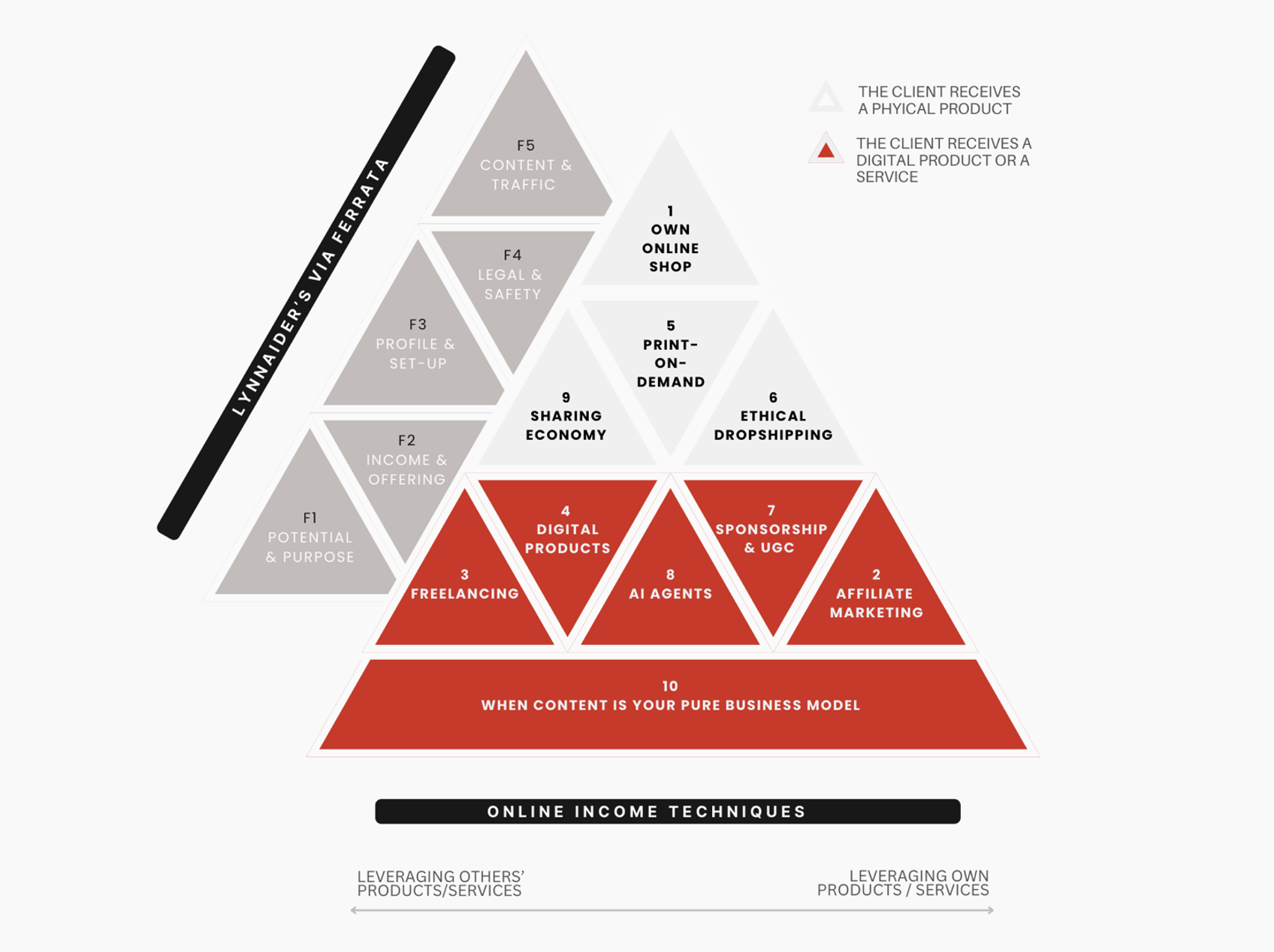
After understanding the five foundational theory lessons on the left of the Via Ferrata framework (Potential and Purpose, Income and Offering, Profile and Set-Up, Legal and Safety, and Content and Traffic) you are in a good position to begin exploring the ten online income techniques shown on the right. The techniques are numbered from 1 to 10, and that order is the recommended order of study. The numbering does not necessarily reflect ease of application, which depends on individual preferences, ideas, and capabilities. What the numbering reflects is an order that makes the techniques easier to understand one after the other.
You can of course read them independently. But once you have understood all ten, you will begin to see how they can be layered on top of a single business idea. The same idea can support several techniques at once, and understanding the full picture of the online income framework makes the layering visible in a way that any one technique in isolation cannot.
Two Visual Signals in the Framework: Red vs. White, Own vs. Others’
The colour coding in the front mountain illustration of the framework makes two groupings within the ten techniques easier to grasp. Techniques shown in red (or dark grey, depending on the print) are those in which you do not deliver a physical product to the client. This removes one meaningful layer of responsibility from your shoulders. The client receives either a digital product or a service instead. Techniques shown in white, towards the peak, do involve physical product delivery.
The white techniques are not more complex than the red ones. In fact, working with physical products makes the work itself more enjoyable in the long run for many people. The object being made is tangible, and the connection to the buyer often carries a different weight. Neither colour is a hierarchy of difficulty. Both are legitimate paths, and the choice between them depends more on temperament than on skill level.
The second visual signal in the framework is the horizontal axis, which arranges the techniques along a scale. Towards the right of the mountain, you are leveraging other people’s or businesses’ products and services. The techniques here begin with promotional efforts or partnerships with suppliers rather than with creating something entirely of your own. Towards the left, you are leveraging your own products or services, and you would be creating or selling what is genuinely yours. This axis, too, does not indicate ease. It indicates which end of the effort spectrum a technique sits on, and different beginners will find different ends of it more natural to start from.
How to Use the Via Ferrata Framework in Practice
The most useful way to hold this framework in mind is not as a linear ladder to climb, but as a map with two dimensions. What you are willing to deliver (physical or not), and how much of what you sell comes from your own creation versus other people’s. Placing yourself somewhere on that map is the first step. Choosing one technique from the region that suits you is the second. Working through the five foundational lessons in parallel is the third.
Everything else the teaching covers (potential, purpose, offer, profile, setup, traffic, content, legal, safety) sits inside this map. It is what makes each individual technique navigable rather than overwhelming. The Via Ferrata framework is not a promise that the climb will be easy. It is a promise that it will be structured, and that at every point along the way, the next foothold will be clearly marked.
DON’T FORGET: Traffic is what gives life to any online business. Many beginners believe it’s sufficient to setup a presence online. It’s not. Every online business-oriented endeavor depends on people discovering it. Thankfully, there are several learnable ways to drive traffic. You do not need to place yourself at the centre of your content, but learning how to guide “eyeballs” consistently toward your offering is essential. Read more about this under the Traffic and Content categories of this blog.
Frequently asked questions
Why is the framework called a Via Ferrata framework?
Because of the Italian climbing metaphor. It refers to a protected route equipped with fixed iron ladders and cables, which makes challenging terrain safely traversable for those willing to learn. The inspiration came from a real Via Ferrata climb in the Swiss Alps ten years ago, and the metaphor captures the combination of structure and guidance that Lynnaider aims to provide.
Do I need to study all ten income techniques in the framework?
Not to begin. You need to understand the five foundational theory lessons first, then choose one income technique to work through. Studying the other techniques becomes valuable later, once you can see how they might layer onto the same business idea inside the Via Ferrata framework.
What is the difference between the red and white techniques in the framework?
Red techniques deliver a digital product or a service to the client, so no physical object changes hands. White techniques involve physical product delivery. Neither colour is harder than the other. The choice reflects temperament and preference more than skill level.
What does “leveraging your own” versus “leveraging others’” mean?
The horizontal axis of the framework indicates whether a technique starts from what you create yourself or from what someone else has already made. On the left, you sell what you make. On the right, you promote or resell what others make. Both approaches are valid, and different beginners are naturally drawn to different ends.
Should I follow the numbered order strictly?
The numbered order is a recommended sequence for understanding, not a required order for practising. You can read the techniques in any order that suits you. The numbering makes them easier to grasp one after the other, but it does not imply that the earlier ones are simpler or should be tried first.
What happens after the ten techniques of the framework?
Once you have understood the ten techniques, the more advanced work is layering them intentionally on a single business idea, integrating the traffic and content principles across them, and refining the whole based on real feedback. That is the ongoing work of any mature online activity.
How is this online income framework different from other online business teaching?
Most online teaching focuses narrowly on one technique or sells the promise of quick income across many. The Via Ferrata framework does neither. It sequences the whole picture, foundations first, techniques second, layering last, and treats the person doing the climb as someone whose pacing matters as much as the eventual outcome.
PRIVATE TUTORING: If you are looking for personal guidance through the process of starting your online endeavour, I offer private tutoring sessions, available remotely online or in person in Geneva, Switzerland. Read more about my approach here or send me a message directly via email.
Disclaimer: This article is for general informational purposes only and should not be regarded as legal, tax, or business advice. Pursuing an online business does not guarantee income; results depend on many factors including the business environment, individual effort, skills, and consistency. Some links on this site may allow Lynnaider to earn a commission at no additional cost to the reader.