
How the Sharing Economy Works: The Process Flow, Step by Step
Would you like to read this article told by Lynnie, our fictional kid character? Jump here.
Now that you know what you offer in the sharing economy, this article shows the process flow, step by step.
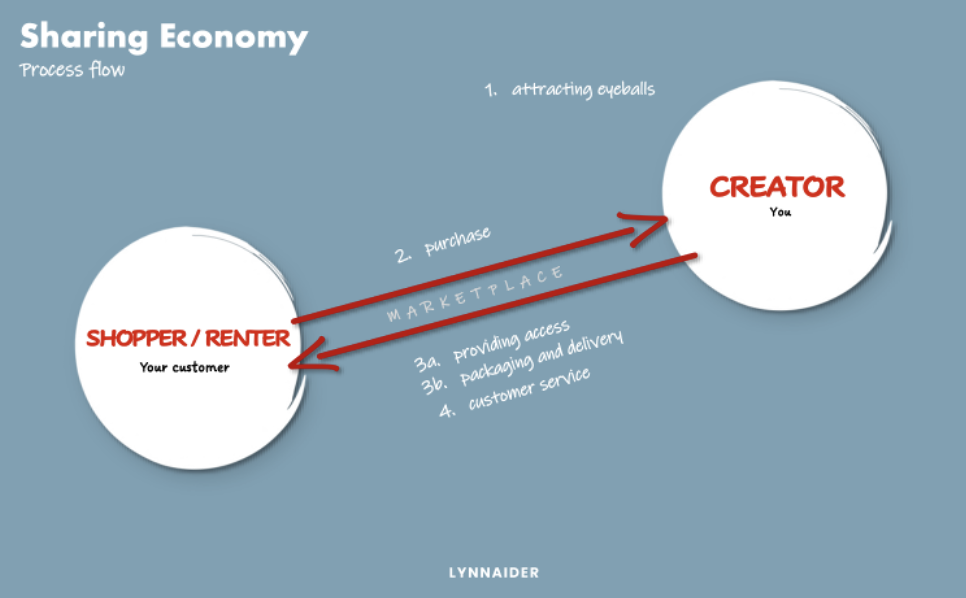
In Lynnaider’s teaching, we capture each online income technique in a simple process flow. The figure you see here shows how the sharing economy works, for both renting and reselling. In this article, we walk through each step.
How the sharing economy works: preparing your item
Since you already own the property or asset you want to share or resell, your preparation is simple. Make sure it is in good condition. Then position it for visibility.
How the sharing economy works: the four steps
Step 1 of how the sharing economy works: you attract eyeballs
You begin by (1) attracting eyeballs to your offer. Most commonly, you list it on a relevant marketplace and possibly invest in marketplace ads. Marketplace discovery may be enough on its own.
Extra visibility can come from other channels. Evan, from our sharing economy examples, posts social media content that leads to his marketplace profile. Vicky shares her rentals in local photographer groups.
Step 2: a customer books or buys
Once a potential customer is convinced, they (2) make the booking or purchase. On most marketplaces, payment happens through the platform.
Step 3: you grant access or ship
Depending on the offer, you either (3a) grant access to the asset, or (3b) pack and ship the item to the buyer. Access is typical for properties, vehicles and short-term rentals. Shipping is typical for resold, movable items.
In some cases, especially with large items such as furniture or collectibles, buyers arrange an in-person pickup. This needs more manual coordination, but the core logic stays the same. Here, we focus on the more automatable scenarios.
Step 4: you handle customer service
Whatever the delivery or access method, you remain responsible for (4) customer service. Marketplaces may handle communication, payments or disputes. Still, accountability ultimately rests with you.
How the sharing economy works: a natural limit
Because the sharing economy depends on what you personally own, its scale is naturally limited. You can rent your car only so many days per month and sell each item only once. That is fine for many people, who use it as a side income or a first step.
Some grow it by buying additional assets to rent, or by upgrading items before reselling, like Evan does with furniture. Others combine it with other techniques.
Renting vs reselling in the process
| Step | Renting | Reselling |
|---|---|---|
| 1. Attract eyeballs | Listing on a rental marketplace | Listing on a resale marketplace |
| 2. Booking or purchase | A booking for set dates | A one-time purchase |
| 3. Access or shipping | Handover and return | Packing and shipping, or pickup |
| 4. Customer service | Before, during and after the rental | Questions, delivery issues, returns |
Where your time goes in the sharing economy
Most of your time goes into steps 3 and 4: handovers, packing and customer service. Step 1 takes effort mainly at the start, when you create your listing. Step 2 runs through the platform.
Plan your availability. For rentals, block dates when you cannot hand over or collect items.
Common mistakes in how the sharing economy works
The first mistake is accepting bookings you cannot handle on time. The second is not checking items after each rental, which can lead to disputes. The third is slow communication, which hurts your ratings.
An example of how the sharing economy works
Imagine someone renting out a projector for home cinema evenings. They list it on a local rental marketplace with clear photos and a note on what is included. A neighbor books it for Saturday.
The owner hands it over on Friday evening with a short instruction card. On Sunday, the neighbor returns it, the owner checks it and the platform releases the payment.
How the sharing economy works with reviews
After each rental or sale, both sides usually leave reviews. Good reviews push your listings higher and make new customers trust you. That is why steps 3 and 4 matter so much: a smooth handover and friendly service lead to strong reviews.
Politely remind customers to leave a review if they were happy. Respond calmly and helpfully to any critical review.
How the sharing economy works with seasons
Demand often follows seasons. Tools rent more in spring, camping gear in summer, party equipment around holidays. Adjust your prices and availability to these patterns, and refresh your listings before the busy season starts.
How the sharing economy works for resold items
When you resell, the process ends after delivery and any return period. You pack the item carefully, ship it with tracking and keep the receipt. If the platform offers buyer protection, follow its steps for any issue.
For local sales, agree on a safe meeting place or doorstep pickup. Let the buyer check the item before paying if the platform allows cash or in-person payment.
Communication at each step
Send a short message at each step: a thank-you after booking, a reminder before handover, and a check-in after return or delivery. These small messages prevent misunderstandings and make customers feel looked after.
Many platforms let you save message templates, so this takes only seconds.
Starting small and staying private
The sharing economy needs almost no starting budget, because you already own what you offer. We recommend spending no more than about 20 dollars on your setup, for example on good photos or small extras, with no monthly fees. Marketplaces bring much of the traffic, and you can add your own content without an agency.
You can share and resell without building a public persona. If the idea of self-branding is what held you back so far, Lynnaider recaps the alternatives for you.
Your next step
The next article explains the key profile in the sharing economy: why marketplaces are essential. The complete module, alongside the other online income techniques, is in the book on our products page. If you would like help mapping out how the sharing economy works for your items, see our services page.
Frequently asked questions
Do I need to be home for every handover?
Not always. Lockboxes or courier services can help, if your platform and item allow it.
Can I automate messages on sharing platforms?
Some platforms offer saved replies or scheduled messages. Use them for routine steps, and reply personally to specific questions.
Do I need to accept returns when reselling?
It depends on the platform’s rules and your country. Many second-hand platforms have their own buyer protection policies.
How fast should I ship resold items?
As quickly as possible, ideally within one or two days. Fast shipping leads to better reviews.
What if a renter damages my item?
Follow the platform’s damage process, using your handover photos as evidence. Deposits or insurance may cover the cost.
How does the sharing economy work?
You list your item on a marketplace, a customer books or buys it, you grant access or ship it, and you handle customer service.
How do I attract renters or buyers?
Mostly through a good marketplace listing, sometimes with marketplace ads. Extra visibility can come from social media or local groups.
What does granting access mean?
Giving the customer use of the asset, such as keys to a car or room, typically for properties, vehicles or short-term rentals.
Can buyers pick items up in person?
Yes, especially for large items such as furniture. It needs more coordination but follows the same logic.
Who handles customer service?
You do. Even when the marketplace handles communication, payments or disputes, you remain accountable.
Why is the sharing economy limited in scale?
Because it depends on what you personally own. You can only rent or sell what you have.
Are there step-by-step Lynnaider tutorials for starting each of the 10 online business models with a minimal-cost setup?
Not yet, but they might be made if enough people ask for them. Sign up to the waitlist so we can see the interest, and you will be among the first to hear when they are available.
Should I use marketplace ads?
They can help in competitive categories. Start with a strong listing, then test small ad budgets if needed.
What should I prepare before listing?
Make sure the item is in good condition, clean and complete, then take clear photos.
Where can I get step-by-step help to set up the Sharing Economy technique on a small budget?
Yes. Lynnaider teaches setup routes for the Sharing Economy technique that cost nothing, or very little (under 20 dollars), to go live, so you do not pay setup costs long before you earn. Our free AI agent, Lynnaider Compass, guides you through them step by step, in the same logic as the whole Lynnaider teaching.
Disclaimer: This article is for general informational purposes only and should not be regarded as legal, tax, or business advice. Pursuing an online business does not guarantee income; results depend on many factors including the business environment, individual effort, skills, and consistency. Some links on this site may allow Lynnaider to earn a commission at no additional cost to the reader.