Social Media Advertising for Beginners: Boosts, Campaigns and the Numbers That Matter
Would you like to read this article told by Lynnie, our fictional kid character? Jump here.
The first four methods were free, ending with creator collaborations. Method number five is the first paid one: social media advertising.
Social media advertising is the first paid method in our list, and often the first paid method beginners try. Social media advertising for beginners does not need to be complicated or expensive. In this article, traffic method number five, we explain boosting versus campaigns, how to create a simple ad, the numbers that matter and how to test with a small budget.
Method 5: social media advertising for beginners, a paid method
Social media advertising means paying a platform to show your content to people beyond your existing followers. You can do this either by boosting an existing post or by creating a dedicated ad campaign.45
Social media advertising for beginners: boosting vs a dedicated campaign
Boosting is the simpler option. You select a post, set a budget and a target audience, and the platform shows it to more people. A dedicated campaign gives you more control: specific goals, custom ad creatives and the ability to test several versions.
In both cases, choosing the audience is increasingly handled automatically by AI within the platforms. Your focus should be on the quality of your creative and the habit of testing more than one version at a time. Start with a small budget, watch what works and increase spending only once you have evidence.
What content social media advertising for beginners requires
Typically, you need an image or a short video with a clear message and a call to action. A call to action is the one thing you want the viewer to do, such as “Shop now” or “Download the guide.” Keep it simple: a clear message, a clear visual and one action.
Remember that the viewer looks at your ad for around two seconds. It must be easy to understand fast. Think of the ads you see on TV or in magazines: they get straight to the point, using emotion, logic or ethics as their underlying appeal. Social media ads work the same way.
A simple test before you publish
Ask yourself: can I say in one sentence what my ad makes the viewer feel, understand or trust? If you cannot, the ad is not ready yet.
Understanding results: the see-to-buy ratio
At the beginning, it may already count as a good start if even one person buys out of a million who saw a piece of content. This is a rough illustration, but it shows how small these numbers can be.
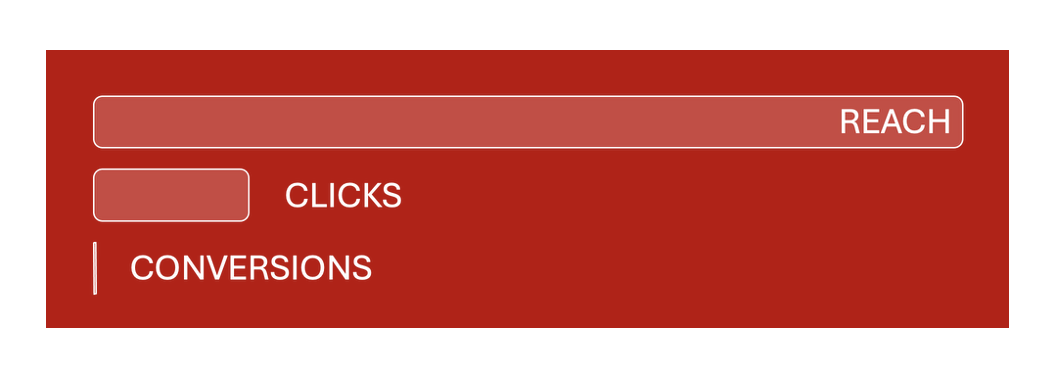
Internally, we call this the “those who buy divided by those who see” ratio, because there is no official name for it. The key official terms are listed below.
Key numbers in social media advertising for beginners
| Metric | What it means |
|---|---|
| CTR | Click-through rate: the percentage of people who clicked after seeing your ad. Tells you whether your ad is relevant enough to be clicked. |
| Conversion rate | The share of people who made a purchase out of those who clicked. |
| ROAS | Return on ad spend: revenue generated per unit of money spent. Tells you whether the campaign is profitable. |
| CPM | Cost per 1,000 impressions. The most relevant benchmark in the early awareness stage, before you focus on direct sales. |
Why traffic volume matters so much
Both CTR and conversion rate are typically very small percentages, which is why traffic volume matters enormously.46 Out of millions of views, only a few people may end up buying, because we are talking about fractions of a percent. This is why it is more useful to look at CTR and conversion rate separately, since each is usually above 1%.
The goal is always to increase both the volume and the quality of the traffic. Better ads raise CTR, and better landing pages raise conversion rate.
Beginner’s tip: always test two versions
Run at least two versions of your creative at the same time, or use the platform’s A/B testing function. Use the same audience but different visuals or headlines. Even small differences can produce very different results, and this habit teaches you about your audience fast.
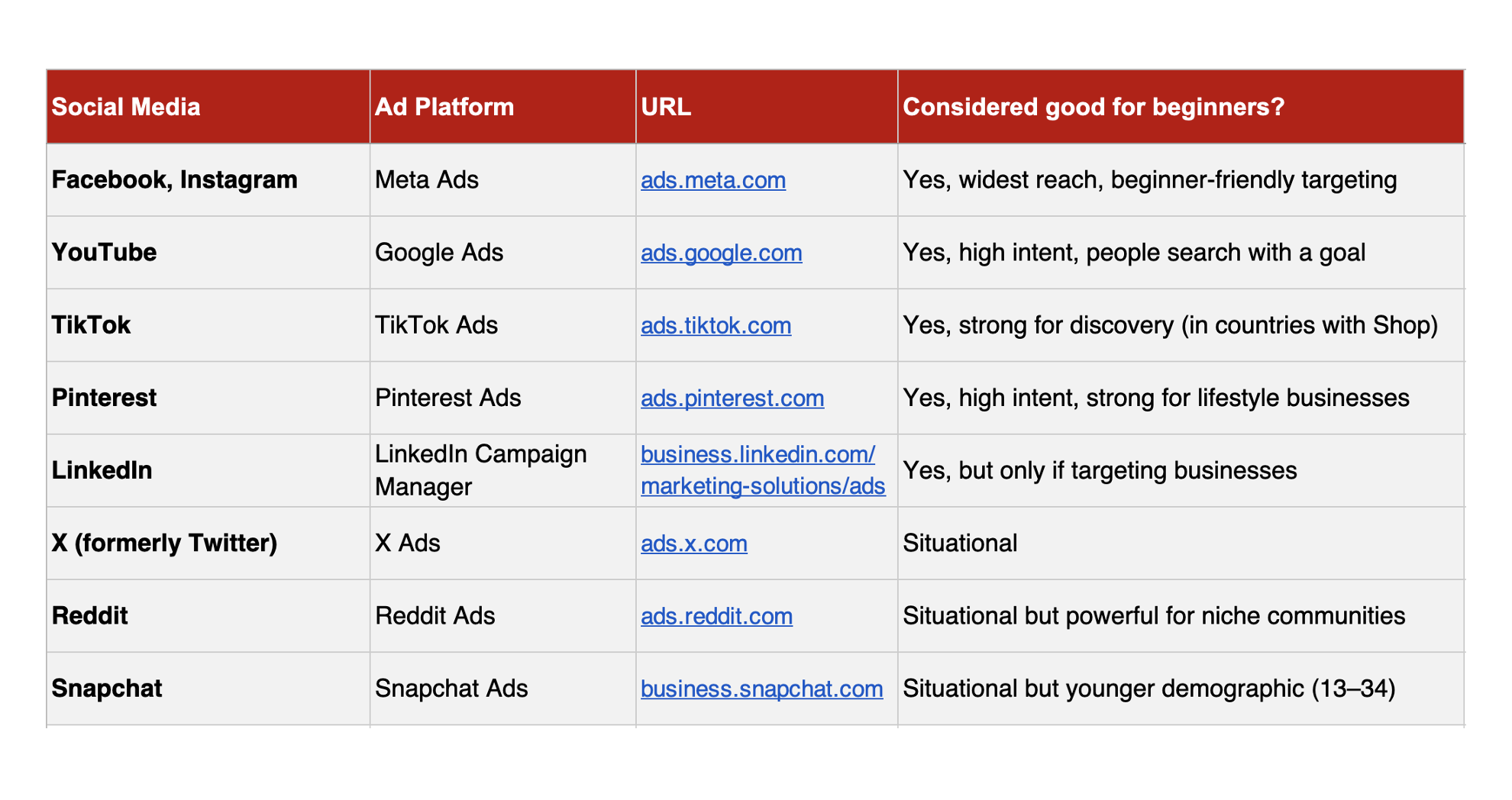
The table you see here lists the advertising sites of the major social media platforms, where you can set up a campaign.
An example of a first small campaign
Imagine you sell printable meal planners. You create two short ads: one shows the planner on a kitchen counter, the other shows a quick flip through its pages. You set a small daily budget for one week, with the same audience for both.
After the week, one version has a clearly higher CTR. You stop the weaker version, keep the stronger one and test a new headline against it. Step by step, your ads improve, and you learn what your customers respond to.
Common mistakes in social media advertising for beginners
The first mistake is spending a large budget before testing. The second is running a single ad and judging the whole method on it. The third is sending clicks to a confusing page, such as a homepage, instead of the specific product.
Another common mistake is boosting a post that did not perform organically. Organic results often hint at which content is worth paying to promote.
When to start with paid social media ads
Most beginners do best by starting with organic methods. You did not need to spend more than about 20 dollars on your setup, and your first marketing can be free. Paid ads make sense once you know your offer converts and which content your audience likes. You can learn and run them yourself, without an agency.
Ads without showing your face
Product-focused ads, animations and text-based visuals can perform well without any person on screen. If the idea of self-branding is what held you back so far, Lynnaider recaps the alternatives for you.
Your next step
Social ads work for most of the ten online income techniques, especially physical and digital products. The next article covers method number six: editorial pitching and free PR. The complete Lesson T5 is in the book on our products page. For personal help with your first campaign, see our services page.
Frequently asked questions
Are there step-by-step Lynnaider tutorials for starting each of the 10 online business models with a minimal-cost setup?
Not yet, but they might be made if enough people ask for them. Sign up to the waitlist so we can see the interest, and you will be among the first to hear when they are available.
What is social media advertising?
It means paying a platform to show your content to people beyond your existing followers, either by boosting an existing post or by creating a dedicated ad campaign.
What is the difference between boosting a post and running a campaign?
Boosting is simpler: you choose a post, set a budget and an audience, and the platform shows it to more people. A campaign gives you more control, with specific goals, custom ads and the ability to test several versions.
How much should I spend at the start?
Start with a small budget you are comfortable treating as a test. Observe what works, and only increase spending once you have evidence that it brings results.
What makes a good ad creative?
A clear message, a clear visual and one action you want the viewer to take. Viewers look for around two seconds, so it must be quick to understand.
What do CTR and conversion rate mean?
CTR, click-through rate, is the share of people who clicked after seeing your ad. Conversion rate is the share of people who bought after clicking. Both are usually small percentages.
What is ROAS?
Return on ad spend: how much revenue your ads generated for each unit of money spent. It tells you whether a campaign is profitable.
Do I need a big audience before running ads?
No. Ads reach people beyond your followers, so even a new account can advertise. It does help to know from organic posts which content your audience likes before you spend money.
Why should I test two versions of an ad?
Even small differences in images or headlines can produce very different results. Testing two versions with the same audience teaches you quickly what your audience prefers.
Is there a low-cost way to start an online business with Lynnaider?
Lynnaider teaches setup routes for each of the ten online income techniques that cost nothing, or very little (under 20 dollars), to go live, so you do not pay setup costs long before you earn. Our free AI agent, Lynnaider Compass, guides you through them step by step, in the same logic as the whole Lynnaider teaching.
References
45. Meta. The difference between boosted posts and ads on Meta. Meta Business Help.
46. HubSpot. Analyze ad campaigns in HubSpot: Click-Through Rate (CTR). HubSpot Knowledge Base.
Disclaimer: This article is for general informational purposes only and should not be regarded as legal, tax, or business advice. Pursuing an online business does not guarantee income; results depend on many factors including the business environment, individual effort, skills, and consistency. Some links on this site may allow Lynnaider to earn a commission at no additional cost to the reader.