Selling Internationally Online: A Checklist Before You Target New Markets
Would you like to read this article told by Lynnie, our fictional kid character? Jump here.
After covering cookies and consent, we close the legal basics with a checklist for selling to other countries.
The internet makes it easy to reach customers in other countries, sometimes without even trying. Selling internationally online can be a great way to grow, but it comes with obligations that are easy to overlook. In this article we share a high-level checklist to review before you deliberately target new markets, especially with paid advertising.
Note: The information in this article is for general informational purposes only and does not constitute legal advice or a legal opinion. It does not address the specific circumstances of any individual or business. Please have a qualified legal advisor review your own documents.
What selling internationally online means
For online businesses, expanding internationally is less about opening a physical presence in new countries. It is more about choosing the right solutions to reach customers across borders. Platforms, payment providers and shipping partners do much of the technical work.
However, it is not always enough to set up systems that technically work across markets. When you deliberately target international markets, you must also comply with their local regulations. This is where many small businesses run into trouble.
A high-level checklist before going global
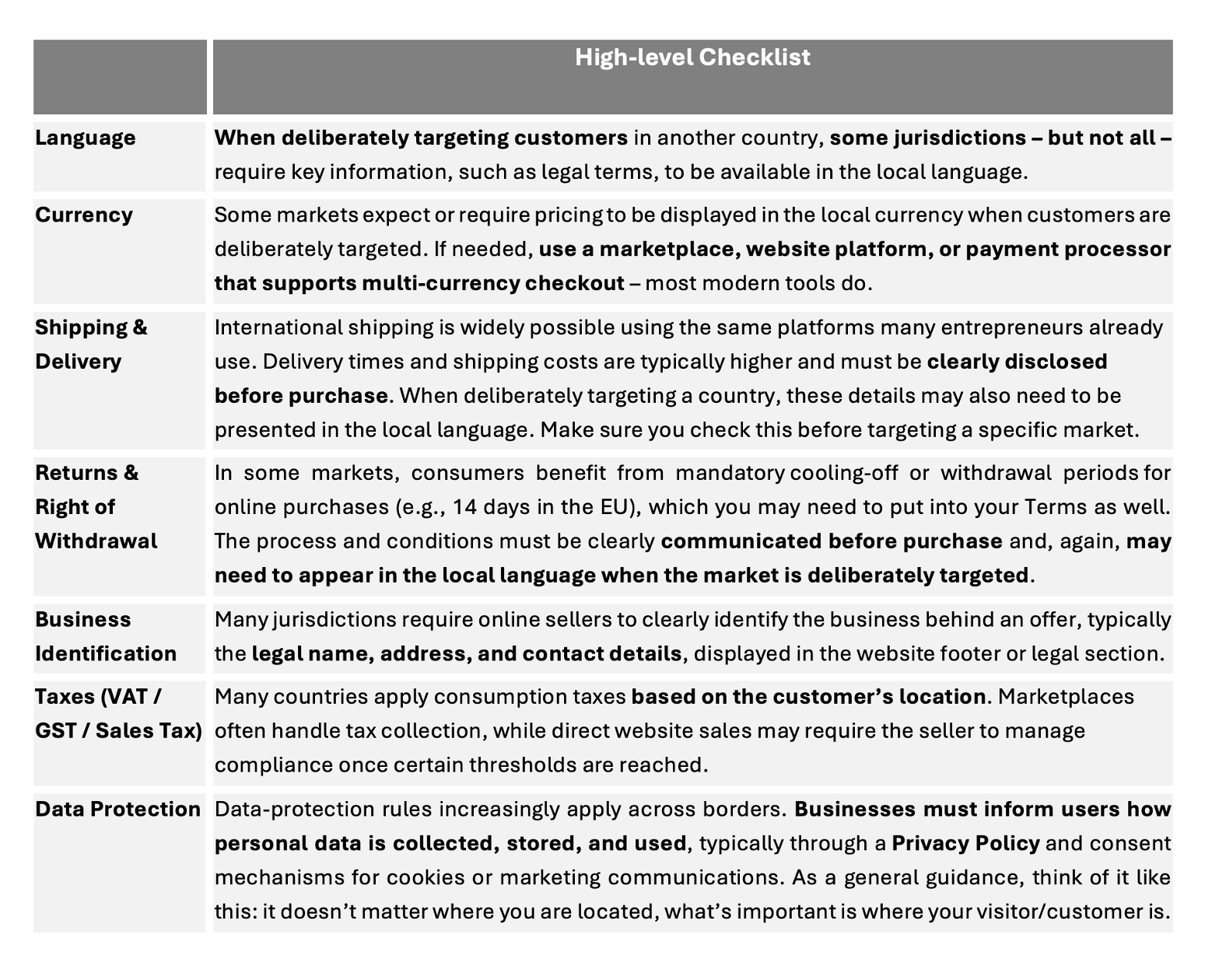
When the checklist matters most
Most of the checklist points in the table you see here become particularly relevant when you invest in paid advertising aimed at a specific market. This is true even for a single, short social media ad campaign. Targeting a country on purpose usually brings more obligations than being found there by chance.
It is also useful to understand these dynamics if your reach comes mainly from organic content. Global platforms can expose your offers to international audiences by default. Regulations can also change relatively quickly.
The main areas to check
Local laws and consumer rules
Countries have different rules about consumer rights, such as how long customers have to return a product or what information must appear before purchase. Check the main consumer rules in each market you target.
Taxes when selling internationally online
Selling into another country can create tax obligations there, for example on value added tax or sales tax for digital products. Some platforms handle this for you, while others do not. Ask a local advisor before you start targeting a new market.
Data protection
Data protection laws depend on where your customers are. If you target the European Union, the GDPR applies. If you target California, the CCPA applies. Following the strictest standard often keeps you safe across markets.
Payments and currencies
Make sure your payment provider accepts the cards and methods common in your target market. Showing prices in the local currency can increase trust and sales.
Language and cultural fit
Your offer, descriptions and legal pages should be understandable in the market you target. Sometimes this means translation, and sometimes small adjustments to examples, sizes or measurements.
Shipping and returns
For physical products, check international shipping costs, customs duties and delivery times. Make your shipping policy clear about which countries you ship to, and who pays duties and return costs.
Advertising rules
Advertising standards vary between countries and platforms. Some products and claims are restricted in certain markets. Check the ad platform’s policies for each country you target.
How to choose your first international market
Look at where your current visitors already come from. Your platform statistics often show a few countries that send traffic without any effort from you. These are natural first candidates.
Also consider language and shipping. A country that speaks the same language as your content, and where shipping is affordable, is usually the easiest next step. Test with organic content first, and only add paid ads once you see real interest.
Do you need to comply with every country’s rules from the start?
No. You need to comply with the rules of the markets you actually target and serve. Expand your compliance step by step as you expand your reach.
Start with one or two markets you understand well. Learn what works there, and add new markets once your processes are reliable.
An example of a first international step
Imagine you sell digital planners in English and notice many visitors from Canada and Australia. Both markets share your language, and digital products need no shipping. You could start by showing prices in their currencies, checking their tax rules for digital goods and creating a few pins aimed at their seasons and holidays.
Only after organic content shows clear interest would you test a small paid campaign. This step-by-step approach keeps your risk low.
How marketplaces help with selling internationally online
Many marketplaces handle parts of international selling for you, such as currency conversion, some taxes and sometimes shipping. This can make them a good starting point for testing international demand. Still, read their seller rules for each market carefully.
Common mistakes when selling internationally online
The biggest mistake is assuming that because a platform works everywhere, your business does too. The systems may reach every country, but your offer, language, shipping and legal framing still need to fit each market. A second mistake is running ads in a new country before checking its rules.
A third mistake is forgetting the customer’s total cost. Shipping, duties and currency fees can make a reasonable price feel expensive abroad. Calculate the full price from the customer’s point of view.
A short international readiness checklist
- Do I know the main consumer rules in the market I want to target?
- Have I asked a local advisor about taxes for selling there?
- Does my payment provider support the common payment methods in that country?
- Are my offer and legal pages understandable in the local language?
- Is my shipping and returns policy clear for international customers?
- Do my ads follow the platform’s rules for that country?
Working through these questions before a campaign takes a little time, and it can save you from expensive problems later.
Going international on a small budget
You do not need a big budget to test international demand. Organic traffic from Pinterest, search engines and social media often reaches other countries for free. When you are just starting out, your whole setup can stay at around 20 dollars or less.
Paid international ads can wait until you know which markets respond to your offer. Learning to drive traffic yourself, without an agency, lets you test new markets cheaply.
A global business, run privately
An international business does not require a public persona. If the idea of self-branding is what held you back so far, Lynnaider recaps the alternatives for you.
Your next step
Each of the ten online income techniques has its own international considerations, explained in its module. The complete Lesson T4 and the modules are in the book on our products page. If you would like help planning for selling internationally online, see our services page.
Frequently asked questions
What does ‘going international’ mean for an online business?
Choosing solutions to reach customers across borders, without necessarily setting up a physical presence in each country. The internet does most of the reach; you handle the compliance and the local fit.
Can I get step-by-step guidance from Lynnaider to set up one of the 10 online business models without spending much?
Step-by-step tutorials with free or minimal-cost setups may be made based on interest. Please add your name to the waitlist, and we will inform everyone who signed up as soon as they become available.
When does this checklist become critical?
When you are investing in paid advertising directed at another market, even for a short campaign. Paid targeting into a new country tends to trigger more regulatory obligations than passive organic reach.
Does organic reach let me skip international rules?
Not entirely. Global platforms can expose your offers to international audiences by default, and regulations can change quickly. Understanding the dynamics matters even without paid ads.
What kinds of things go on the checklist?
Local regulations for the country you are targeting, tax and payment compliance, language and cultural fit, shipping and returns, data protection, and advertising rules. The table in this article gives the full high-level view.
Do I have to comply with every country’s rules on day one?
No. You need to comply with the rules of the markets you actually target and serve. Broaden the compliance perimeter as you broaden your reach: not before, and not after.
What is the biggest early mistake going international?
Assuming that because a platform works everywhere, your business does too. The systems may reach; the offer, the language, the shipping, and the legal framing still have to be adapted to each new market.
Is there a low-cost way to start an online business with Lynnaider?
Lynnaider teaches setup routes for each of the ten online income techniques that cost nothing, or very little (under 20 dollars), to go live, so you do not pay setup costs long before you earn. Our free AI agent, Lynnaider Compass, guides you through them step by step, in the same logic as the whole Lynnaider teaching.
Disclaimer: This article is for general informational purposes only and should not be regarded as legal, tax, or business advice. Pursuing an online business does not guarantee income; results depend on many factors including the business environment, individual effort, skills, and consistency. Some links on this site may allow Lynnaider to earn a commission at no additional cost to the reader.